Moz DA vs Ahrefs DR: Which Metric Should You Actually Use?

You're building a link prospect list. You pull up two tools and get two completely different numbers for the same domain. Moz says one thing. Ahrefs says something else. Now you need to decide whether to pursue the link — and you're not sure which number to trust.
This confusion is extremely common, and it mostly comes from asking the wrong question. The debate isn't really "which metric is more accurate." The better question is:
What decision are you trying to make, and which tool is built for that job?
Moz DA and Ahrefs DR overlap significantly but they're solving slightly different problems. This guide breaks down exactly what each one measures, where each one works best, and — most importantly — what you should actually be tracking if you want your SEO to produce business results.
Does Google Use Moz DA or Ahrefs DR to Rank Websites?
Neither. Google does not use Moz's Domain Authority or Ahrefs' Domain Rating as ranking inputs. This isn't ambiguous.
Google's ranking systems documentation describes Search as a combination of many signals — most of them at the page level, with some site-wide signals layered in. PageRank still plays a role, but as one factor among many, with relevance taking precedence. Moz states directly that Google does not factor DA into rankings. Ahrefs notes that Google representatives have denied "domain authority" as a ranking factor.The practical breakdown:
- For backlink prospecting — DR is generally more useful as a first filter.
- For benchmarking against SERP competitors — DA gives a slightly more contextual read.
- As your primary KPI — neither one. You'd be optimizing a proxy rather than an outcome.
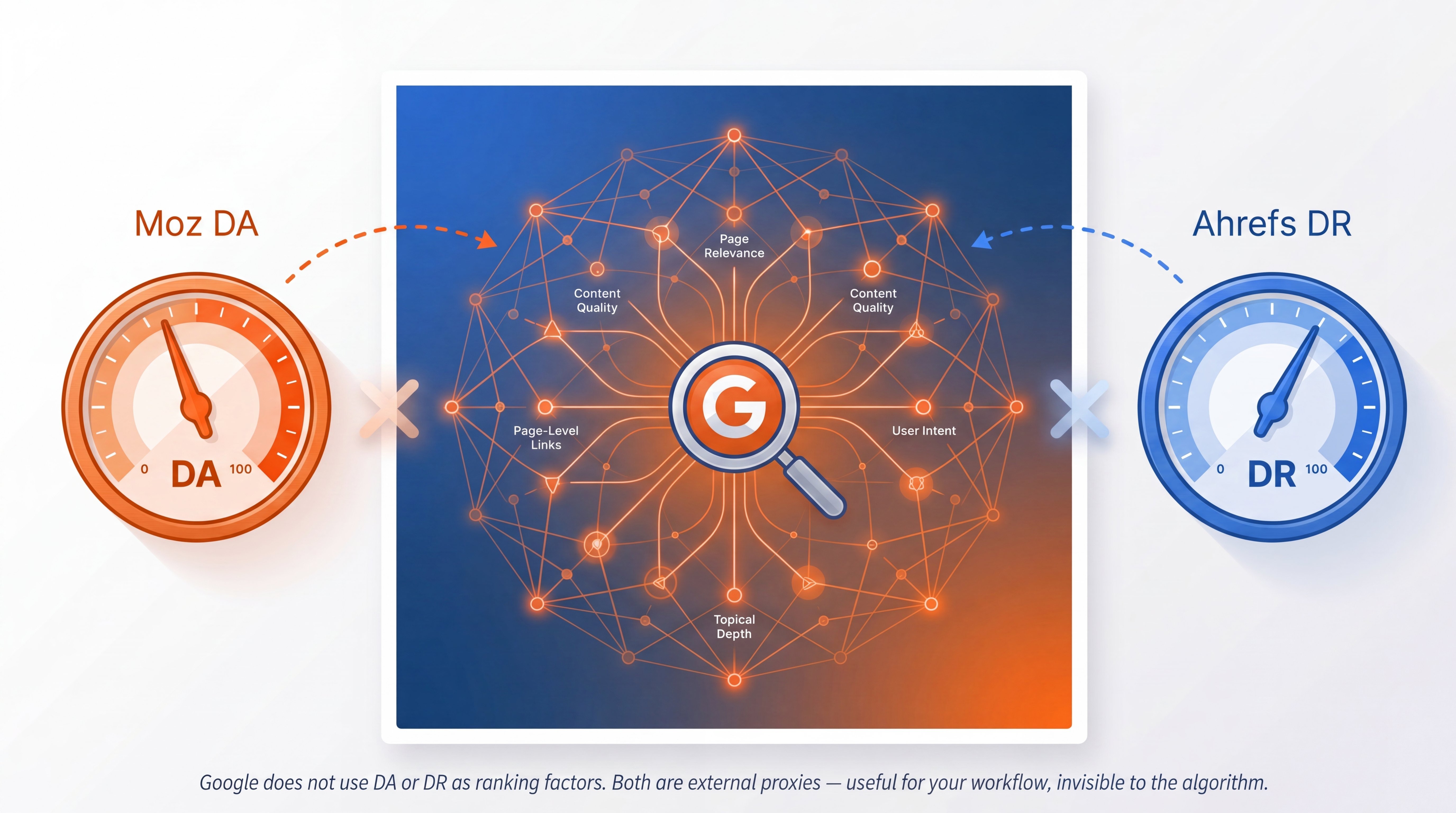
Think of DA and DR like two independent credit scores issued by different agencies using different models. Both give you useful signals, but neither one is what the bank actually uses when it decides whether to approve your application.
Why These Two Metrics Get Confused So Easily
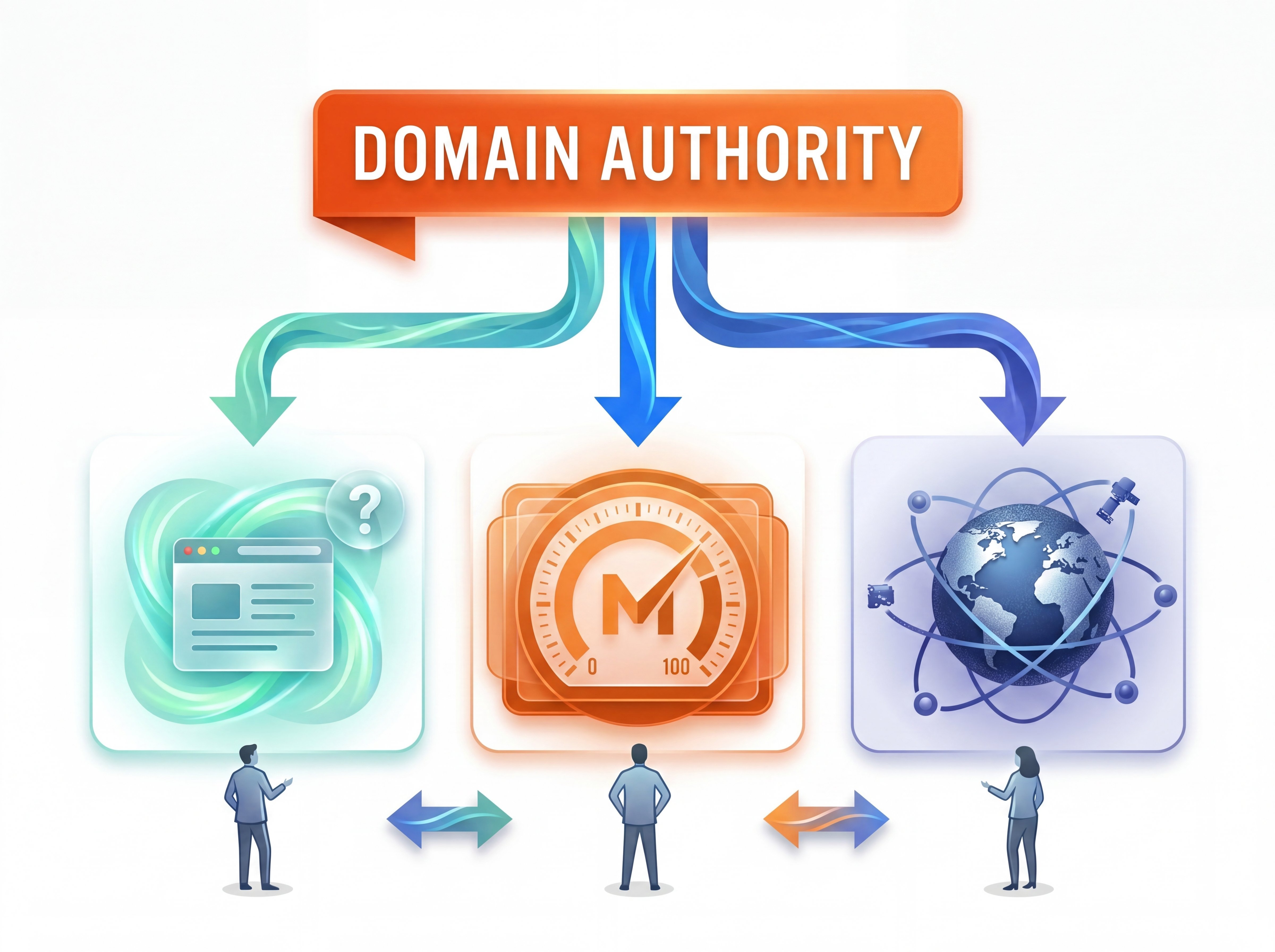
The terminology is partly to blame. People use "domain authority" to mean at least three distinct things:
- A general concept — how "strong" or "established" a site is
- Moz's specific proprietary metric called Domain Authority
- Any tool's estimate of domain-level SEO strength
Ahrefs explicitly distinguishes the generic concept of "website authority" from Moz's trademarked product. That distinction matters, because a lot of DA vs DR debates end up going in circles — people think they're arguing about the same metric when they're talking about completely different calculations applied to the same underlying idea.
How Google Actually Ranks Content (It's Not by Domain)
Before comparing the metrics, it helps to understand what they're both trying to approximate.
Google's documentation is clear that its systems are designed to rank individual pages, not to assign a universal domain grade. Site-wide classifiers do contribute, but the primary work happens at the page level. Relevance remains the dominant factor; PageRank is one component within a much larger system.This matters because both DA and DR compress a messy, multi-dimensional reality into a single number. A domain can have a strong backlink graph but weak individual pages, poor topical coverage, thin content, or traffic from an audience that's completely unrelated to your niche. None of that shows up in either score.
A single domain-level number can't capture whether a specific page will rank for a specific query.

What Is Moz Domain Authority?
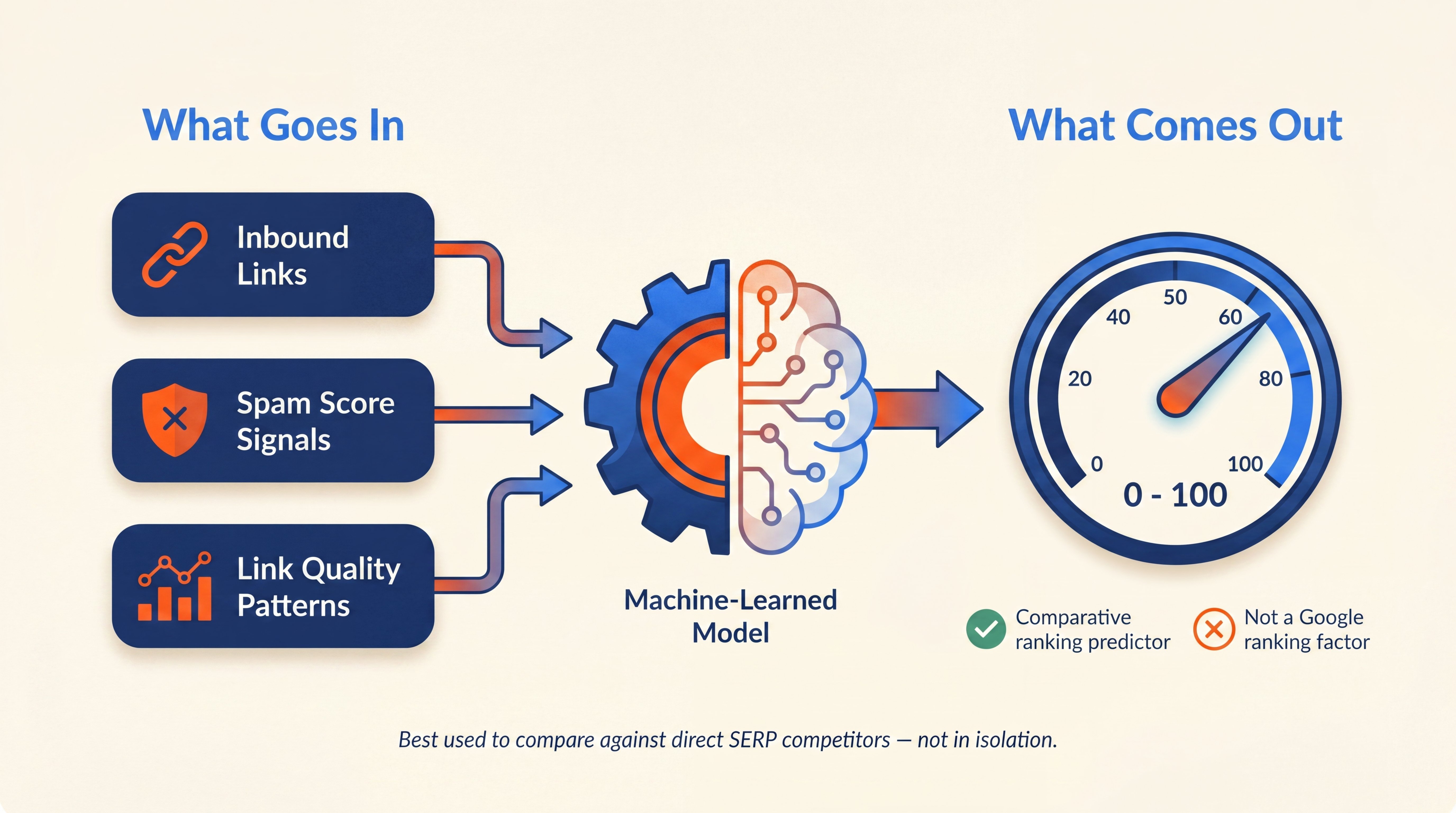
Moz describes DA as a score that predicts the ranking ability of a website. The current version (DA 2.0) uses a machine-learned model trained on inbound link data, and it incorporates signals like Spam Score and link quality patterns — making it a broader, more opinionated estimate than a raw link count.
Moz explicitly tells users to use DA comparatively: measure yourself against sites in the same category or industry, particularly the ones already competing with you in the SERPs. The metric is not a proxy for PageRank and is not intended to be read as a direct Google signal.
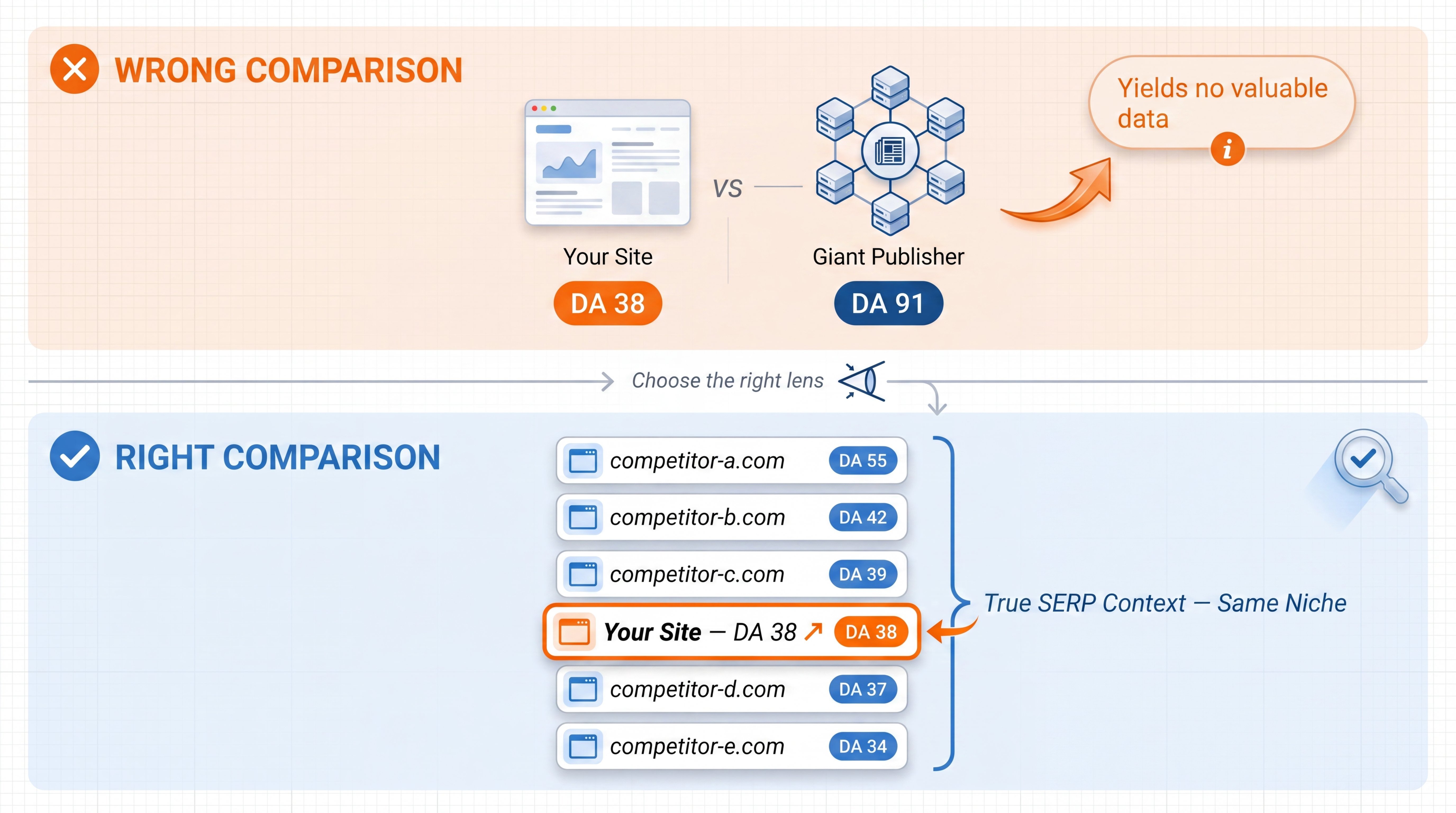
That comparative framing is what makes DA more useful for competitive analysis. If six domains are consistently outranking you for the same cluster of keywords, comparing your DA against those specific six sites tells you something meaningful. Comparing your DA against large media publishers tells you almost nothing actionable.
Moz continues to maintain DA actively. MozBar, updated in April 2025, gives users access to Domain Authority and Page Authority, while Moz Pro users also get Spam Score alongside their DA data.
What Is Ahrefs Domain Rating?
Ahrefs defines Domain Rating as a 0–100, logarithmic metric that reflects the strength of a website's backlink profile. The score is driven by the number of unique referring domains, the "authority" of those linking domains, and how many other sites those domains link out to.
DR deliberately excludes traffic, spam signals, domain age, and any non-link variables. Ahrefs is transparent about this.
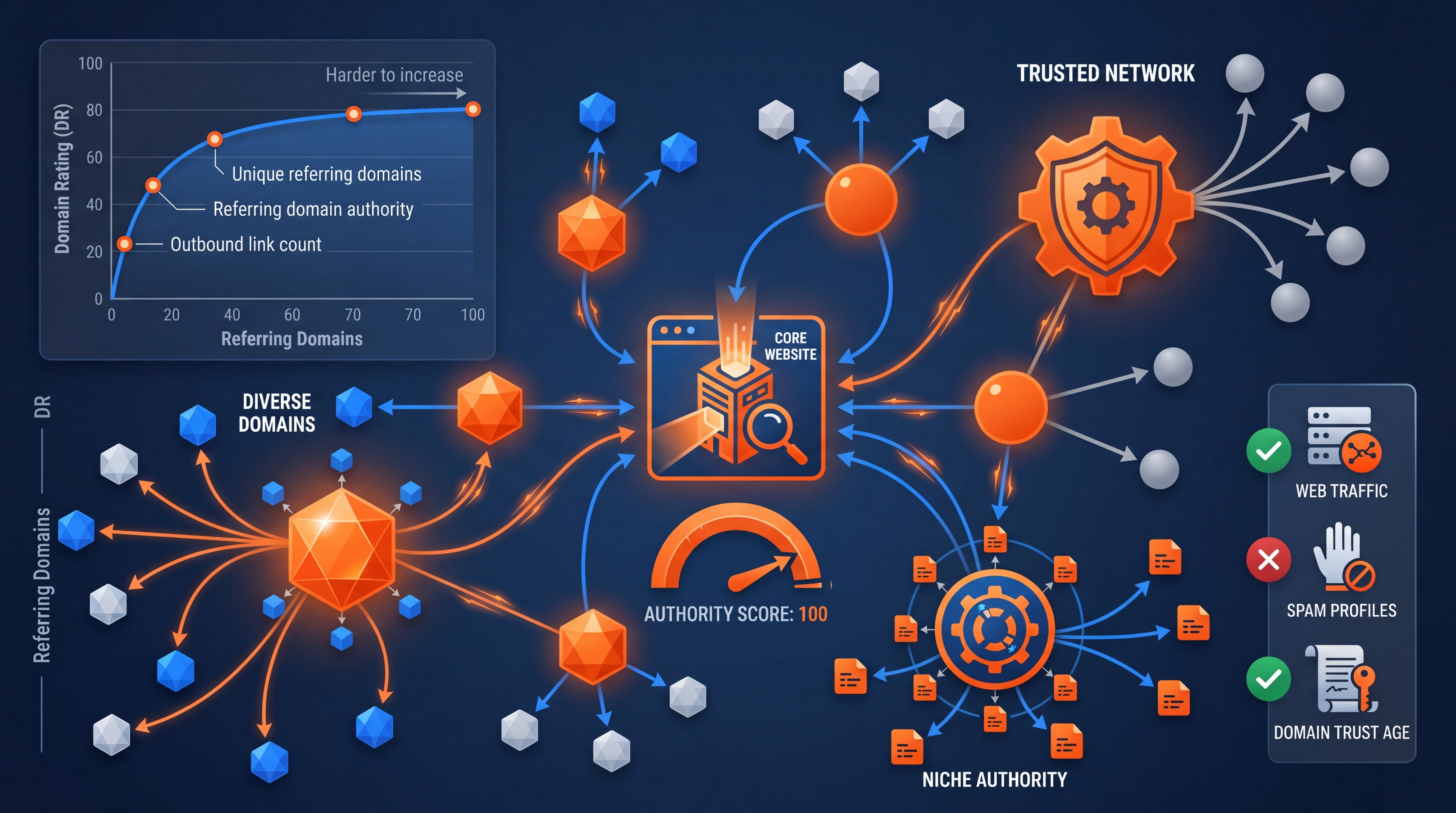
That makes DR a narrower metric — not a worse one. DR is essentially a link-graph score. The question it answers is: "How strong does this site's backlink profile look?" — not "How likely is this site to rank for the things I care about?"
Because the scope is tighter, DR is often the cleaner signal for backlink prospecting and gap analysis. When you're sorting through hundreds of potential link targets, a metric that focuses exclusively on link profile strength is more honest than one trying to solve a broader prediction problem.
Moz DA vs Ahrefs DR: Key Differences
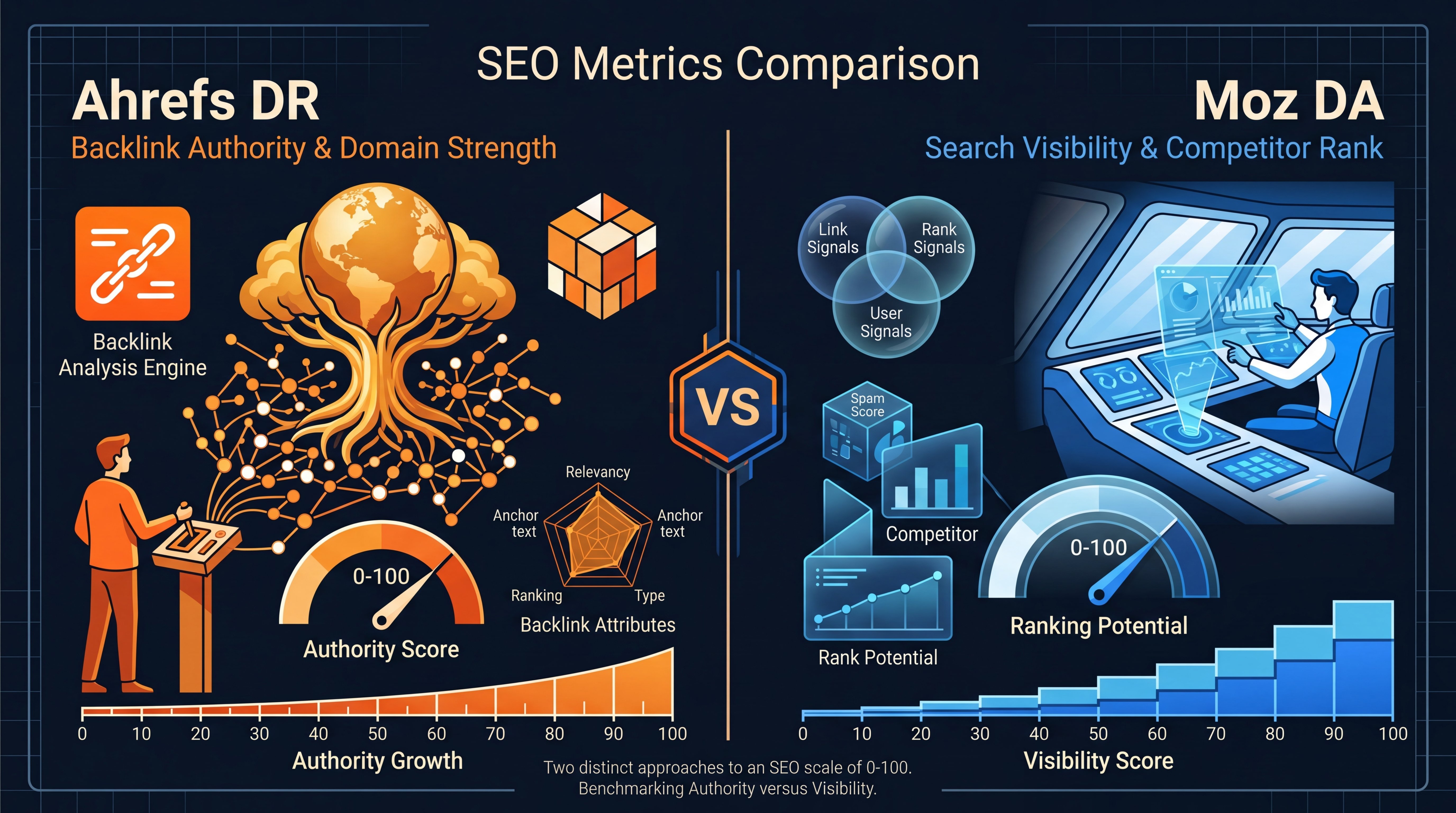
If you had to compress the distinction into one line: DA tries to predict ranking ability; DR describes link profile strength.
That's the real difference. Most people treat them as competitors trying to solve the same problem. They're not. The overlap is significant, but they're aimed at different questions.
| Moz DA | Ahrefs DR | |
|---|---|---|
| What it measures | Predicted ranking ability of a domain | Strength of a domain's backlink profile |
| Model type | Machine-learned, multi-signal | Link-graph-based, logarithmic |
| Includes spam signals? | Yes (Spam Score incorporated) | No |
| Includes traffic data? | Not directly | No |
| Scale | 0–100, relative and comparative | 0–100, logarithmic |
| Best for | Competitor benchmarking | Backlink prospecting |
| Methodology transparency | DA 2.0 guide (2019) + current Moz docs | Ahrefs glossary + documentation |
Neither is the "right" one. They're answering different questions.
When to Use Ahrefs DR (And Where It Falls Short)
Use DR as your first filter when vetting link prospects.
Ahrefs recommends DR for this job but also warns against judging a site by site-wide authority alone. Their recommended vetting process goes beyond the score:
- Does the site have quality backlinks of its own?
- How heavily does it link out to external sites?
- Does it publish genuinely useful content?
- Does it get real organic search traffic?
- Is it topically relevant to your site?
DR wins for link prospecting because the question is narrow and honest. If you want to estimate the raw strength of a domain's link network, a link-centric metric is more transparent than one baking in a dozen additional variables.
The failure mode is sorting a spreadsheet from highest DR to lowest and treating that as your final answer. A DR 75 general lifestyle blog is not automatically a better link than a DR 42 industry-specific publication if your site operates in that industry. A domain-level score can't tell you whether the actual linking page will pass meaningful equity — or whether the link will matter for your rankings at all.

When to Use Moz DA (And Where It Falls Short)
Use DA when benchmarking against the domains actually competing with you in the SERPs.
Moz explicitly tells users to compare DA against sites of similar type, category, or industry — specifically the competitors appearing near you for your target keywords. That's almost exactly the benchmarking use case.
The failure mode for DA is the same as DR: wrong comparison set. Comparing your DA against Wikipedia or Forbes tells you nothing useful. Comparing it against the five or six domains consistently outranking you for the same keyword cluster? That's actionable information.
For example, if you run a B2B SaaS blog and you're trying to rank for "CRM comparison" type queries, your meaningful DA benchmark is the other SaaS review sites and mid-size publications appearing in that SERP — not the biggest media brands in your industry's orbit.
Moz's own guidance points toward this narrower, more targeted comparison. Used this way, DA becomes a practical diagnostic: you're asking "how does my site's predicted competitive ability compare to the exact sites I'm competing against?"
Why DA 50 and DR 50 Are Not the Same Number
This is a common trap.
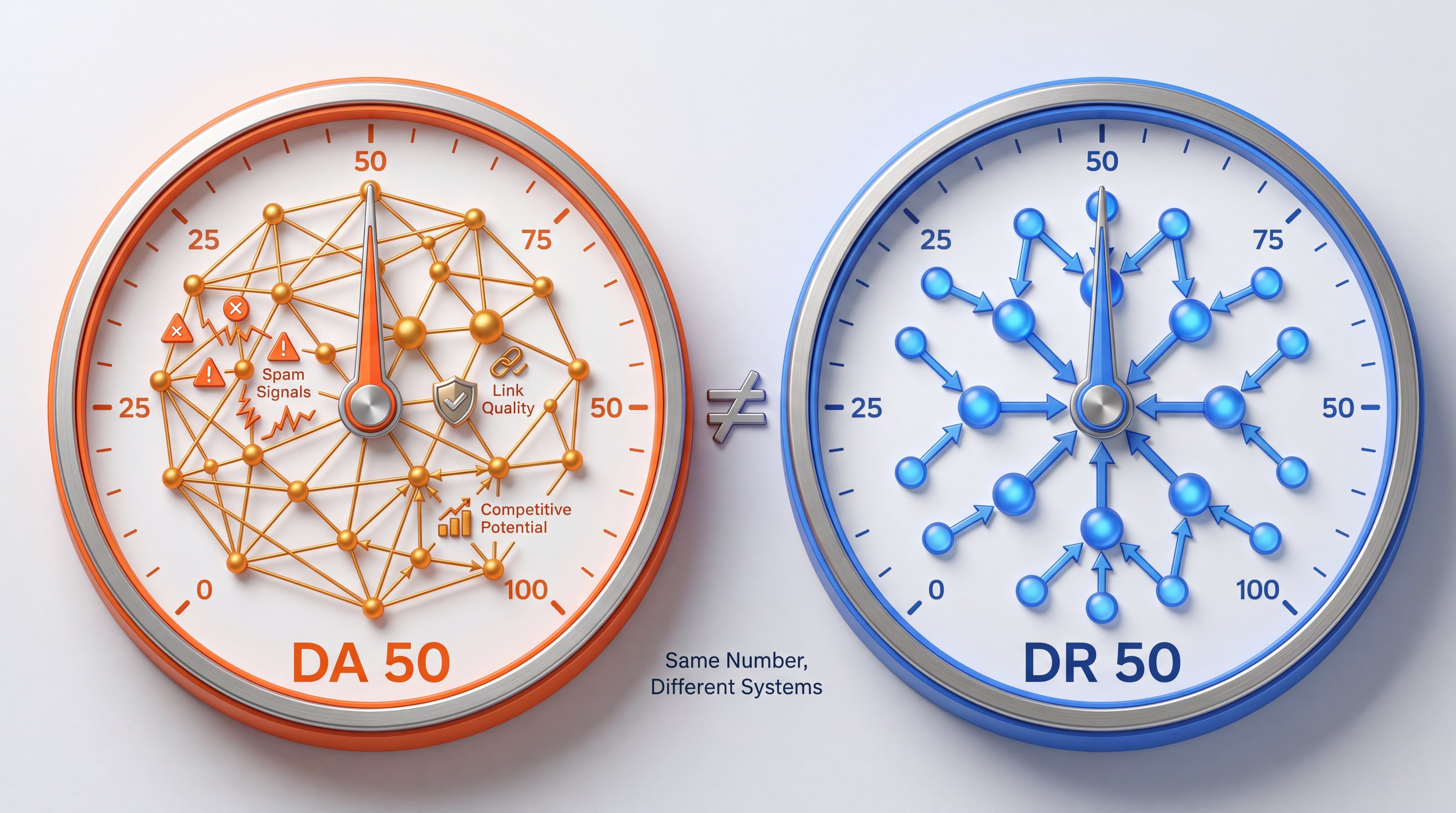
Both scores run on a 0–100 scale, but they come from different link indexes, different crawlers, different weighting systems, and different objectives. Ahrefs explains that DR is logarithmic — moving from 70 to 80 is dramatically harder than moving from 20 to 30. Moz frames DA as a relative, comparative score that will fluctuate as link profiles and the broader web shift over time.
So "DA 50 vs DR 50" is not apples-to-apples at all.
If your site has a much higher DR than DA, one reasonable interpretation is that your raw backlink graph looks strong, but Moz's broader multi-signal model isn't as impressed by your competitive positioning. If your DA exceeds your DR, Moz's model may be picking up quality or relevance signals that Ahrefs' link-graph view doesn't capture.
These are clues worth investigating — not verdicts worth optimizing for directly. The only verdict that matters is whether the specific pages you care about are earning rankings and driving traffic.
What Both Metrics Miss
Even if you use DA and DR correctly, they share some significant blind spots.
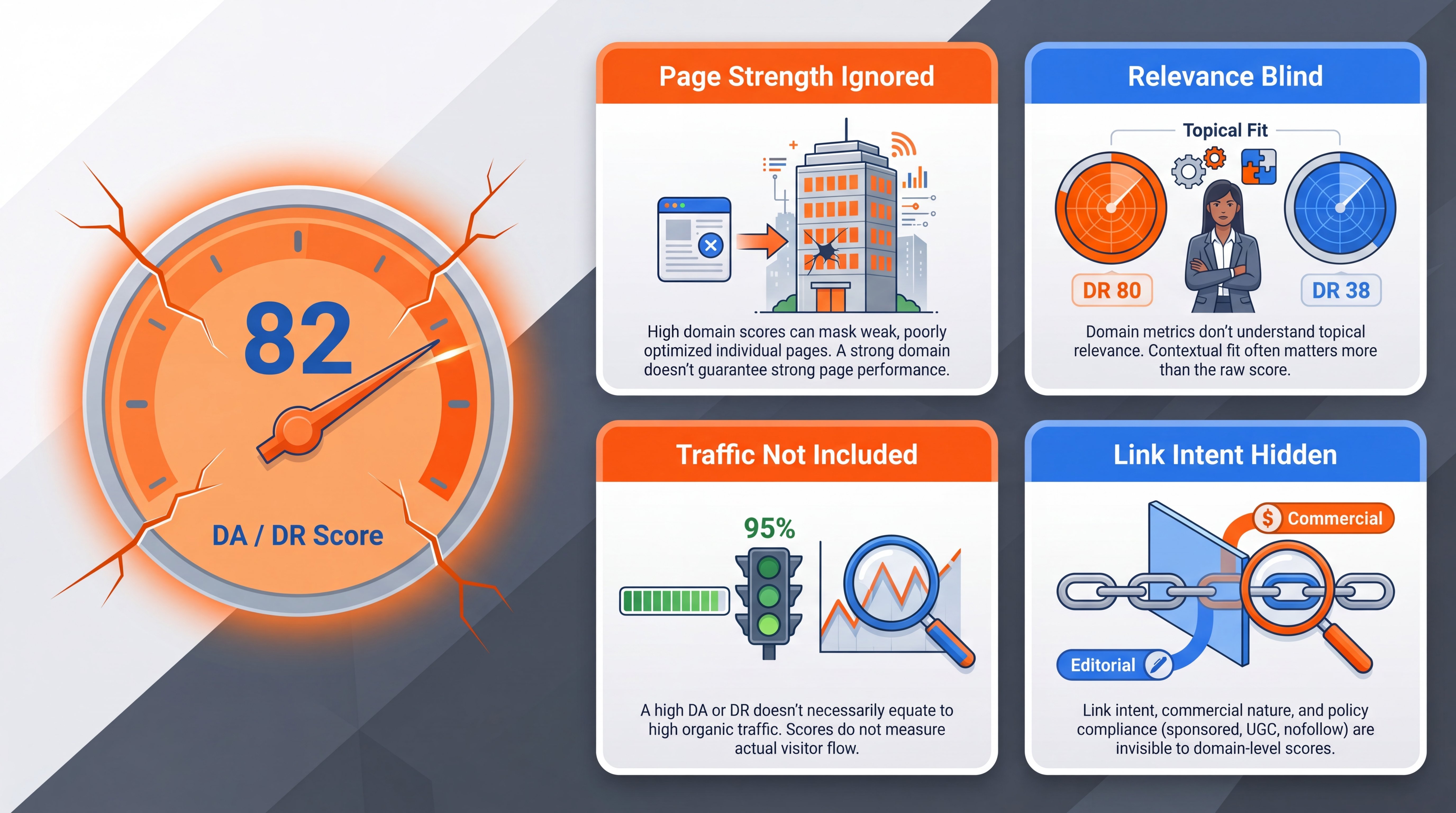
Blind spot #1: Page-level strength. Google's documentation confirms its ranking systems work primarily at the page level. According to Ahrefs, Google cares more about the strength of the linking page than the linking domain. A highly relevant, well-ranking page on a DA 45 site can deliver more value than a buried, low-traffic page on a DA 75 site.
Blind spot #2: Topical relevance. Ahrefs tells users to check whether a prospect is topically relevant. A DR 82 cooking site is not a better link source than a DR 39 logistics blog if you sell supply chain software. The relevance gap changes the entire value equation.
Blind spot #3: Real organic visibility. DR doesn't include traffic data. A domain can have a high DR while its pages generate little to no organic search traffic. You have to verify this separately — a high-DR site that lost most of its rankings in a recent algorithm update is not the link opportunity it appears to be.
Blind spot #4: Link intent and compliance. Google's spam policies are explicit: policy-violating link practices can cause pages to rank lower or be omitted from results entirely. Google also provides guidance on using rel="sponsored", ugc, or nofollow for specific outbound relationships. A link that improves a third-party metric doesn't automatically translate to durable ranking benefit.
How to Actually Evaluate a Backlink Opportunity in 2026
Stop sorting by DR and calling it done. Work through these questions in order:
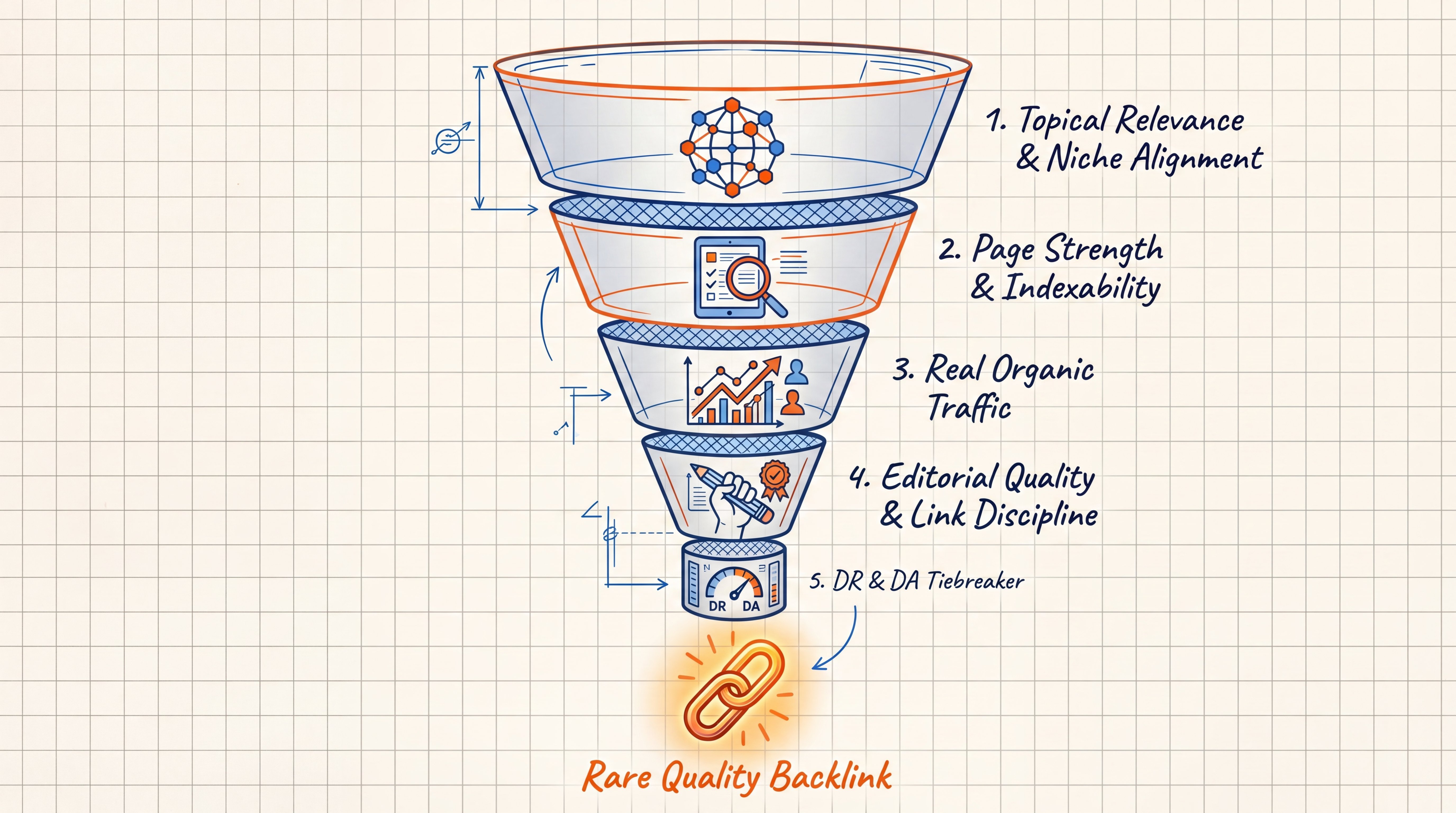
1. Is the site genuinely relevant to your topic? Google prioritizes relevance at both the page and domain level. Topical fit should be your first filter — not an afterthought.
2. Is the linking page itself strong, indexable, and likely to rank? Google ranks pages. A link from a deeply buried, low-visibility page on a high-DR domain delivers far less than a link from a well-ranking page on a moderate-DR site.
3. Does the site get real, relevant organic traffic? DR tells you nothing about traffic. Check it independently. A site with impressive DR but collapsing organic visibility isn't the asset it looks like.
4. Does the site link out editorially, or does it spray links everywhere? A site that indiscriminately links to hundreds of domains provides less link equity per link. Google's spam policies also provide clear guidance on paid, UGC, and nofollow link relationships.
5. Use DR or DA as a tiebreaker only at this stage. DR is usually the better tiebreaker for link prospecting. DA is usually the better tiebreaker for SERP competitor comparisons.
A useful gut-check: if Google ignored the link entirely, would you still want it for the referral traffic, audience fit, brand credibility, or partnership value? If the answer is no, you're chasing the metric rather than the opportunity.
DA and DR in the Age of AI Overviews
Here's where domain-level scores start to look even less relevant.
Google says the same fundamentals apply in AI features: use standard SEO best practices, make sure your pages are indexable, follow Search policies, and create helpful, reliable, people-first content. Importantly, Google states there are no additional technical requirements and no special optimizations needed to appear in AI Overviews or AI Mode beyond standard SEO fundamentals.AI Overviews may also use "query fan-out" — issuing multiple related searches across subtopics and data sources to build a response. This makes topic depth increasingly important: a site that covers a subject thoroughly across many pages has a structural advantage over one that relies on a handful of high-DA links.
A January 2026 analysis of 1.9 million AI Overview citations found that 76% of cited URLs also rank in the top 10 organic results. The median ranking of the most-cited URL was position 2. If your pages aren't competing effectively in standard search, a strong domain score won't get them cited in AI-generated answers.
Page-level relevance and topical depth matter more than domain-level scores. The more Google uses fan-out retrieval to answer broad questions, the less useful a single domain number becomes as a planning input.
What to Track Instead of DA and DR
If you're running SEO for a business, the most valuable metrics are outcome metrics — not tool-internal scores.
Start with rankings for the specific pages and queries that drive revenue, then track organic clicks, conversions from organic traffic, and the share of traffic coming from non-branded queries. Google added a branded queries filter to Search Console in late 2025 and rolled it out broadly in March 2026. Google notes explicitly that non-branded queries reflect how new users discover your content without any prior brand intent — which is a more honest measure of organic reach.
In 2026, this matters more than ever because Search isn't only about blue-link clicks. Google notes that traffic from AI features is included in Search Console's overall web data, and has observed that clicks from AI Overviews tend to be higher quality, with users spending more time on site after clicking.
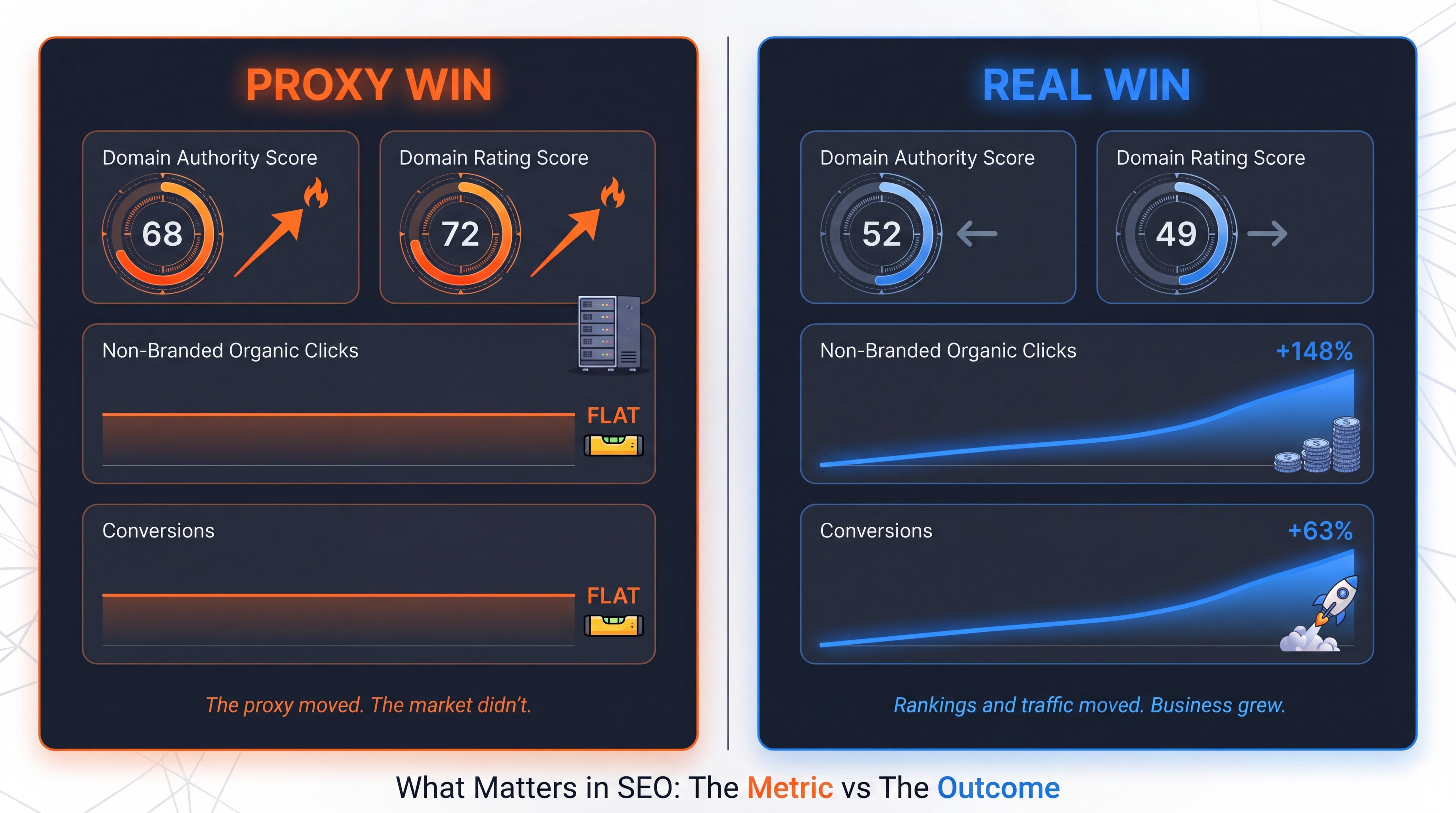
Judge your SEO program by business outcomes, not by a dashboard number ticking upward five points. Watching your DA slowly increase while your non-branded search traffic stays flat is a sign you're optimizing the wrong thing.
Frequently Asked Questions: Moz DA vs Ahrefs DR
Does Google use Domain Authority or Domain Rating?
No. Moz states Google does not factor DA into rankings. Ahrefs notes that Google representatives have denied "domain authority" as a ranking factor. Google's own documentation describes Search as using many page-level and site-wide signals — none of which are DA or DR.
Can a high-DR site still be a bad link?
Absolutely. Ahrefs explicitly states that DR does not account for spam, traffic, or domain age, and cautions against judging a site by site-wide authority alone. A strong DR can coexist with weak topical fit, low-visibility pages, or genuine organic traffic that has nothing to do with your industry. Always investigate beyond the score.
Is DA more useful because it includes spam and link-quality signals?
Not automatically. DA's machine-learned model does incorporate Spam Score and link-quality patterns, making it a broader estimate than a pure link-graph metric. But broader doesn't mean universally better — it means DA is answering a different question. The metric's breadth is valuable for competitive benchmarking; it's less precise as a link prospect filter.
Should you only pursue links from sites with higher DA or DR than yours?
No. Moz explicitly recommends against using DA in isolation. Google ranks pages and relevance, and Ahrefs recommends evaluating topical fit and individual page strength rather than domain-level scores alone. A lower-scoring but tightly relevant site can be a significantly better link than a high-scoring domain with no connection to your topic.
Which score should I check first?
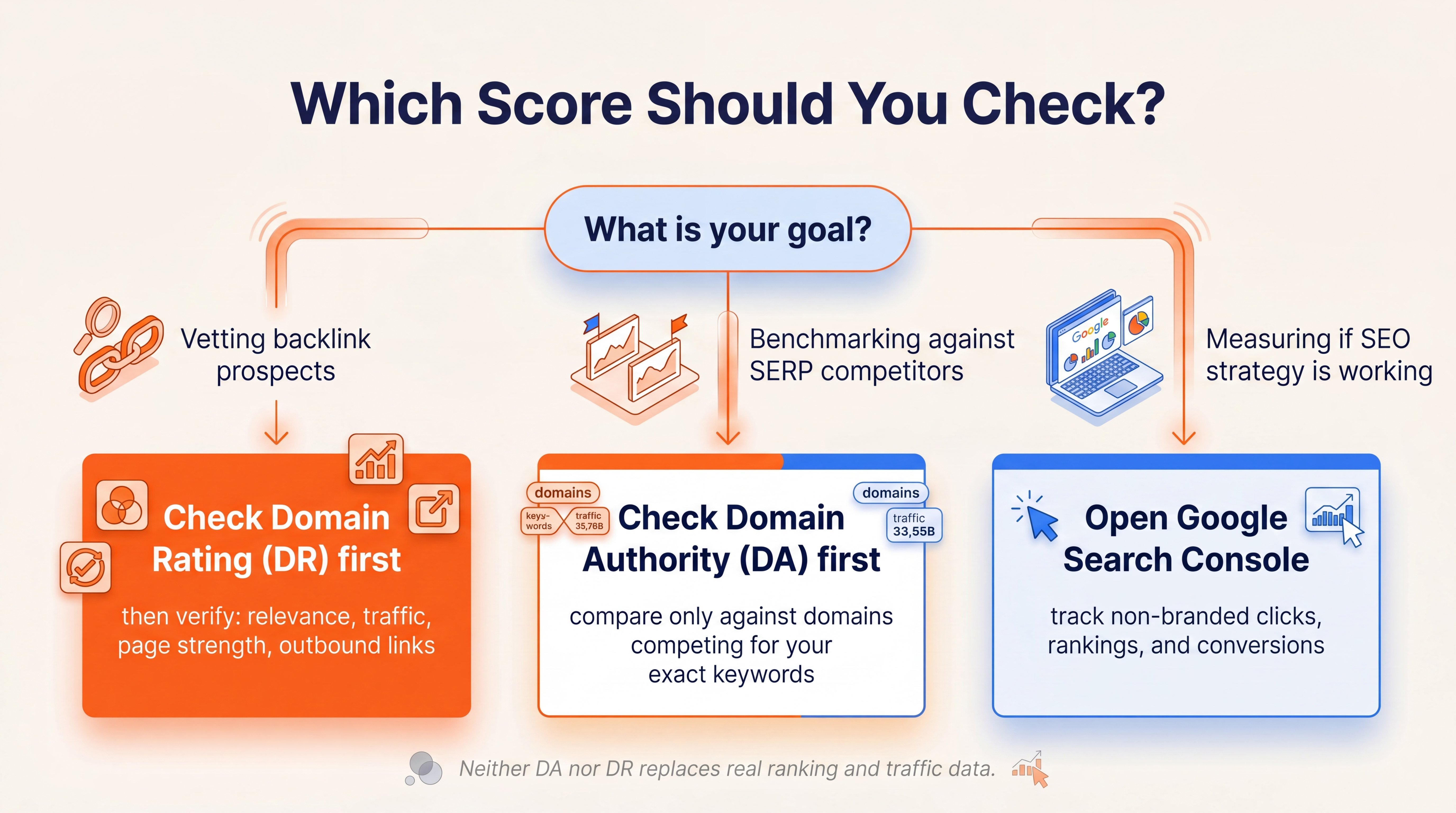
If you're evaluating a backlink prospect list, start with DR as your first filter — then layer in relevance, traffic verification, and page strength. If you're sizing up the domains outranking you for specific keywords, start with DA. If you're trying to understand whether your overall SEO program is working, skip both and open Search Console. Track actual rankings and non-branded organic clicks.
What's a "good" DA or DR score?
There's no universal answer — both scores are entirely relative. A DR 38 can be highly competitive in a niche where most sites cluster below 30. That same DR 38 is unremarkable in a vertical dominated by large media brands with DR 75+. The only comparison that matters is how you stack up against the specific domains competing for your keywords. Closing the gap with your actual SERP competitors is more actionable than chasing an arbitrary number.
The Bottom Line: Moz DA vs Ahrefs DR
Here's the direct answer:
For Google's ranking algorithm — neither DA nor DR is a direct input.
For backlink prospecting — DR is usually the cleaner, more honest first filter.
For competitive SERP benchmarking — DA is usually the more contextual proxy.
For actual SEO success — both are secondary to page-level relevance, content quality, real rankings, and links that make sense beyond the number attached to them.
Both metrics respond to the same underlying inputs. Publish better content, earn relevant links from quality sources, and build genuine depth in your subject area — and both scores will tend to move in the right direction over time. The question is whether moving those scores is the goal, or whether winning the rankings and traffic your business actually needs is the goal.
The SEO industry gravitates toward clean scores because they create the feeling of certainty. Google doesn't rank certainty. It ranks documents that best answer what someone searched for. That's a messier game — but it's the only one worth playing.
Smart SEO,
Faster Growth!
Most Read Articles
Generative Engine Optimization (GEO)
Learn how Generative Engine Optimization (GEO) helps your content rank in AI search engines like ChatGPT and Google AI. This comprehensive guide explains the differences between SEO and GEO, why it matters for your business, and practical steps to implement GEO strategies for better visibility in AI-generated responses.
DylenJan 18, 2025
Track LLM Traffic in Google Analytics 4 (GA4)
Learn how to track and analyze traffic from AI sources like ChatGPT, Claude, Perplexity, and Google Gemini in Google Analytics 4. This step-by-step guide shows you how to set up custom filters to monitor AI-driven traffic and make data-driven decisions for your content strategy.
DylenMar 18, 2025
How to Humanize AI Text with Instructions
Learn practical techniques to make AI-generated content sound more natural and human. This guide covers active voice, direct addressing, concise writing, and other proven strategies to transform robotic text into engaging content.
DylenApril 7, 2025Moz DA vs Ahrefs DR: Which Metric Should You Actually Use?
Moz Domain Authority and Ahrefs Domain Rating look similar but measure very different things. Learn what each score actually tells you, when to use each one, and what to track instead for real SEO results in 2026.
DylenApr 23, 2026
Open AI Revenue and Statistics (2024)
Comprehensive analysis of OpenAI financial performance, user engagement, and market position in 2023. Discover key statistics including $20B valuation, $1B projected revenue, and 100M+ monthly active users.
DylenOctober 03, 2025
"Search Google or Type a URL": What It Means & What to Do
Learn what "Search Google or type a URL" actually means, how your browser decides whether to search or navigate, and what to do if your address bar starts behaving unexpectedly. Includes browser settings guides for Chrome, Firefox, Edge, and Safari.
DylenApr 21, 2026