Long-Tail Keywords: Boosting SEO Traffic and ROI


Most American businesses miss out on valuable website traffic by ignoring the power of long-tail keywords. These precise search terms account for over 70 percent of all online queries, yet many marketers stick with broad, highly competitive keywords. Understanding how long-tail keywords work allows American brands to attract shoppers who know what they want and are ready to take action, leading to better results with less effort.
Table of Contents
- What Are Long-Tail Keywords and How They Differ
- Types of Long-Tail Keywords for SEO Success
- Key Benefits and Real-World Applications
- How to Research and Identify Long-Tail Keywords
- Common Pitfalls When Using Long-Tail Keywords
Key Takeaways
| Point | Details |
|---|---|
| Long-Tail Keywords are Specific | They consist of multi-word phrases that cater to precise user intentions, improving targeting and relevance. |
| Higher Conversion Potential | Despite having lower search volumes, long-tail keywords significantly boost conversion rates due to their specificity. |
| Strategic Research is Crucial | Employ tools and techniques like Google Search Console and customer language mining to discover valuable long-tail keywords. |
| Avoid Common Pitfalls | Steer clear of keyword stuffing and targeting overly narrow keywords to maintain SEO effectiveness and user engagement. |
What Are Long-Tail Keywords and How They Differ
Long-tail keywords represent highly specific search phrases that offer powerful opportunities for targeted digital marketing strategies. Unlike broad, generic terms, these multi-word phrases target precise user intentions with remarkable precision. Imagine searching for "running shoes" versus "affordable womens trail running shoes size 8" - the latter represents a quintessential long-tail keyword approach.
While short-tail keywords are competitive and generic, long-tail keywords deliver strategic advantages. Less popular search terms can collectively generate significant website traffic by capturing niche audience segments. They typically have lower search volumes but dramatically higher conversion potential because they reflect specific user needs and purchase intentions.
The core characteristics of long-tail keywords include:
Here's how long-tail and short-tail keywords compare in key digital marketing aspects:
| Aspect | Long-Tail Keywords | Short-Tail Keywords |
|---|---|---|
| Typical Word Length | 4-6 words | 1-2 words |
| Competition Level | Low to moderate | Very high |
| Conversion Rate | High due to specific intent | Low due to broad targeting |
| Cost per Click | More affordable advertising | Often expensive |
| Audience Targeting | Niche, highly relevant | Broad, less targeted |
| Traffic Volume | Lower per keyword, higher in aggregate | High per keyword |
| SEO Difficulty | Easier to rank for | Difficult to achieve top ranking |
- Longer, more detailed search phrases (4-6 words typically)
- Lower competition compared to generic terms
- Higher purchase intent from searchers
- More affordable pay-per-click advertising costs
- Better alignment with user-specific queries
Pro Marketing Hack: Research long-tail keywords by analyzing customer support emails, forum discussions, and social media comments to uncover precise language your target audience actually uses when describing their needs.
Types of Long-Tail Keywords for SEO Success
Long-tail keywords are not a monolithic category but a diverse ecosystem of search phrases strategically designed to capture specific user intents. Marketers can effectively categorize these keywords into three primary types: navigational, informational, and transactional. Understanding these distinct categories allows digital marketers to craft more precise targeting strategies.
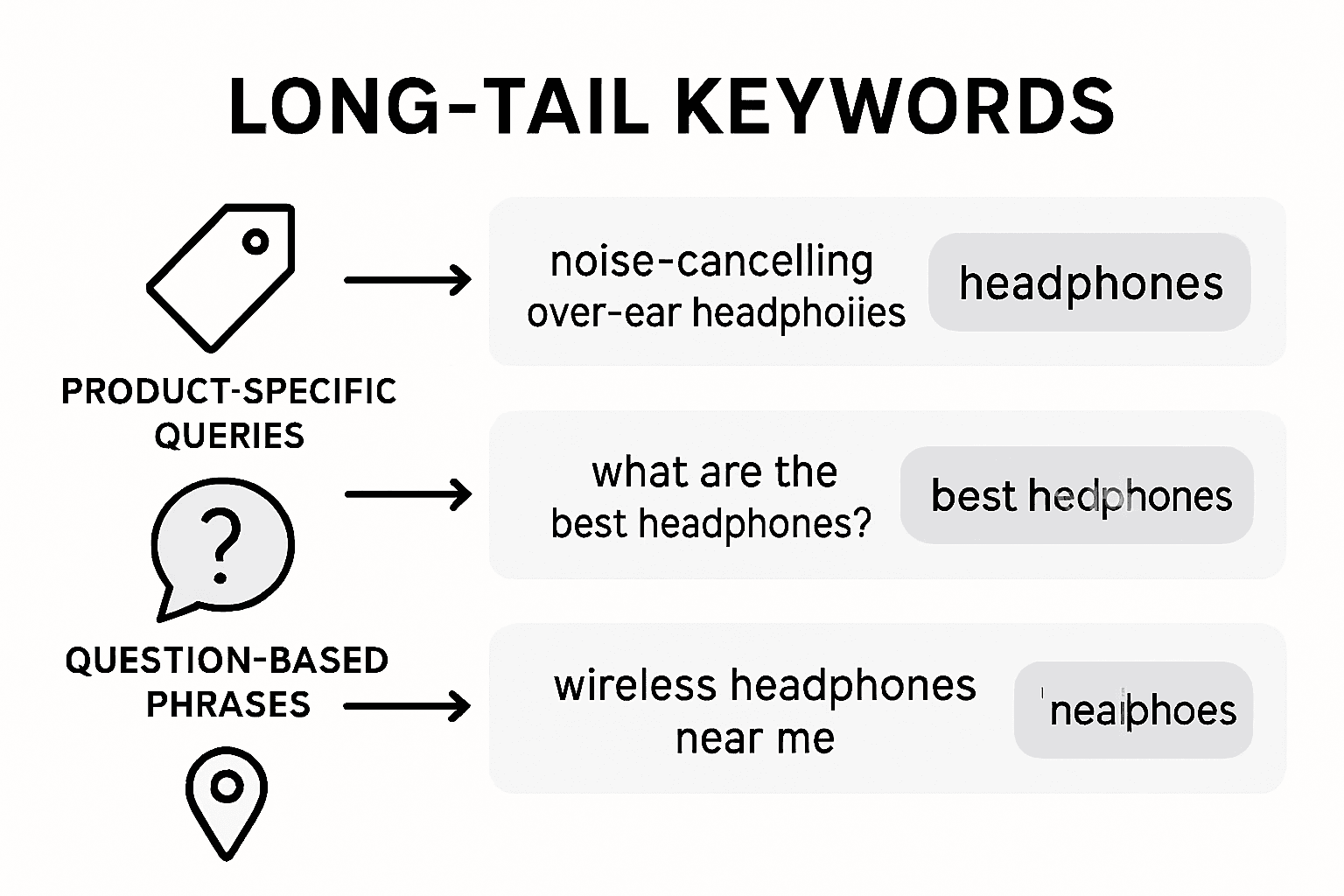
Navigational long-tail keywords represent searches where users seek a specific website or brand. For instance, "best affordable MacBook Pro for graphic design" demonstrates a navigational intent with clear purchase motivation. Informational long-tail keywords focus on solving problems or gathering knowledge, like "how to optimize WordPress website speed" - indicating the searcher wants educational content. Transactional long-tail keywords signal immediate purchase readiness, such as "buy wireless noise-canceling headphones under 200 dollars".
Each long-tail keyword type offers unique strategic advantages:
- Navigational Keywords
- Target brand-aware consumers
- Indicate high purchase probability
- Demonstrate specific product interest
- Informational Keywords
- Build trust through educational content
- Attract researchers and potential customers
- Establish thought leadership
- Transactional Keywords
- Capture bottom-of-funnel consumers
- Signal direct purchase intent
- Maximize conversion potential
Pro Targeting Technique: Cross-reference your long-tail keywords with Google Search Console data to identify which keyword types generate the highest click-through and conversion rates for your specific audience.
Key Benefits and Real-World Applications
Long-tail keywords generate exceptional value by capturing highly specific search traffic, representing over 70% of all search queries. Unlike generic keywords, these precise search phrases enable businesses to connect with audiences at exact moments of interest, dramatically improving marketing efficiency and relevance.
Small businesses and niche marketers particularly benefit from long-tail keyword strategies. By utilizing targeted keywords, companies can achieve higher conversion rates and substantially reduce their cost per lead. For example, an artisan coffee roaster targeting "organic single-origin Ethiopian light roast coffee" will likely attract more motivated buyers than someone using broad terms like "coffee beans".
Real-world applications of long-tail keywords span multiple industries:
- E-commerce: Precise product descriptions
- Local Businesses: Neighborhood-specific service offerings
- B2B Technology: Specialized solution descriptions
- Healthcare: Treatment-specific patient information
- Education: Specific course and program queries
Pro Targeting Technique: Create a spreadsheet mapping your long-tail keywords to specific customer journey stages, tracking conversion rates and engagement metrics to continuously refine your strategy.
How to Research and Identify Long-Tail Keywords
Identifying long-tail keywords requires a strategic approach that analyzes search trends and user behavior, diving deep into the specific language and intent of your target audience. The process goes beyond simple keyword generation, demanding a nuanced understanding of how potential customers actually search for solutions.Several powerful research techniques can uncover valuable long-tail keyword opportunities. Start by exploring Google's autocomplete suggestions, which reveal real-world search patterns. Leverage tools like Google Search Console to examine the actual search queries driving traffic to your website. Online forums, customer support tickets, and social media conversations provide rich insights into the specific language and pain points your audience experiences.
Below is a summary of effective research techniques for uncovering long-tail keyword opportunities:
| Research Technique | Main Tool or Source | Unique Benefit |
|---|---|---|
| Google Autocomplete | Google Search Bar | Reveals authentic user queries |
| Search Console Analysis | Google Search Console | Highlights real keywords driving site traffic |
| Competitor Content Review | Industry competitor websites | Uncovers gaps and niche opportunities |
| Customer Language Mining | Emails, forums, social media | Captures audience-specific terminology |
Key research strategies for long-tail keyword discovery include:
- Google Search Console Analysis
- Review current search queries
- Identify underperforming keywords
- Understand user search intent
- Competitor Keyword Research
- Analyze competitor content
- Identify content gaps
- Discover niche search opportunities
- Customer Language Mining
- Review customer support emails
- Analyze forum discussions
- Examine product review language
- Keyword Research Tools
- Use SEO research platforms
- Explore related search suggestions
- Track search volume and competition
Pro Keyword Hunting Technique: Create a living document that captures every unique phrase customers use to describe your product or service, treating it as an evolving repository of potential long-tail keyword goldmines.
Common Pitfalls When Using Long-Tail Keywords
Navigating the world of long-tail keywords requires more than simply stringing together random phrases. Keyword research insights from marketing professionals reveal that many businesses inadvertently sabotage their SEO efforts through common misconceptions and strategic errors.
One of the most significant mistakes marketers make is forcing keywords unnaturally into content, creating text that reads awkwardly and fails to engage readers. Keyword stuffing not only damages readability but also triggers search engine penalties that can dramatically reduce website visibility. Another critical error involves targeting keywords with extremely low search volumes, which might seem specific but ultimately provide negligible traffic potential.
Key long-tail keyword pitfalls to avoid include:
- Keyword Stuffing
- Unnatural phrase insertion
- Reduced content quality
- Potential search engine penalties
- Ignoring User Intent
- Misaligning content with search purpose
- Poor user experience
- Higher bounce rates
- Overly Narrow Keyword Targeting
- Extremely low search volume
- Minimal traffic potential
- Wasted content development effort
- Neglecting Semantic Variations
- Missing related search queries
- Incomplete topic coverage
- Reduced content discoverability
Pro Strategy Warning: Regularly audit your long-tail keywords, eliminating underperforming phrases and continuously expanding your semantic keyword network to maintain dynamic, responsive content strategies.
Unlock the Power of Long-Tail Keywords with AI-Driven SEO Solutions
Long-tail keywords offer a unique chance to connect deeply with your target audience by capturing specific search intent and boosting conversions. However, the challenge lies in researching, optimizing, and continuously refining these precise phrases without wasting valuable time or resources. If you struggle to identify effective long-tail keywords or to turn them into tangible SEO results, you are not alone.
At Babylovegrowth.ai, we specialize in simplifying this process through an AI-powered platform that generates optimized, highly targeted content tailored for both Google and ChatGPT. Our automated system helps you rank higher for niche, low-competition long-tail keywords while maximizing ROI with affordable, scalable growth strategies. Use our platform to harness detailed business analysis and personalized content plans designed to keep your SEO strategy dynamic and on autopilot.
Experience how AI-driven content and backlink strategies can empower your digital marketing with smarter long-tail keyword targeting. Start today with a free trial and transform your SEO efforts into measurable success.
Explore AI-Powered SEO Solutions
Discover Personalized Content Plans
Start Your Free Trial Now

Frequently Asked Questions
What are long-tail keywords and how do they differ from short-tail keywords?
Long-tail keywords are highly specific search phrases, typically consisting of 4-6 words, that target precise user intentions. Unlike short-tail keywords, which are more generic and competitive, long-tail keywords have lower competition, higher conversion rates, and are often more cost-effective in advertising.
Why are long-tail keywords important for SEO?
Long-tail keywords are crucial for SEO because they help businesses connect with highly targeted audiences. They represent over 70% of all search queries and can significantly improve marketing efficiency by attracting users with specific needs and intentions, ultimately leading to higher conversion rates.
How can I research long-tail keywords for my website?
To research long-tail keywords, you can use techniques such as analyzing Google autocomplete suggestions, examining your Google Search Console data for real search queries driving traffic, reviewing competitor content for gaps, and mining customer language from emails, forums, and social media.
What are some common mistakes to avoid when using long-tail keywords?
Common mistakes include keyword stuffing, which can harm readability and trigger penalties, ignoring user intent, overly narrow targeting of keywords with very low search volumes, and neglecting semantic variations that can enhance content discoverability.
Recommended
Smart SEO,
Faster Growth!
Most Read Articles
Generative Engine Optimization (GEO)
Learn how Generative Engine Optimization (GEO) helps your content rank in AI search engines like ChatGPT and Google AI. This comprehensive guide explains the differences between SEO and GEO, why it matters for your business, and practical steps to implement GEO strategies for better visibility in AI-generated responses.
DylenJan 18, 2025
Track LLM Traffic in Google Analytics 4 (GA4)
Learn how to track and analyze traffic from AI sources like ChatGPT, Claude, Perplexity, and Google Gemini in Google Analytics 4. This step-by-step guide shows you how to set up custom filters to monitor AI-driven traffic and make data-driven decisions for your content strategy.
DylenMar 18, 2025
How to Humanize AI Text with Instructions
Learn practical techniques to make AI-generated content sound more natural and human. This guide covers active voice, direct addressing, concise writing, and other proven strategies to transform robotic text into engaging content.
DylenApril 7, 2025
Open AI Revenue and Statistics (2024)
Comprehensive analysis of OpenAI financial performance, user engagement, and market position in 2023. Discover key statistics including $20B valuation, $1B projected revenue, and 100M+ monthly active users.
DylenOctober 03, 2025