How to Utilize Analytics for Growth Effectively


Over 90 percent of American e-commerce businesses struggle to extract real value from their growing pools of digital data. For digital marketing managers, this gap translates to missed opportunities for traffic growth and wasted spend. Understanding how to assess your data landscape, harness integrated analytics tools, and automate content strategies with AI puts you ahead of competitors still relying on guesswork. This guide outlines clear steps to transform scattered data into automated growth for your American or global brand.
Table of Contents
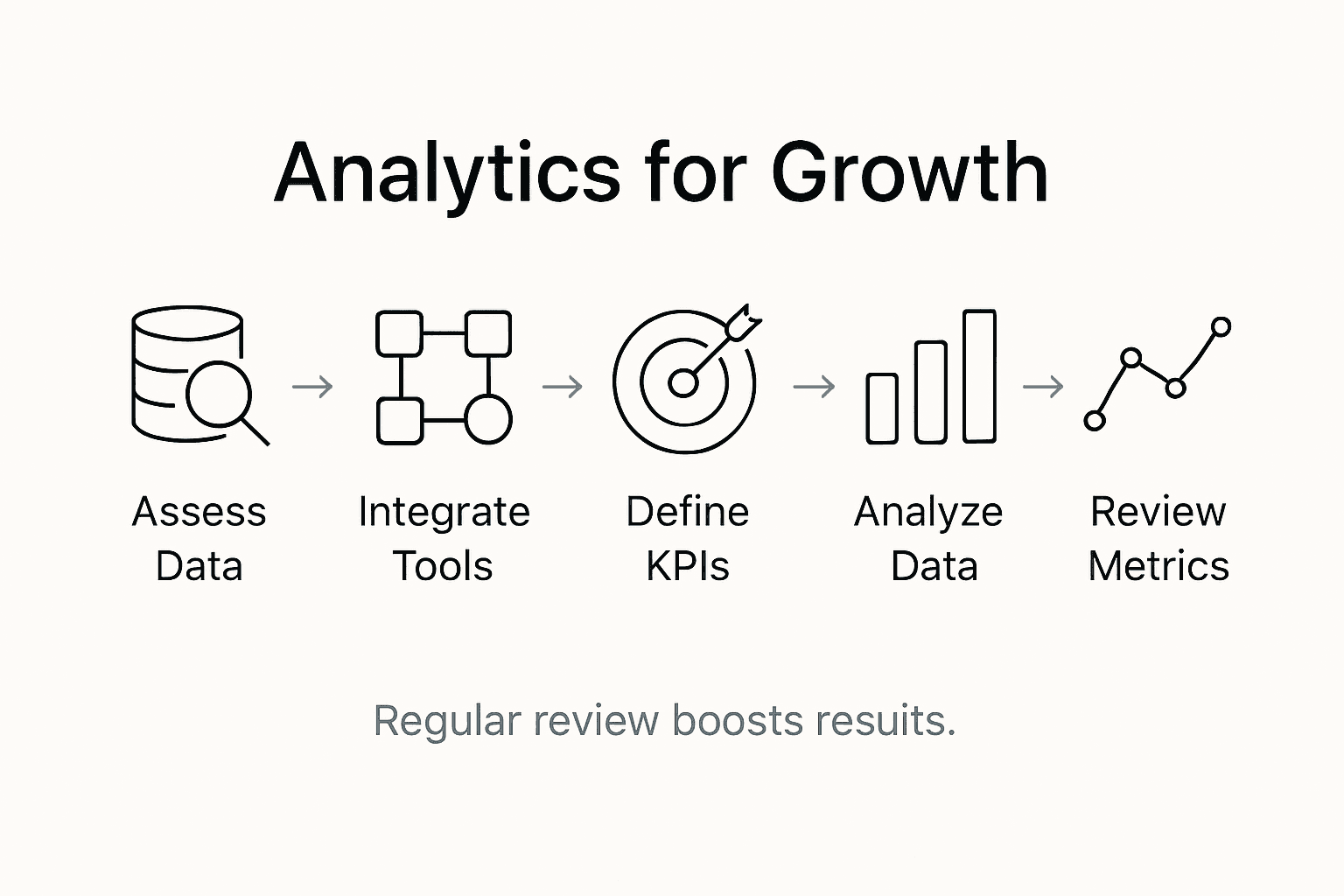
- Step 1: Assess Current Data Sources And Needs
- Step 2: Integrate Analytics Tools With Your Platform
- Step 3: Define Growth-Focused KPIs And Metrics
- Step 4: Analyze Data To Uncover Actionable Insights
- Step 5: Automate Content And Backlink Strategies With AI
- Step 6: Review Success Metrics And Refine Processes
Quick Summary
| Key Insight | Explanation |
|---|---|
| 1. Assess Data Sources | Map and evaluate all data sources for strategic value. |
| 2. Integrate Analytics Tools | Connect analytics tools with your platform for real-time insights. |
| 3. Define Growth-Focused KPIs | Establish measurable KPIs that align with business growth objectives. |
| 4. Analyze Data for Insights | Organize and interpret data to uncover actionable business strategies. |
| 5. Review Metrics Continuously | Regularly monitor KPIs for ongoing improvement and strategic adjustments. |
Step 1: Assess current data sources and needs
Evaluating your current data landscape is crucial for developing an effective analytics strategy. You will identify the range of data sources available to your organization and determine which sources provide meaningful insights for business growth.
Start by conducting a comprehensive inventory of your existing data repositories. This means mapping out all internal systems like transactional databases, customer relationship management (CRM) platforms, and enterprise resource planning (ERP) systems. Organizations must understand their data needs and current data environment to effectively leverage data for strategic decision-making. Look beyond your internal systems and consider external public datasets that might provide competitive intelligence or supplemental context.
Organize these data sources into categories based on their potential value and reliability. Assess each source for data quality, completeness, and relevance to your specific business questions. Pay close attention to potential gaps in your current data ecosystem that might require additional collection or integration efforts. Not all data is equally valuable, so prioritize sources that directly connect to your growth objectives and can provide actionable insights.
Pro tip: Create a simple spreadsheet tracking each data source, its update frequency, accessibility, and potential strategic value to streamline your assessment process.
Here's a summary of common types of data sources and their typical business value:
| Data Source Type | Example System | Strategic Value |
|---|---|---|
| Internal Systems | CRM, ERP, transactional database | Direct insights for business growth |
| External Public Data | Government datasets, research | Competitive intelligence |
| Third-Party Platforms | Social media analytics, SaaS | Supplement customer understanding |
| Proprietary Research | Market surveys, user studies | Unique insights for innovation |
Step 2: Integrate analytics tools with your platform
Successfully integrating analytics tools into your digital platform requires a strategic approach that enables comprehensive data collection and insights generation. You will establish a robust connection between your existing systems and powerful analytics technologies to unlock actionable business intelligence.
Integrating analytics tools within digital platforms requires establishing a strong, flexible digital core that seamlessly connects cloud, data, and analytics technologies. Begin by identifying the key performance indicators (KPIs) most critical to your business objectives. Next, select analytics tools that offer comprehensive tracking capabilities aligned with these specific metrics. Ensure your chosen platforms support easy implementation through standardized tracking codes or application programming interfaces (APIs).Implement the integration systematically by first creating accounts with your selected analytics providers, then carefully inserting tracking scripts into your platform's core infrastructure. Verify the installation by testing data transmission and checking that metrics are being recorded accurately. Configure custom event tracking to capture nuanced user interactions that provide deeper insights into user behavior and engagement patterns.
Pro tip: Create a staged rollout plan for your analytics integration, testing each component in a controlled environment before full deployment to minimize potential disruptions.
Step 3: Define growth-focused KPIs and metrics
Defining precise growth-focused key performance indicators (KPIs) is essential for tracking your business's strategic progress and making data-driven decisions. You will create a comprehensive measurement framework that transforms abstract goals into tangible, trackable metrics.

Prioritize metrics that not only measure past performance but also provide predictive insights into future growth potential. Consider creating a balanced scorecard that incorporates financial, customer, internal process, and learning perspectives. Ensure each selected KPI is specific, measurable, achievable, relevant, and time-bound. Regularly review and adjust your metrics to maintain their relevance as your business evolves and market conditions change.
Pro tip: Develop a dynamic KPI dashboard that visualizes your most critical metrics, allowing for real-time monitoring and quick strategic adjustments.
Step 4: Analyze data to uncover actionable insights
Transforming raw data into meaningful strategic guidance requires a systematic and thoughtful approach to analysis. You will learn to extract valuable insights that drive tangible business improvements and inform strategic decision-making.
Turning data into actionable insights involves organizing data by themes, identifying recurring patterns, and interpreting root causes that can directly impact business performance. Begin by clustering your collected data into meaningful categories that reveal underlying trends and relationships. Look beyond surface-level metrics to understand the deeper narrative your data is telling. This means examining not just what happened, but why it happened and what specific actions you can take in response.Develop a structured analysis framework that moves from data observation to strategic recommendation. Implement techniques like comparative analysis, trend mapping, and correlation studies to uncover nuanced insights. Create visual representations of your findings using charts, graphs, and dashboards that make complex information immediately comprehensible. Critically evaluate each insight through the lens of potential business impact, filtering out noise and focusing on recommendations that can drive meaningful growth and efficiency.
Pro tip: Establish a regular cadence for data review and insight generation, treating your analytical process as a continuous improvement cycle rather than a one-time exercise.
Step 5: Automate content and backlink strategies with AI
Leveraging artificial intelligence to streamline your content and backlink strategies can dramatically accelerate your growth potential. You will learn how to implement smart automation techniques that reduce manual effort while enhancing your digital marketing effectiveness.
AI is transforming SEO strategies by automating content creation, structured data management, and ongoing site audits to maintain competitive digital presence. Start by selecting AI powered tools that can generate high quality content drafts, analyze existing content performance, and identify strategic backlink opportunities. Focus on solutions that understand semantic context and can produce nuanced, original content that resonates with your target audience. Configure these tools to align with your brand voice, industry specifics, and unique value propositions.Implement a phased approach to AI automation by first integrating tools for content research, keyword identification, and initial draft generation. Then gradually expand to more advanced capabilities like automated content optimization, backlink prospecting, and performance tracking. Continuously monitor and refine your AI strategies, ensuring the generated content maintains authenticity and provides genuine value to your readers. Remember that AI should augment human creativity, not replace the strategic thinking and unique perspectives that drive meaningful engagement.
Pro tip: Regularly test and validate AI generated content against your brand guidelines and audience expectations to maintain high quality standards.
The table below compares traditional vs. AI-driven content and backlink strategies:
| Approach | Manual Methods | AI-Driven Techniques |
|---|---|---|
| Content Creation | Human drafting and editing | Automated drafting, content analysis |
| Backlink Discovery | Manual outreach, research | Automated prospecting, analysis |
| Data Updates | Periodic, often delayed | Real-time or scheduled updates |
| Scalability | Resource-limited expansion | Rapid scaling with less manual work |
Step 6: Review success metrics and refine processes
Continuously evaluating your organizational performance requires a systematic approach to tracking, analyzing, and adapting your strategies. You will develop a robust framework for monitoring key performance indicators and implementing meaningful improvements based on data driven insights.
Continuous review of success metrics involves engaging leadership and establishing roles and processes for measurement that drive organizational growth. Implement a Perform-Review-Adapt cycle where metrics are not just passive indicators but active tools for strategic refinement. Schedule regular review sessions where your team critically examines performance data, identifying patterns of success and areas requiring intervention. Compare your current metrics against initial benchmarks and industry standards to understand your relative performance and potential growth opportunities.Develop a dynamic feedback mechanism that allows for rapid iteration and strategic pivots. This means creating clear communication channels where insights can be quickly translated into actionable recommendations. Pay special attention to metrics that demonstrate consistent underperformance or unexpected variations. Use these anomalies as opportunities for deeper investigation, potentially uncovering systemic challenges or emerging market trends that require strategic recalibration. Remember that metric review is not about finding fault but about continuous learning and adaptive improvement.
Pro tip: Create a visual dashboard that highlights key metrics with color coded performance indicators to enable quick strategic decision making.
Unlock Growth with Smart Analytics and AI-Driven SEO
Many businesses struggle to turn complex data into clear growth strategies. This article highlights challenges like integrating analytics tools, defining precise KPIs, and transforming insights into actionable plans. It also points out how automating content and backlink strategies with AI can save time while delivering measurable results. If you want to simplify your organic growth process and focus on what really moves the needle, leveraging AI-powered solutions is the key.
Babylovegrowth.ai offers exactly that: a powerful platform that automates high-quality content creation and backlink management using AI. You get a personalized 30-day content plan tailored to your business needs, optimizing your SEO efforts on Google and ChatGPT without complicated manual steps. By combining detailed business analysis with a seamless AI workflow, you can track performance, adapt your strategy, and accelerate growth effortlessly.

Ready to stop guessing and start growing with data-backed AI automation? Visit Babylovegrowth.ai to explore how our smart, scalable SEO tools can plug directly into your growth plan. Discover more about our step-by-step SEO autopilot method here and get started with a free trial designed for business owners and marketers who want fast, transparent results.
Frequently Asked Questions
How can I assess my current data sources for effective analytics?
To assess your current data sources, conduct a comprehensive inventory of all existing data repositories, such as CRM platforms and transactional databases. Organize these sources based on their quality and relevance to your business objectives, focusing on obtaining actionable insights within the next 30 days.
What are the key performance indicators I should focus on for growth?
Focus on key performance indicators (KPIs) that directly reflect your growth objectives, such as customer acquisition cost, conversion rates, and customer lifetime value. Define at least three KPIs that resonate with your strategic goals, and start tracking them immediately to measure your progress.
How do I analyze data to uncover actionable insights?
To analyze data, first categorize your collected information into meaningful groups, looking for trends and patterns that impact your business. Develop a structured framework for your analysis and begin to produce visual representations of your findings within two weeks to facilitate strategic decision-making.
What steps should I take to integrate analytics tools into my platform?
Start by identifying the key performance indicators critical to your business, then select analytics tools that align with those metrics. Implement the integration systematically, ensuring all tracking components are installed correctly, and conduct tests to validate the setup within the first month.
How can I automate my content and backlink strategies using AI?
Select AI-powered tools that can automate content creation and analyze backlink opportunities. Begin by integrating these tools for content research and drafting, and aim to automate at least 50% of your content processes within the next three months to enhance efficiency.
Why is it important to review success metrics regularly?
Regularly reviewing success metrics is essential for identifying areas of improvement and adapting your strategies based on data-driven insights. Establish a routine for performance reviews every month to ensure continuous learning and more effective decision-making.
Recommended
Smart SEO,
Faster Growth!
Most Read Articles
Generative Engine Optimization (GEO)
Learn how Generative Engine Optimization (GEO) helps your content rank in AI search engines like ChatGPT and Google AI. This comprehensive guide explains the differences between SEO and GEO, why it matters for your business, and practical steps to implement GEO strategies for better visibility in AI-generated responses.
DylenJan 18, 2025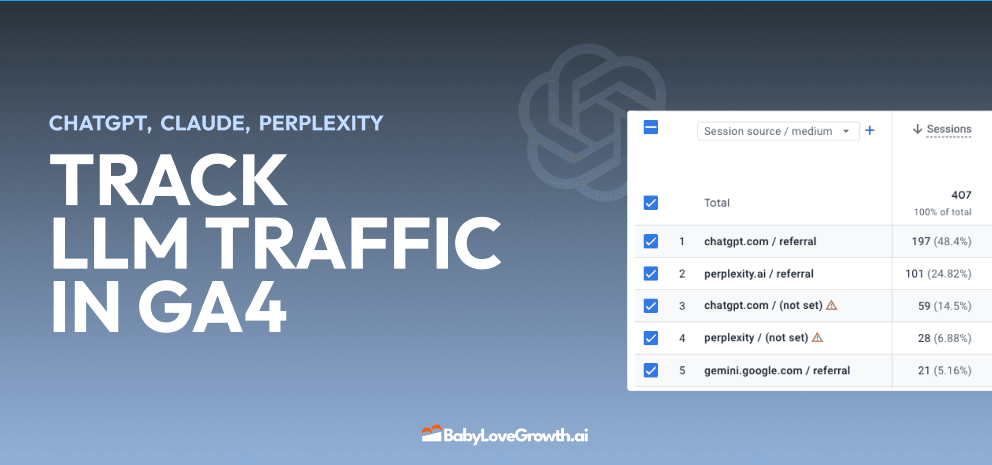
Track LLM Traffic in Google Analytics 4 (GA4)
Learn how to track and analyze traffic from AI sources like ChatGPT, Claude, Perplexity, and Google Gemini in Google Analytics 4. This step-by-step guide shows you how to set up custom filters to monitor AI-driven traffic and make data-driven decisions for your content strategy.
DylenMar 18, 2025
How to Humanize AI Text with Instructions
Learn practical techniques to make AI-generated content sound more natural and human. This guide covers active voice, direct addressing, concise writing, and other proven strategies to transform robotic text into engaging content.
DylenApril 7, 2025
Open AI Revenue and Statistics (2024)
Comprehensive analysis of OpenAI financial performance, user engagement, and market position in 2023. Discover key statistics including $20B valuation, $1B projected revenue, and 100M+ monthly active users.
DylenOctober 03, 2025