How to plan a content calendar for marketing success


You know the feeling. Content deadlines sneak up, your team scrambles to publish something, anything, and your organic traffic stagnates because there's no cohesive strategy tying it all together. Without a structured content calendar, even the most talented marketers find themselves trapped in reactive mode, chasing trends instead of building sustainable growth. A well-planned content calendar transforms this chaos into a strategic asset that aligns your team, supports SEO goals, and creates consistent touchpoints with your audience. This guide walks you through the preparation, execution, and optimization steps to build a content calendar that actually drives results.
Table of Contents
- Key takeaways
- Understanding the need for a content calendar
- Essential preparation steps before creating your content calendar
- Step-by-step guide to building your content calendar
- Common pitfalls and how to verify your content calendar's effectiveness
- Enhance your content planning with BabyLoveGrowth tools
- FAQ
Key Takeaways
| Point | Details |
|---|---|
| Structured calendar benefits | A structured calendar eliminates guesswork and creates accountability across the marketing team. |
| Measurable goals | Define concrete targets that tie to business objectives to guide scheduling decisions. |
| Quarterly planning | Start with a quarterly calendar to maintain structure while allowing adjustments based on performance data. |
| Avoid reactive mode | Establish a centralized plan that aligns teams and reduces last minute scrambling. |
| Verification tips | Review results against goals and use keyword performance and seasonal trends to inform future content. |
Understanding the need for a content calendar
Digital marketers in small to mid-sized businesses face a unique challenge. You're expected to produce high-quality content consistently, but you're often working with limited resources and competing priorities. Without a content calendar, your team operates in firefighting mode, reacting to immediate needs rather than executing a cohesive strategy. This reactive approach leads to inconsistent publishing schedules, missed opportunities for seasonal content, and gaps in your keyword coverage.
A content calendar solves these problems by creating a centralized planning system that aligns everyone around shared goals. It transforms content production from a chaotic scramble into a predictable, repeatable process. Consistent content planning significantly enhances organic growth potential by ensuring you publish regularly, target the right keywords at the right times, and maintain topical authority in your niche. Search engines reward consistency, and your audience learns to expect valuable content from you on a reliable schedule.
The relationship between content planning and organic traffic growth is direct and measurable. When you plan content strategically, you can:
- Coordinate keyword targeting across multiple pieces to build topical clusters
- Time content releases to match seasonal search trends and buying cycles
- Ensure every piece supports broader marketing campaigns and business objectives
- Allocate resources efficiently by planning production schedules in advance
Pro Tip: Start small with a quarterly calendar rather than trying to plan a full year upfront. This gives you flexibility to adapt based on performance data while still providing enough structure to drive consistency.
The calendar itself becomes a communication tool that keeps stakeholders informed and aligned. Writers know what they're producing and when. Designers understand upcoming visual needs. Leadership can see how content supports business goals. This alignment eliminates the last-minute scrambles that compromise quality and burn out your team.
Essential preparation steps before creating your content calendar
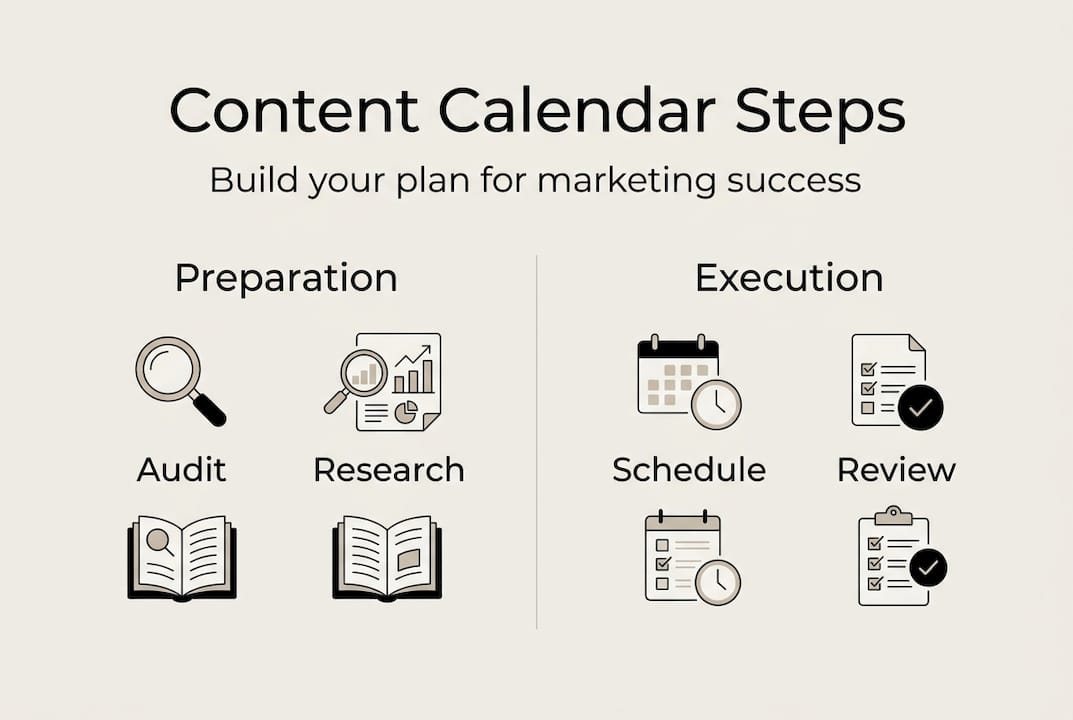
Building an effective content calendar starts well before you open a spreadsheet or project management tool. The preparation phase determines whether your calendar becomes a strategic asset or just another abandoned planning document. You need to establish clear goals, understand your current content landscape, and gather the insights that will inform smart scheduling decisions.
Start by defining measurable content goals that tie directly to business objectives. Vague aspirations like "increase traffic" won't guide your calendar decisions effectively. Instead, set specific targets such as "generate 500 qualified leads from organic search by Q3" or "rank in the top 3 positions for 15 high-intent keywords by year end." These concrete goals help you prioritize topics and allocate resources strategically.
Next, conduct a thorough content audit to identify what's working and what's missing. Follow these steps:
- Catalog all existing content with performance metrics like traffic, engagement, and conversions
- Identify gaps in your keyword coverage and topic areas where competitors outrank you
- Flag outdated content that needs refreshing or consolidation
- Document your top-performing pieces to understand what resonates with your audience
This audit reveals patterns that should inform your calendar planning. Maybe your how-to guides consistently outperform other formats, or perhaps content published on Tuesdays gets higher engagement. These insights help you plan website content for organic traffic more effectively by doubling down on what works.
Keyword discovery and audience intent analysis are vital prerequisites for effective content scheduling. Your calendar should reflect real search demand, not just topics your team finds interesting. Use keyword research tools to identify opportunities where search volume meets manageable competition. Look for question-based queries that signal informational intent, as these often convert well for mid-funnel content.
Pro Tip: Create a simple matrix that maps keywords to buyer journey stages. This ensures your calendar balances awareness, consideration, and decision-stage content rather than skewing too heavily toward one phase.
Organize your research findings in a way that feeds directly into calendar planning. The table below shows a useful framework:
| Content pillar | Priority keywords | Monthly search volume | Current ranking | Content gap |
|---|---|---|---|---|
| SEO strategy | content calendar planning | 1,200 | Not ranking | Complete guide needed |
| Content marketing | editorial calendar templates | 800 | Position 12 | Update existing post |
| Marketing automation | automated content scheduling | 600 | Not ranking | How-to article needed |
This preparation work might feel time-consuming, but it's the foundation that makes your calendar actually useful. Without it, you're just guessing at what to publish and when.
Step-by-step guide to building your content calendar
Now that you've completed the preparation work, it's time to build the actual calendar structure. The right approach balances flexibility with enough structure to drive consistent execution. Your calendar should be detailed enough to guide daily work but not so rigid that it can't adapt to new opportunities or changing priorities.
Start by selecting tools that match your team's workflow and technical comfort level. Simple spreadsheets work fine for small teams, while larger organizations might need dedicated project management platforms. The key is choosing something your team will actually use consistently. Many marketers successfully use:
- Google Sheets or Excel for basic calendars with color coding and filters
- Trello or Asana for visual, card-based planning with assignment features
- Specialized content marketing platforms that integrate with publishing systems
- Marketing automation tools that combine planning with distribution
Next, determine your publishing frequency based on resources and goals. Quality always trumps quantity, but consistency matters for SEO. Most small to mid-sized businesses find success with two to four substantial pieces per week, supplemented by shorter updates or social content. Automating aspects of content marketing production improves efficiency and scalability, allowing you to maintain higher frequency without sacrificing quality.
Structure your calendar with these essential columns or fields:
- Publication date and time
- Content title and working headline
- Target keyword and secondary keywords
- Content type and format
- Assigned writer, editor, and designer
- Status and milestone dates
- Distribution channels and promotion plan
- Performance tracking notes
This content creation workflow for SEO success ensures nothing falls through the cracks while providing visibility into production bottlenecks. Assign clear ownership for each piece so accountability is never ambiguous.
The comparison table below shows how different calendar approaches stack up:
| Calendar type | Best for | Pros | Cons |
|---|---|---|---|
| Spreadsheet | Small teams, simple needs | Free, flexible, easy to customize | Limited automation, manual updates |
| Project management tool | Growing teams, complex workflows | Visual, collaborative, integrations | Learning curve, potential cost |
| Marketing automation platform | Larger teams, multi-channel | End-to-end workflow, analytics | Higher cost, setup complexity |
Integrate your calendar with other marketing activities to maximize impact. Coordinate content releases with product launches, seasonal campaigns, and promotional activities. This alignment ensures your content supports broader business initiatives rather than existing in isolation. Reference your content marketing checklist for 2026 to ensure you're covering all the optimization elements that make content perform.
Build in buffer time for unexpected opportunities or necessary pivots. A calendar packed to capacity with no flexibility becomes a constraint rather than an enabler. Leave 15 to 20 percent of your capacity unscheduled so you can respond to trending topics or capitalize on sudden opportunities without derailing your entire plan.
Common pitfalls and how to verify your content calendar's effectiveness
Even well-intentioned content calendars can fail if you fall into common traps or neglect ongoing optimization. The difference between a calendar that drives results and one that collects digital dust often comes down to how you monitor, adapt, and refine your approach based on real performance data.
Typical mistakes that undermine content calendar effectiveness include:
- Publishing inconsistently despite having a calendar, which signals unreliability to both search engines and audiences
- Ignoring performance analytics and continuing to produce content that doesn't resonate
- Overloading the calendar with ambitious plans that your team can't realistically execute
- Failing to account for production timelines, leading to rushed, lower-quality content
- Creating content in isolation without considering how pieces connect and support each other
- Neglecting to update the calendar when priorities shift or new opportunities emerge
Pro Tip: Schedule a monthly calendar review session where your team examines what published, what didn't, and why. This creates accountability and surfaces process improvements before small issues become major problems.
Regular audits and performance tracking ensure content calendars remain aligned with marketing objectives. Establish a rhythm for reviewing key performance indicators tied to your original goals. Track metrics like organic traffic growth, keyword ranking improvements, engagement rates, and conversion metrics for each piece you publish. This data reveals patterns that should inform future calendar decisions.
Monitor these specific indicators to gauge calendar effectiveness:
- Publishing consistency rate: Are you hitting your scheduled dates at least 85 percent of the time?
- Content performance trends: Are newer pieces outperforming older ones as you refine your approach?
- Keyword coverage: Are you systematically addressing priority keywords identified in your research?
- Team capacity utilization: Is your calendar realistic given actual production speeds?
- Cross-functional alignment: Do other departments know what's coming and how to support it?
Adjust your strategy based on what the data tells you. If long-form guides consistently outperform shorter posts, shift your calendar to prioritize depth over frequency. If certain topics generate strong engagement but weak conversions, consider how to better connect that content to decision-stage pieces. The calendar should evolve as you learn what works for your specific audience and business.
One marketing director who implemented these verification practices shared:
We were publishing three times per week but saw minimal traffic growth. After analyzing our calendar against performance data, we realized we were spreading ourselves too thin across too many topics. We cut back to twice weekly, focused on building topical clusters, and saw organic traffic increase 40 percent in four months.
This insight captures a critical truth about content calendars. More isn't always better. Strategic focus beats scattered volume every time. Use content optimization tips for agency success to ensure each piece you schedule meets quality standards before you commit to publishing it.
Set up a simple dashboard that tracks calendar health metrics alongside content performance. This visibility helps you spot problems early and make data-driven adjustments. Your calendar should be a living document that improves continuously based on real-world results, not a static plan you follow blindly regardless of outcomes.
Enhance your content planning with BabyLoveGrowth tools
Planning an effective content calendar requires the right intelligence and automation to support your decisions. BabyLoveGrowth offers AI-powered tools specifically designed to streamline the research, planning, and execution phases we've covered in this guide. Our keyword discovery platform uncovers hidden opportunities that inform smarter calendar decisions, while our keyword research tool helps you prioritize topics based on real search demand and competition analysis.

The platform's content marketing automation capabilities take the manual work out of production and publishing, letting you maintain consistency without burning out your team. From automated content generation to structured data markup and internal linking, BabyLoveGrowth handles the technical optimization that makes content perform in search results. This means your calendar can focus on strategy and messaging while the platform manages execution details. Explore how these tools can transform your content planning from a time-consuming challenge into a scalable growth driver.
FAQ
How long should a content calendar be planned ahead?
Most successful marketing teams plan three to six months ahead for their core content calendar. This timeframe provides enough structure to coordinate resources and align with business initiatives while maintaining flexibility to respond to emerging trends or unexpected opportunities. Planning beyond six months often results in calendars that feel rigid and disconnected from current market conditions.
What tools are best for managing content calendars?
The best tool depends on your team size and workflow complexity. Project management platforms like Trello or Asana work well for visual, collaborative planning with clear task assignments. Specialized content marketing automation platforms offer end-to-end solutions that integrate planning with production and distribution. Start with tools your team already uses comfortably, then upgrade as your needs become more sophisticated.
How can I measure the success of my content calendar?
Track metrics that directly connect to your original goals, including organic traffic growth, keyword ranking improvements, engagement rates, and conversion metrics for each published piece. Monitor your publishing consistency rate to ensure you're executing the calendar as planned. Regular reviews using content optimization tips for agency success help you identify patterns and adjust your approach based on real performance data rather than assumptions.
Should my content calendar include social media and email content?
Yes, integrating all content types into a single calendar creates better coordination and prevents message conflicts across channels. Your calendar should show how blog posts, social updates, email campaigns, and other content work together to support unified marketing themes. This holistic view helps you repurpose content efficiently and ensures consistent messaging across all customer touchpoints.
How do I handle urgent content needs that weren't in the calendar?
Build flexibility into your calendar by leaving 15 to 20 percent of your capacity unscheduled for reactive opportunities. When urgent needs arise, evaluate them against your strategic goals before disrupting the calendar. If the opportunity is genuinely valuable, adjust the schedule and communicate changes clearly to your team. Not every trending topic deserves to derail your strategic plan.
Recommended
Smart SEO,
Faster Growth!
Most Read Articles
Generative Engine Optimization (GEO)
Learn how Generative Engine Optimization (GEO) helps your content rank in AI search engines like ChatGPT and Google AI. This comprehensive guide explains the differences between SEO and GEO, why it matters for your business, and practical steps to implement GEO strategies for better visibility in AI-generated responses.
DylenJan 18, 2025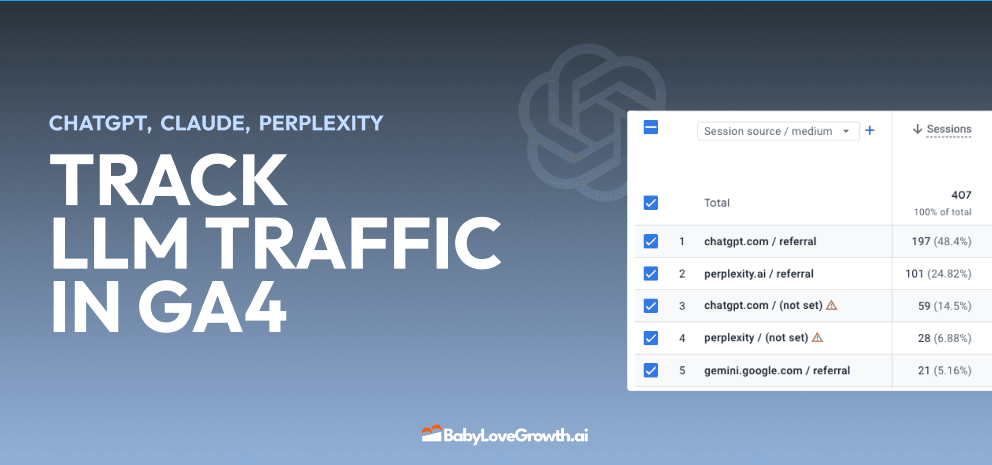
Track LLM Traffic in Google Analytics 4 (GA4)
Learn how to track and analyze traffic from AI sources like ChatGPT, Claude, Perplexity, and Google Gemini in Google Analytics 4. This step-by-step guide shows you how to set up custom filters to monitor AI-driven traffic and make data-driven decisions for your content strategy.
DylenMar 18, 2025
How to Humanize AI Text with Instructions
Learn practical techniques to make AI-generated content sound more natural and human. This guide covers active voice, direct addressing, concise writing, and other proven strategies to transform robotic text into engaging content.
DylenApril 7, 2025
Open AI Revenue and Statistics (2024)
Comprehensive analysis of OpenAI financial performance, user engagement, and market position in 2023. Discover key statistics including $20B valuation, $1B projected revenue, and 100M+ monthly active users.
DylenOctober 03, 2025