How to Engage With Your Audience for SEO Success


Finding your ideal customer can feel like searching in the dark without a clear plan. For small and medium-sized e-commerce brands, guessing what people want rarely leads to lasting results. When you rely on collecting audience data and segmenting groups by their real interests, you transform random content into meaningful connections. This guide lays out practical steps to clarify your audience’s needs, create engaging content, and use AI for smarter, more personalized outreach that actually drives visibility.
Table of Contents
- Step 1: Identify Your Target Audience Needs
- Step 2: Create Tailored, Interactive Content
- Step 3: Leverage AI For Personalized Outreach
- Step 4: Monitor Engagement Metrics And Feedback
- Step 5: Refine Strategies For Ongoing Improvement
Quick Summary
| Key Insight | Explanation |
|---|---|
| 1. Identify Audience Needs | Understand your target audience's demographics and pain points to create relevant SEO content. |
| 2. Create Interactive Content | Use quizzes and tools to engage users, increasing time spent on page and reducing bounce rates. |
| 3. Leverage AI for Personalization | Utilize AI to tailor outreach messages to specific audience interests and behaviors for better engagement. |
| 4. Track Engagement Metrics | Monitor user interactions and feedback to identify successful content and areas needing improvement. |
| 5. Continuously Refine Strategies | Regularly review performance and adapt content based on data trends and audience needs for sustained success. |
Step 1: Identify your target audience needs
Knowing who your customers are and what they're looking for is the foundation of SEO success. Without this clarity, you're essentially writing content in the dark, hoping someone finds it. This step transforms guesses into data-driven decisions that drive real traffic and engagement.
Start by collecting audience data across multiple channels. Look at your current customer base, website analytics, and social media followers. What demographics show up most often? Are they primarily business owners, marketing professionals, or something else? Understanding audience demographics and behaviors helps you create content that actually resonates.
Use surveys and direct feedback to uncover what your audience truly needs. Ask simple questions: What problems are you trying to solve? What questions do you search for online? What keeps you up at night? These answers reveal the actual pain points your content should address.
Analyze your current top-performing content to identify patterns. Which pages get the most traffic? Which ones have the lowest bounce rates? This data shows you what your audience already cares about.
Create detailed audience segments based on what you've discovered. Not all your customers have identical needs, and your content strategy shouldn't treat them that way. Different groups may search using different keywords and need different solutions.
Identify the specific search behaviors and motivations for each segment. Using search habits and analytics helps uncover motivations and popular content that aligns with what your audience actually wants to read. Monitor what keywords bring people to your competitors' sites. Check industry forums and social media to see what questions people are asking.
Document your findings in a simple audience profile. Include their age range, business type, main challenges, search habits, and preferred content formats. This becomes your roadmap for everything that follows.
Here's a comparison of audience segmentation approaches and their advantages:
| Segmentation Approach | Examples | Insights Unlocked | Strategic Benefit |
|---|---|---|---|
| Demographic Segmentation | Age, Location, Industry | Basic content targeting | Broad reach |
| Behavioral Segmentation | Site visits, Interactions | Reveals engagement and needs | High personalization |
| Psychographic Segmentation | Values, Goals, Motivations | Understands audience mindset | Deeper message resonance |
| Technographic Segmentation | Device, Platform Preferences | Adapts content format and delivery | Better user experience |
Your SEO strategy only works when it speaks directly to what your specific audience is searching for and trying to accomplish.
Key takeaways from this step:
- Compile demographics, behaviors, and motivations into clear audience profiles
- Survey existing customers about their pain points and search behaviors
- Analyze top-performing content to identify audience preferences
- Segment audiences into distinct groups with different needs
- Document search keywords and questions for each segment
Pro tip: Create a one-page audience profile document for each major segment and review it before writing any new content—this keeps your SEO efforts laser-focused on what actually matters to your customers.
Step 2: Create tailored, interactive content
Static blog posts are fine, but interactive content is what makes audiences stick around. Quizzes, calculators, assessments, and interactive tools transform passive readers into active participants who spend more time engaging with your brand.

Start by identifying what interactive format makes sense for your audience's needs. Think about the problems you uncovered in step one. What tool would help them solve those problems faster? A calculator for pricing estimates? A quiz to diagnose their main challenge? An interactive checklist they can actually use?
Interactive content like quizzes and calculators encourages users to participate actively, which increases how long they stay on your page and reduces bounce rates. This engagement signals to search engines that your content is valuable, improving your SEO performance.Tailor each interactive element to your specific audience segment. A tool for small business owners needs different features and language than one for enterprise clients. The more specific you make it, the more relevant it becomes to the people searching for solutions.
Incorporate your target keywords naturally into the interactive experience. If someone uses a calculator, what labels appear on the form? What results do they see? What copy accompanies those results? All of this should reflect the language your audience actually uses when searching.
Make the interactive element easy to use. Nobody will engage with a confusing tool. Test it yourself multiple times. Try it on mobile. Can a new visitor understand how to use it within 10 seconds? If not, simplify.
Create shareable results or outcomes. After someone completes your quiz or calculator, give them something worth sharing—a personalized report, a downloadable result, or a custom recommendation. This naturally encourages them to share the content, generating backlinks and expanding your reach.
Below is a summary of interactive content types and their engagement benefits:
| Interactive Format | Best Use Case | Audience Benefit | SEO Impact |
|---|---|---|---|
| Quiz | Self-assessment, Diagnostics | Personalized feedback | Increases dwell time |
| Calculator | Pricing, ROI, Estimates | Instant actionable insights | Boosts shareability |
| Checklist | Task completion, Readiness | Step-by-step guidance | Enhances repeated visits |
| Assessment Tool | Skill or Need Evaluation | Custom recommendations | Generates backlinks |
Interactive content wins because it provides immediate value while keeping visitors engaged long enough for search engines to recognize your content as high quality.
Quick checklist for interactive content:
- Choose a format that solves a real problem for your audience
- Tailor language and features to specific audience segments
- Optimize for mobile devices and quick comprehension
- Include target keywords throughout the experience
- Make results shareable or downloadable
- Test thoroughly before publishing
Pro tip: Start with one interactive tool that addresses your highest-value audience segment, measure how long visitors spend with it, and use that data to inform your next interactive content piece.
Step 3: Leverage AI for personalized outreach
One message to thousands doesn't work anymore. Customers expect communication tailored to their specific interests and behaviors. AI makes this personalization possible at scale, transforming generic outreach into resonant, individual experiences.
Start by collecting behavioral data on your audience. What content do they engage with? What products or topics interest them? Which email subject lines get opened? Which pages do they spend the most time on? This information becomes the foundation for AI-powered personalization.
Use AI tools to segment your audience based on behavior and interests rather than just demographics. Instead of "all business owners," you might have "small business owners in e-commerce searching for inventory solutions" or "mid-market companies looking to reduce support costs." These precise segments become targets for hyper-relevant messages.
AI enables marketers to analyze vast data sets and create tailored messages that resonate far better than generic campaigns. When your outreach reflects each audience segment's actual interests and pain points, open rates and conversion rates climb dramatically.Generate personalized email and content variations using AI. Instead of writing one email to everyone, create templates that AI fills with relevant details. Reference their industry, their specific challenge, or content they previously engaged with. Personalization signals that you understand their situation.
Test different messaging approaches with small segments first. What works for one audience type might fall flat with another. Let AI identify which variations generate better responses, then scale what actually works.
Monitor engagement metrics closely. Track open rates, click-through rates, and conversion rates for each personalized campaign. These metrics reveal which audience segments respond to what type of messaging, informing your next round of outreach.
Personalized outreach powered by AI cuts through the noise because every message speaks directly to what each person actually needs.
Key actions for AI-powered outreach:
- Collect and organize behavioral data from all customer touchpoints
- Segment audiences by behavior and interests, not just basic demographics
- Use AI to generate personalized message variations at scale
- Reference specific interests or previous engagement in your outreach
- Test variations with small segments before scaling
- Analyze response metrics to refine your approach
Pro tip: Start by personalizing your highest-value audience segment with AI-generated outreach, measure the response rate against your previous generic campaigns, and use that improvement data to justify expanding AI personalization across other segments.
Step 4: Monitor engagement metrics and feedback
You can't improve what you don't measure. Tracking engagement metrics and gathering feedback reveals what's working, what's falling flat, and where your audience needs support. This data becomes your roadmap for continuous optimization.
Start by identifying the right metrics to track. Don't measure everything—focus on metrics that actually connect to your SEO and business goals. Time on page, bounce rate, scroll depth, click-through rate, and conversion rate tell you whether your content resonates with visitors.
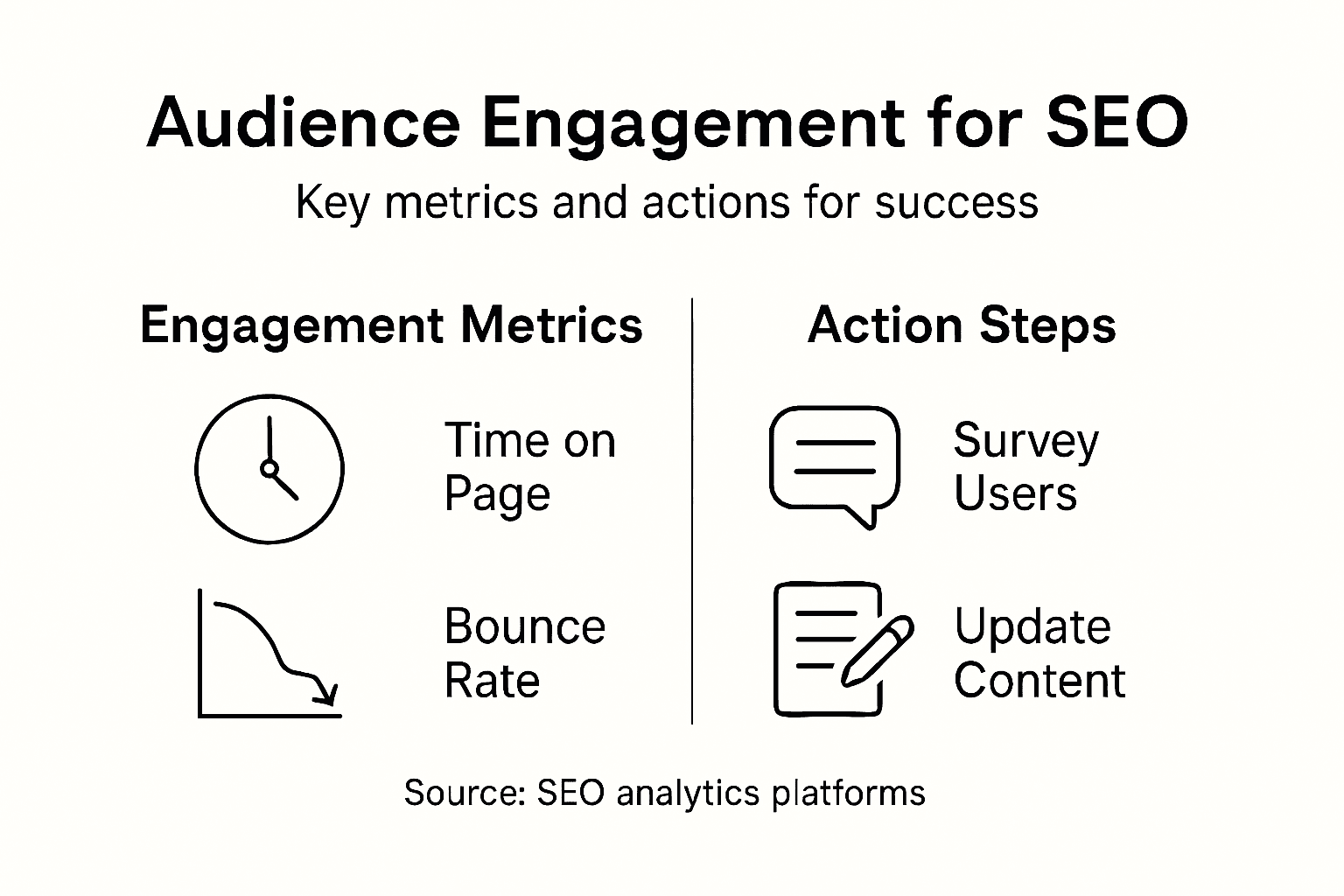
Set up analytics dashboards that display your key metrics in one place. Most SEO platforms offer built-in reporting that tracks traffic sources, user behavior, and conversion paths. Review these dashboards weekly to spot trends early.
Collect direct feedback from your audience through surveys, comments, and support conversations. Ask what content helps them most. Ask what topics they want covered. This qualitative feedback complements quantitative metrics and reveals nuances numbers alone can't show.
Analyze feedback for patterns. If five customers mention the same problem, that's a signal to create content addressing it. If multiple people struggle with a specific part of your tool or process, that's friction worth fixing.
Use metrics and feedback together to prioritize improvements. A page with high traffic but low conversion might need better calls to action. A page with low traffic might need better keyword optimization. Feedback helps explain what the metrics mean.
Test changes and measure impact. If you rewrite a page based on feedback, track whether it improves engagement and conversion. Let data guide your next iteration.
Engagement metrics show you what's working. Feedback explains why. Together, they create a feedback loop that drives continuous improvement.
Metrics to prioritize tracking:
- Time on page and scroll depth
- Bounce rate and exit pages
- Click-through rate from search results
- Conversion rate by traffic source
- User feedback and support inquiries
- Return visitor percentage
Pro tip: Set up a weekly metric review ritual where you spend 15 minutes identifying your top three engagement trends, then pair that data with one piece of user feedback to decide your next content or optimization priority.
Step 5: Refine strategies for ongoing improvement
SEO isn't a one-time effort. Search algorithms change, your competitors adapt, and your audience's needs evolve. Continuous refinement keeps your strategy aligned with these shifts, ensuring sustained visibility and engagement.
Start by reviewing performance data monthly. Look at which pages gained traffic, which lost visibility, and which keywords shifted positions. Identify patterns. Did certain content types perform better? Did specific topics resonate more with your audience?
Analyze what your highest-performing pages have in common. What keywords do they target? How long are they? What structure do they use? What engagement metrics do they achieve? These pages reveal your winning formula.
Update underperforming pages based on what's working. If a page ranks on page two for your target keyword, refresh the content, improve the structure, or add missing information. Regular updates to content structure and keywords improve discoverability and help pages climb search rankings.
Monitor search algorithm updates. Major platforms announce changes that affect ranking factors. When updates roll out, test how your pages respond. Did you gain or lose rankings? Adjust your strategy based on these signals.
Experiment with new content formats and topics. What worked last quarter might feel stale next quarter. Try different formats like video, interactive tools, or longer guides. Test new keyword opportunities in your niche. Let successful experiments guide your content calendar.
AI enables automatic keyword research and content optimization to keep your strategy aligned with user search intent. Tools can identify emerging keywords, suggest content improvements, and highlight optimization opportunities at scale.Document what you learn. Keep a simple record of what worked, what didn't, and why. This knowledge base becomes invaluable when planning next quarter's strategy.
Continuous improvement isn't about chasing every new trend. It's about systematically learning what resonates with your audience and doubling down on it.
Refinement checklist for ongoing improvement:
- Review monthly performance data and identify trends
- Update top-performing content to maintain rankings
- Refresh underperforming pages with new information
- Monitor search algorithm changes and adapt
- Test new content formats and keywords
- Use AI tools for keyword and optimization insights
- Document lessons learned for future reference
Pro tip: Create a quarterly "content audit" template that tracks your top 20 pages, their rankings, engagement metrics, and last update date—this makes it easy to spot which pages need refreshing and which are performing so well you should replicate their approach.
Unlock Your SEO Success with AI-Powered Audience Engagement
Engaging your audience with personalized, interactive content and smart outreach is the core challenge many marketers face when aiming for SEO success. This article highlights how understanding your audience’s needs, creating tailored content, and leveraging AI for personalization can dramatically boost your search rankings and user engagement. You want to transform data-driven insights into actionable strategies that truly connect with your visitors.
Babylovegrowth.ai offers an all-in-one solution built to simplify these exact pain points. Our AI-driven platform delivers high-quality, automated content optimized for Google and ChatGPT, backed by a personalized content plan designed just for your business. Whether you need hands-free SEO growth or want to supercharge your backlink strategy, we make it effortless to implement the article’s proven steps like audience segmentation and interactive content creation.
Ready to turn insights into impact today?
Discover how Babylovegrowth.ai can automate your SEO journey with AI-powered content strategies that speak directly to your audience. Start your free trial now and see how our easy-to-use platform helps you dominate search engines and engage your customers with precision. Visit our landing page to get started and explore solutions tailored for business owners, marketers, and SEO professionals.
Frequently Asked Questions
How can I identify my audience's needs for SEO content?
To identify your audience's needs, collect data from existing customers, website analytics, and social media interactions. Start by conducting surveys to ask specific questions about their challenges and search behaviors.
What types of interactive content can help engage my audience?
Engaging interactive content includes quizzes, calculators, and checklists that address your audience's particular problems. Create a quiz that diagnoses their needs or a calculator that estimates costs for your services.
How can I use AI for personalized outreach?
AI can analyze behavioral data to segment your audience based on their interests and tailor your messaging accordingly. Start by generating personalized email templates that reference users' specific needs and behaviors to achieve higher engagement rates.
What metrics should I track to monitor audience engagement?
Focus on key metrics like time on page, bounce rate, and conversion rate to gauge how well your content resonates with visitors. Set up analytics dashboards to review these metrics weekly for ongoing insights.
How often should I refine my SEO strategies?
Refine your SEO strategies monthly by reviewing performance data and adjusting underperforming pages. Update content based on audience feedback and changing search algorithms to maintain relevancy and visibility.
Recommended
Smart SEO,
Faster Growth!
Most Read Articles
Generative Engine Optimization (GEO)
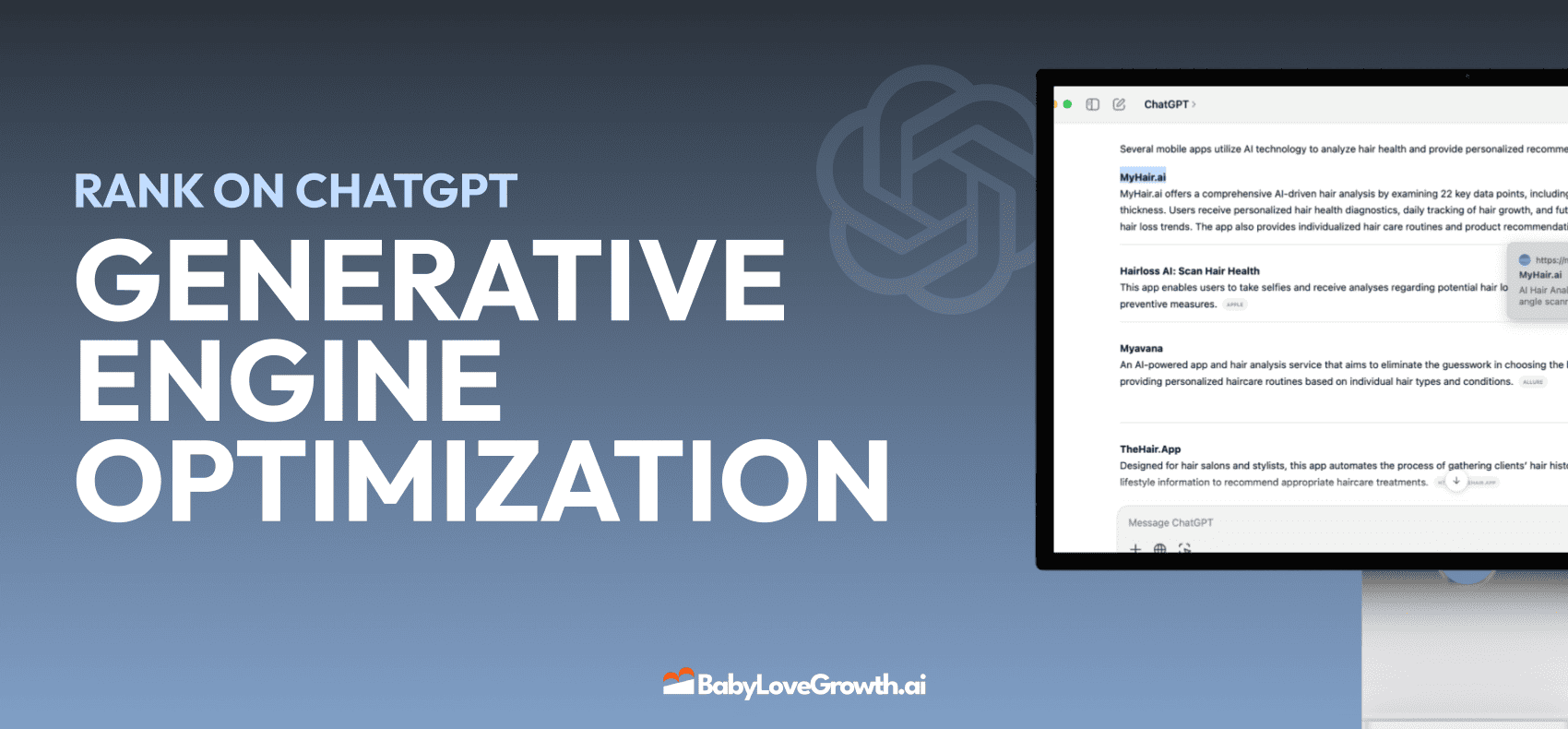
Learn how Generative Engine Optimization (GEO) helps your content rank in AI search engines like ChatGPT and Google AI. This comprehensive guide explains the differences between SEO and GEO, why it matters for your business, and practical steps to implement GEO strategies for better visibility in AI-generated responses.
DylenJan 18, 2025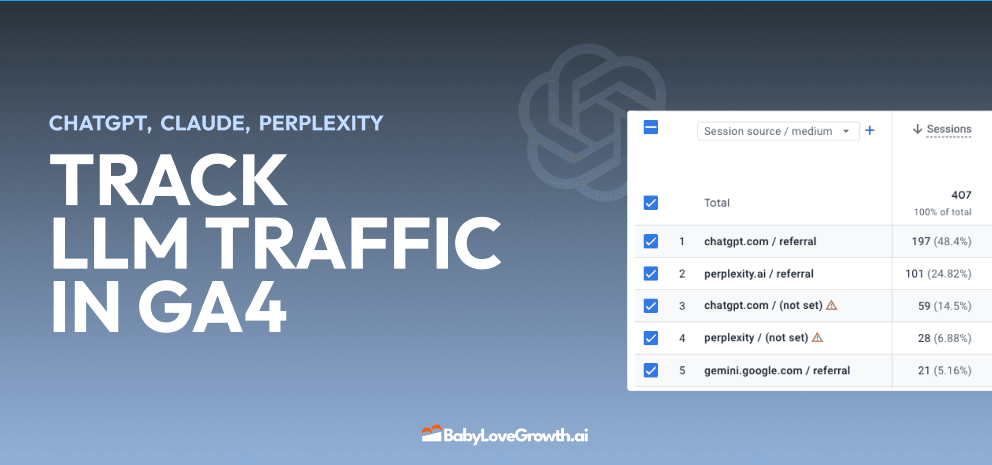
Track LLM Traffic in Google Analytics 4 (GA4)
Learn how to track and analyze traffic from AI sources like ChatGPT, Claude, Perplexity, and Google Gemini in Google Analytics 4. This step-by-step guide shows you how to set up custom filters to monitor AI-driven traffic and make data-driven decisions for your content strategy.
DylenMar 18, 2025
How to Humanize AI Text with Instructions
Learn practical techniques to make AI-generated content sound more natural and human. This guide covers active voice, direct addressing, concise writing, and other proven strategies to transform robotic text into engaging content.
DylenApril 7, 2025
Open AI Revenue and Statistics (2024)
Comprehensive analysis of OpenAI financial performance, user engagement, and market position in 2023. Discover key statistics including $20B valuation, $1B projected revenue, and 100M+ monthly active users.
DylenOctober 03, 2025