How authenticity in branding builds trust and growth


TL;DR:
- Authenticity influences 97% of consumer purchasing decisions and boosts loyalty and willingness to pay more.
- Genuine branding involves internal alignment, consistency, transparency, and real customer engagement.
- Performing authenticity as a campaign harms trust; lasting authenticity requires internal values and consistent actions.
Almost every purchase decision today is shaped by something most businesses never put in their budget: authenticity. 97% of consumers say authenticity influences their buying decisions, 85% actively buy from brands they see as real, and 70% are willing to pay more for those brands. That's not a soft marketing ideal. That's hard revenue on the line. For small and medium business owners, this is actually good news, because authenticity is one competitive advantage that money alone can't buy. This guide breaks down what authenticity truly means, what it does for your brand, and exactly how to build it into every customer touchpoint.
Table of Contents
- What does authenticity mean in branding?
- How authenticity drives customer trust and loyalty
- Common authenticity pitfalls and how to avoid them
- Building and signaling authenticity: Actionable strategies for SMBs
- What most brands get wrong about authenticity
- Take your brand authenticity and engagement further
- Frequently asked questions
Key Takeaways
| Point | Details |
|---|---|
| Authenticity builds trust | Customers are far more likely to trust and buy from brands that show real values. |
| Pitfalls can erode loyalty | Oversharing, inconsistency, or fake authenticity can quickly damage your reputation. |
| Start from within | Begin with internal value audits and ensure team-wide alignment before broadcasting your brand story. |
| Practical steps matter | Storytelling, feedback loops, and honest communication create real, lasting engagement. |
What does authenticity mean in branding?
Authenticity is one of those words that gets used so often it starts to lose meaning. People say "just be real" without explaining what that actually looks like for a business trying to grow. So let's be specific.
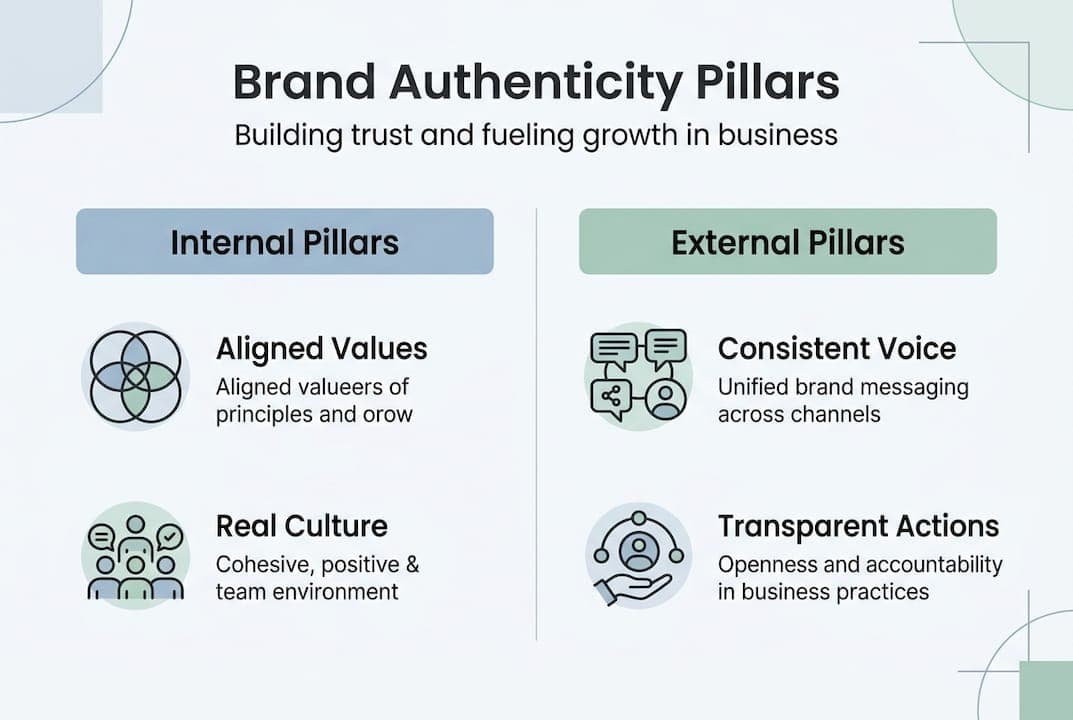
Authentic branding isn't just about being honest or avoiding lies. It involves four interconnected pillars: internal alignment (your team believes in what you say), consistent messaging (you say the same things across channels), transparency (you're open about your processes and even your mistakes), and genuine customer engagement (you listen and respond like a real person, not a script).A lot of brands treat authenticity as an image problem. They try to appear authentic through carefully worded copy or polished "behind the scenes" videos. That's image management, not authenticity. Real authenticity starts on the inside and works outward. If your team doesn't believe in your values, your customers will eventually sense the disconnect.
SMBs have a real structural advantage here. You're closer to your customers, your decisions are faster, and your founders are often still visible and involved. That makes it genuinely easier to show what you stand for, admit when something goes wrong, and have real conversations instead of corporate non-answers.
Here's how authentic branding compares to traditional image management:
| Dimension | Authentic branding | Image management |
|---|---|---|
| Starting point | Internal values | External perception |
| Consistency | Driven by belief | Driven by style guides |
| Transparency | Embraces imperfection | Hides behind polish |
| Customer engagement | Real dialogue | Managed responses |
| Long-term effect | Trust and loyalty | Fragile reputation |
To make the four pillars of authenticity more concrete, here's what each one looks like in practice:
- Internal alignment: Your team can describe your brand values without reading from a document.
- Consistent messaging: Your Instagram voice matches your email tone and your in-store experience.
- Transparency: You tell customers about a delay before they have to ask.
- Genuine engagement: You respond to criticism publicly, thoughtfully, and without defensiveness.
For a deeper look at how these pillars apply to your content, the content authenticity guide on our blog walks through the nuances of applying this across formats. And if you're building from scratch, brand voice development is a practical starting point to get your tone right before you scale.
Pro Tip: Ask five members of your team to each write three words that describe your brand values. If you get 15 different answers, your internal alignment needs work before anything else.
How authenticity drives customer trust and loyalty
Now that we understand authenticity's meaning, let's see the measurable impact it has on customers.
Trust is the mechanism that connects authenticity to revenue. When customers perceive your brand as genuine, they don't just feel good about you. They buy more, buy more often, and tell their friends. A rigorous consumer study of 300 participants found that brand authenticity has a strong direct effect on trust (β=0.54, p<0.001) and that trust in turn drives loyalty (β=0.47, p<0.001). These aren't soft correlations. These are statistically significant relationships tested under controlled conditions.
What does that mean in plain business terms? When customers trust your brand, they're more likely to forgive mistakes, stick around through price increases, and actively recommend you to others. That advocacy is worth far more than any paid acquisition campaign.

Here's a snapshot of how consumer behavior shifts with perceived brand authenticity:
| Consumer behavior | Low authenticity perception | High authenticity perception |
|---|---|---|
| Repeat purchase rate | Below average | Significantly higher |
| Willingness to recommend | Occasional | Frequent and proactive |
| Price sensitivity | High | Lower (will pay a premium) |
| Response to brand mistakes | Harsh criticism | More likely to forgive |
| Emotional connection | Transactional | Relational |
The ripple effects go even further. Loyal customers become advocates, and advocates do your marketing for you. Word of mouth, user-generated content, and positive reviews are all authenticity-fueled assets that compound over time. One satisfied, trust-bonded customer can generate referrals worth multiples of their own lifetime value.
For SMBs, this is especially powerful because your growth doesn't have to depend entirely on advertising spend. When your brand authority is rooted in genuine trust, organic word of mouth and search visibility reinforce each other.
Here's what the trust-loyalty cycle looks like when authenticity is present:
- Customers experience genuine engagement and transparent communication.
- Trust forms because actions consistently match stated values.
- Loyal customers return more frequently and become less price sensitive.
- Advocates share their experience, attracting new customers who already have a positive expectation.
- New customers arrive pre-disposed to trust, which lowers the cost and effort of conversion.
That cycle doesn't start with a marketing budget. It starts with a genuine commitment to being the brand you say you are.
Common authenticity pitfalls and how to avoid them
Authenticity also has pitfalls. Here's what to watch out for and how to stay on track.
The most dangerous trap is performative authenticity: the appearance of realness without the actual substance behind it. This happens when brands launch "raw and honest" social media posts that are actually scripted, or publicly commit to social causes purely for press coverage without changing any internal practices. Performative authenticity doesn't just fail to build trust. It actively destroys it when customers see through the performance.
Oversharing is another subtle trap. Some business owners, in their effort to be transparent, share personal struggles or operational chaos in a way that creates anxiety rather than connection. Transparency should be purposeful and relevant. Sharing a production delay with your customers is transparency. Posting about your personal burnout every week is oversharing.
AI-generated content sits in particularly complicated territory right now. Automation tools are genuinely useful for scaling content production, but research shows that even when brands disclose that content is AI-generated, customer trust can still take a hit. The risk isn't automation itself. It's using automation in a way that strips out the human voice entirely. If your emails, social posts, and blog articles all sound like they came from a template, customers notice. See how to navigate this well in our guide to AI content and brand loyalty.
The most common authenticity mistakes fall into a predictable pattern:
- Making claims your operations don't support. Saying you're "customer obsessed" while having a 5-day email response time.
- Jumping on social causes without internal commitment. Posting a diversity statement while making zero structural changes.
- Changing your voice by channel. Formal on LinkedIn, casual on Instagram, robotic on email. Inconsistency reads as inauthenticity.
- Responding defensively to criticism. Nothing signals inauthenticity faster than a brand that can't handle public feedback gracefully.
- Using authenticity as a campaign. Running a "here's the real us" marketing push that disappears after launch.
"Brands that perform authenticity without living it are just building a more fragile version of the same old marketing problem." The solution is structural change, not surface-level storytelling.
Review your online content authenticity regularly by asking a simple question: "Does this content reflect how we actually operate, or just how we want to be seen?"
Pro Tip: Set a quarterly reminder to audit your last 30 days of customer communications. Look for gaps between what you say your brand stands for and how you actually responded to complaints, delays, or difficult feedback.
Building and signaling authenticity: Actionable strategies for SMBs
Knowing the pitfalls, here's how you can intentionally build and demonstrate real authenticity at every touchpoint.
The foundation comes from the inside. Starting with internal audits is not optional. You need to clarify what your brand actually values before you communicate any of it outward. This means writing down your core values in specific, observable terms, not vague aspirations. "We value honesty" is too abstract. "We tell customers about problems before they ask" is concrete and testable.
Authenticity is also best expressed as something uniquely yours. A useful test from brand strategists: ask if only your brand could have made this piece of content or sent this message. If the answer is no, it's not authentic. It's just content.
Here's a step-by-step framework to build authentic branding into your business:
- Audit your current brand messaging. Pull together your website, social profiles, emails, and customer service scripts. Compare them to your stated values. Where are the gaps?
- Define your brand voice in specific terms. Go beyond adjectives. Document actual examples of on-brand and off-brand language so your whole team can write consistently.
- Train every customer-facing team member. Authenticity breaks down when customer service says one thing and marketing says another. Alignment requires investment in internal training, not just communications.
- Build in customer feedback loops. Real authenticity means listening as much as talking. Use surveys, direct messages, and reviews to understand how customers actually perceive your brand.
- Monitor for drift. Brands become inauthentic gradually, not overnight. Set up regular checks to ensure your messaging still matches your operations.
Beyond process, storytelling is one of the most powerful authenticity signals available to SMBs. Real stories with real outcomes outperform polished brand statements every time. Read more about effective brand storytelling techniques and how to use storytelling for SEO to drive both trust and visibility at the same time.
Key practices that consistently build authentic signals with customers:
- Share the origin story of why you started the business, including the hard parts.
- Feature real customers in your content with genuine quotes and outcomes.
- Acknowledge product or service limitations honestly before a customer discovers them.
- Publicly respond to negative reviews with accountability, not defensiveness.
- Celebrate team members and show the humans behind your brand regularly.
Finally, brand consistency for growth is the long game. Authenticity that only shows up in campaigns doesn't count. It has to be present in your packaging, your support interactions, your refund policy, and your social comments.
What most brands get wrong about authenticity
Most brands treat authenticity as a positioning decision. They ask "how do we want to appear?" instead of "who are we actually?" That framing gets everything backwards.
Curated authenticity is the industry term for filtering genuine expression strategically to maximize brand recall. That sounds sophisticated, but what it describes is a performance. Authenticity isn't a strategy you implement. It's the result of sustained alignment between what you believe, what you say, and what you do. You can't plan your way to being genuine.The brands that get burned are those that launch authenticity as a campaign. They get the content right, the aesthetic right, maybe even the messaging right. But when a real crisis happens, such as a product recall, a PR mistake, or a difficult public moment, the performance collapses because there was nothing real underneath it.
The uncomfortable question to ask your team is this: could only your brand have made this message? If you swapped your logo for a competitor's on your last three campaigns and nothing felt wrong, you're doing branding, not authenticity. Our brand consistency insights explore how structural consistency and genuine identity reinforce each other over time. The brands that build lasting trust aren't the ones with the best authenticity campaigns. They're the ones where authenticity never needed to be a campaign at all.
Take your brand authenticity and engagement further
Authenticity needs to show up consistently across every channel, and that's where many SMBs hit a practical wall. The daily grind of creating content, building visibility, and maintaining a consistent brand voice can crowd out the genuine engagement that actually builds trust.
That's exactly the problem Babylovegrowth.ai was built to solve. By automating the routine SEO and content work through our SEO automation platform, you free up time and attention for the authentic engagement that only humans can do. Our organic traffic growth tool helps your real brand voice reach more people through Google and ChatGPT rankings, and our automated backlink exchange builds the authority signals that make your authenticity visible at scale. Explore a free trial and see how automation supports, not replaces, genuine brand building.
Frequently asked questions
How can SMBs check if their brand is truly authentic?
Conduct internal audits, clarify your core values, and compare how customers actually describe your brand versus how you describe it in your marketing.
Does using AI-generated content always hurt authenticity?
AI content reduces trust when it replaces genuine human expression entirely, so always layer in human oversight and keep emotionally significant communications personal.
What's the biggest risk of performative authenticity?
Performative efforts backfire when customers see the gap between stated values and actual behavior, which erodes trust far more than no authenticity claim would have.
Why are SMBs often trusted as more authentic than bigger brands?
SMBs naturally show real values through personal interactions, founder visibility, and the transparency small businesses demonstrate around mistakes and decisions, which resonates deeply with customers seeking real connection.