High-quality content: the key to organic growth in 2026


TL;DR:
- High-quality SEO content in 2026 focuses on relevance, depth, clarity, accuracy, engagement, and trust signals.
- Building topic clusters with structured briefs and internal linking enhances scalability and authority.
- AI tools serve as research assistants to speed up production while human oversight ensures quality and nuance.
Most digital marketers assume publishing more content automatically means better rankings. That logic made sense a decade ago, but SEO content optimization has shifted dramatically. Search engines, including AI-driven platforms like ChatGPT and Perplexity, now reward relevance and depth over raw volume. For small to mid-sized businesses competing against larger brands with bigger budgets, this shift is actually good news. You don't need to publish daily to win organic traffic. You need to publish well. This article walks you through what high-quality content looks like in 2026, proven frameworks for creating it at scale, how AI fits into your workflow, and how to measure real results.
Table of Contents
- What defines high-quality content for SEO?
- Proven frameworks for producing high-quality content at scale
- Leveraging AI to enhance content quality and workflow
- Measuring the impact of high-quality content on organic visibility
- What most SMBs get wrong about content quality (and how to fix it)
- Take your content strategy further with AI-powered solutions
- Frequently asked questions
Key Takeaways
| Point | Details |
|---|---|
| Quality beats quantity | Modern SEO strategies reward in-depth, intent-driven content over high volume posting. |
| Frameworks drive consistency | Adopting topic clusters and structured checklists helps SMBs produce repeatable, high-quality results. |
| AI multiplies output | Leveraging AI tools automates research and optimization, letting teams focus on strategic excellence. |
| Measure and adapt | Tracking performance metrics ensures your content delivers visible organic growth and ROI. |
What defines high-quality content for SEO?
High-quality content isn't just well-written copy. It's content that answers a specific question better than anything else on the page one results. That definition has grown more demanding as content relevance and depth have become the primary signals search engines use to rank pages. Intent alignment matters just as much as keyword placement.
In 2026, AI search engines like Claude and Perplexity don't just scan for keywords. They evaluate whether a piece of content genuinely satisfies the searcher's underlying need. A 2,000-word article stuffed with variations of the same phrase won't cut it anymore. Context-rich, well-structured content that addresses follow-up questions and related subtopics is what gets surfaced.
For SMBs, understanding content quality for SEO means focusing on a few core attributes:
- Relevance: The content directly matches what the searcher is looking for, not just the keyword they typed.
- Depth: It covers the topic thoroughly, including nuances, edge cases, and practical applications.
- Clarity: Complex ideas are explained simply. Readers don't need a glossary to follow along.
- Accuracy: Every claim is backed by credible data or real-world experience.
- Engagement: The writing holds attention through examples, varied sentence structure, and a clear point of view.
- Trust signals: Author credentials, citations, and internal consistency all signal authority to both readers and search engines.
Shallow content fails not because it's short, but because it leaves the reader with unanswered questions. Search engines are increasingly good at detecting that gap.
The practical takeaway here is that quality is a measurable standard, not a vague aspiration. When you audit your existing content against these six attributes, you'll quickly spot where your pages are losing ranking potential.
Proven frameworks for producing high-quality content at scale
Knowing what quality looks like is one thing. Building a repeatable system to produce it consistently is another challenge entirely. The good news is that SMB content methodologies have matured significantly, and a few frameworks now stand above the rest.
The biggest shift is moving from one-off posts to topic clusters. Instead of publishing random articles on loosely related subjects, you build a pillar page around a broad topic and surround it with supporting content that links back. This structure signals topical authority to search engines and keeps readers navigating within your site longer.

| Old approach | New approach |
|---|---|
| Publish whenever inspiration strikes | Follow a structured 30-day content plan |
| Target isolated keywords | Build topic clusters around pillar pages |
| Write based on assumptions | Use intent mapping and content briefs |
| Measure success by word count | Measure by engagement and organic sessions |
| Internal linking as an afterthought | Internal linking built into every brief |
A solid content cluster strategy follows five repeatable steps:
- Identify your pillar topic. Choose a broad subject your audience cares about and that you have genuine authority on.
- Map supporting topics. List 8 to 12 subtopics that relate to the pillar. Each becomes its own article.
- Draft detailed content briefs. A brief includes target keyword, intent, outline, word count, and internal linking targets. Content brief generation tools can accelerate this step significantly.
- Schedule content. Commit to 2 to 4 pieces per month. Consistency beats bursts of activity followed by silence.
- Link internally. Every supporting article links to the pillar, and the pillar links back to each cluster piece.
Pro Tip: Before publishing any piece, run it through a content marketing checklist that covers intent alignment, readability, internal links, meta description, and structured data. Five minutes of review prevents months of underperformance.
This framework makes scaling feasible because every team member follows the same process. Quality becomes the output of the system, not just the talent of individual writers.
Leveraging AI to enhance content quality and workflow
Once your framework is solid, AI becomes a genuine force multiplier rather than a shortcut. AI-driven content strategies are helping SMBs produce better content faster without the bloated agency retainers that used to be the only alternative.
The key is knowing which tasks AI handles well and which still need a human hand. Understanding AI in content strategy means treating AI as a research assistant and workflow accelerator, not a ghostwriter you never review.
| Task | AI handles it | Human oversight required |
|---|---|---|
| Topic discovery and clustering | Yes | Light review |
| Content brief generation | Yes | Approval before writing |
| Keyword optimization suggestions | Yes | Context check |
| First-draft outlines | Yes | Heavy editing |
| Brand voice and tone | No | Full human ownership |
| Expert opinion and real examples | No | Full human ownership |
| Final quality review | No | Always human |
For SMBs, the benefits of integrating content marketing automation into your workflow are concrete:
- Time savings: Reduce research time by up to 60% using AI-assisted topic clustering.
- Accuracy: AI tools surface keyword data and search trends faster than manual research.
- Scale: Produce more briefs and outlines without adding headcount.
- Consistency: Standardized prompts and templates keep quality stable across different writers.
Pro Tip: Never publish AI-generated content without a human review pass. AI is excellent at structure and coverage, but it misses brand-specific nuance, real customer pain points, and the kind of earned authority that builds long-term trust with readers.
The winning formula is a hybrid workflow: AI handles the heavy lifting on research and structure, while your team focuses on insight, voice, and accuracy. That combination is what separates content that ranks from content that just exists.
Measuring the impact of high-quality content on organic visibility
Strategy and workflow only matter if they produce measurable results. The good news is that publishing 2 to 4 quality pieces monthly, combined with strong internal linking, produces trackable organic gains within a predictable window.
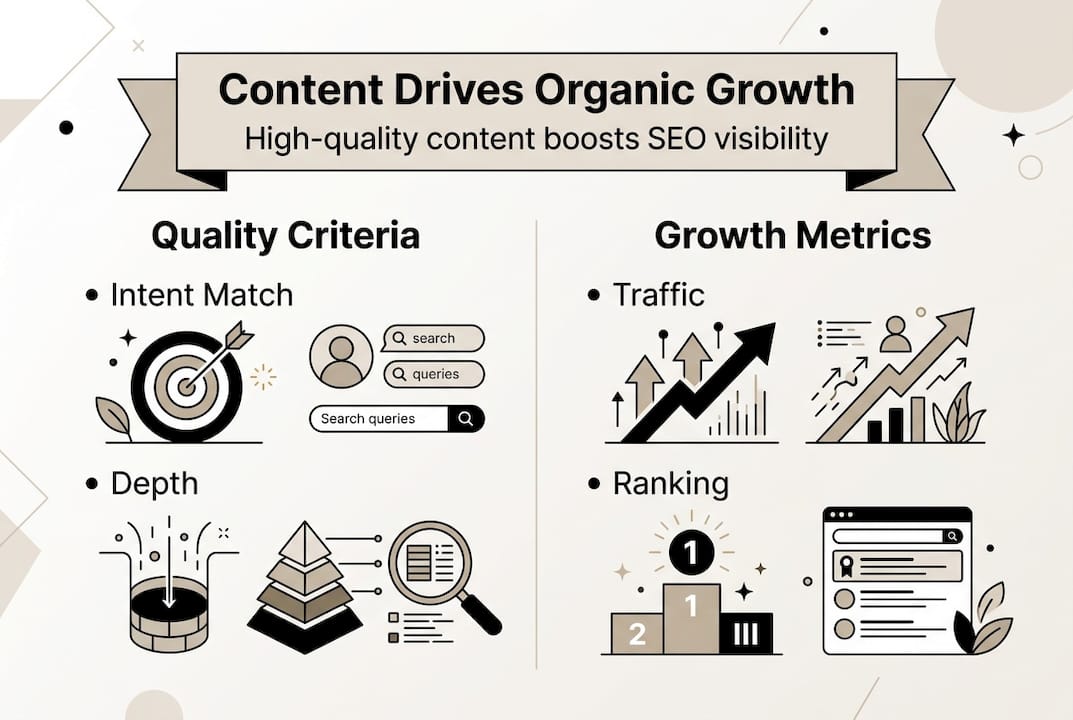
Most SMBs start seeing meaningful movement in rankings and traffic between 6 and 12 months of consistent publishing. That timeline feels long until you realize the alternative is paying for traffic indefinitely. Organic visibility compounds over time in a way that paid channels simply don't.
The metrics worth tracking fall into four categories:
- Organic traffic: Total sessions from unpaid search, tracked weekly in Google Analytics.
- Keyword rankings: Position tracking for your target terms in Google Search Console.
- Engagement: Time on page, scroll depth, and bounce rate signal whether content is resonating.
- Conversions: Form fills, demo requests, or purchases attributed to organic sessions.
- Return visitors: A growing share of returning users signals that your content is building genuine audience loyalty.
The tools that make this measurable without a full analytics team include Google Analytics 4, Google Search Console, and AI-based audit platforms that flag technical issues and content gaps automatically.
Pro Tip: Run a quarterly content audit. Pull your lowest-performing pages by organic traffic, identify the intent gap or thin coverage, and refresh them with updated data and expanded depth. Refreshed pages often recover rankings faster than publishing new content from scratch.
For practical inspiration, reviewing content marketing examples from brands in similar verticals can reveal which formats and topics drive the most organic sessions. Pair that with a structured content calendar plan and your measurement cadence becomes a growth engine rather than a reporting chore.
What most SMBs get wrong about content quality (and how to fix it)
Here's the uncomfortable truth: most SMBs treat content quality as a production problem when it's actually a strategy problem. They obsess over word counts, keyword density, and publishing frequency while ignoring the one question that matters most: does this piece genuinely help the person searching for it?
The brands that win organic traffic consistently are the ones that invite real feedback before publishing. Show a draft to a customer, a sales rep, or someone unfamiliar with your product. If they finish reading with unanswered questions, the content isn't ready. That feedback loop is the most underused quality filter in content marketing.
Publishing more mediocre content doesn't compound. Publishing fewer, genuinely useful pieces does.
Another pattern we see repeatedly: SMBs map content to keywords but not to buyer journey stages. A prospect who just discovered their problem needs different content than someone comparing vendors. Layering that context into your briefs transforms generic articles into conversion assets. For actionable content marketing tips that address this gap, the fix is simpler than most teams expect. Start by tagging every planned piece with an awareness, consideration, or decision label before writing begins.
Take your content strategy further with AI-powered solutions
Understanding quality frameworks is the first step. Executing them consistently at scale is where most SMB teams hit a wall. Babylovegrowth.ai is built specifically to close that gap.

The platform combines a keyword discovery platform with automated keyword clustering so you can build topic clusters in minutes rather than days. Every plan includes daily SEO articles, structured data markup, and internal linking built into each piece automatically. When you're ready to audit what's already on your site, the AI SEO audit surfaces technical gaps and content opportunities in one report. It's the infrastructure that turns your content strategy from a manual effort into a scalable growth system.
Frequently asked questions
What is considered high-quality content for SEO in 2026?
High-quality content aligns with user intent, provides authoritative depth, and is optimized for both humans and AI search engines. It answers the searcher's full question, not just the surface-level keyword.
How often should SMBs publish high-quality content?
Publishing 2 to 4 well-crafted pieces per month is the recommended cadence for sustainable organic growth. Consistency over time matters more than sporadic high-volume output.
How does AI improve content creation for small businesses?
AI tools for SMBs accelerate topic discovery, content brief generation, and internal linking, letting teams focus more on quality and less on manual tasks. The result is faster production without sacrificing depth or accuracy.
What KPIs should I track to measure content quality impact?
Monitor organic traffic, keyword rankings, engagement metrics like time on page, and conversion rates to assess your content's effectiveness. Tracking return visitor rates also reveals whether your content is building lasting audience trust.
Recommended
Smart SEO,
Faster Growth!
Most Read Articles
Generative Engine Optimization (GEO)
Learn how Generative Engine Optimization (GEO) helps your content rank in AI search engines like ChatGPT and Google AI. This comprehensive guide explains the differences between SEO and GEO, why it matters for your business, and practical steps to implement GEO strategies for better visibility in AI-generated responses.
DylenJan 18, 2025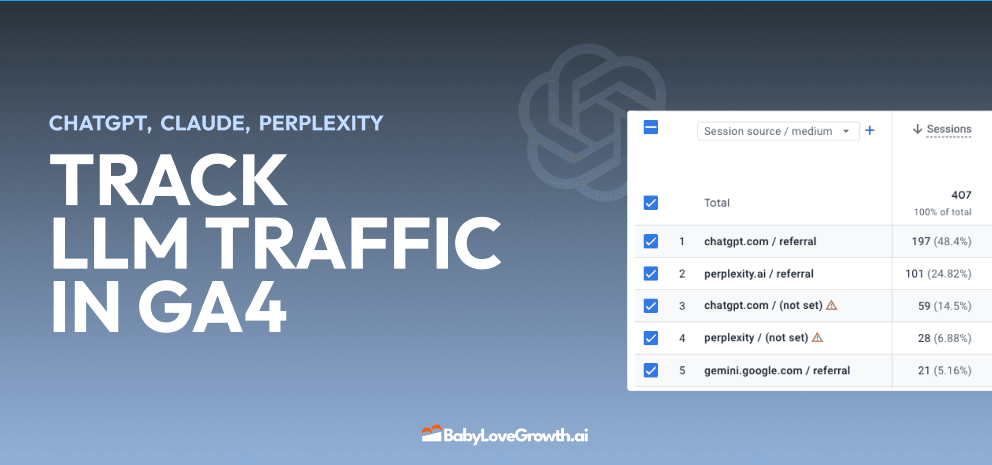
Track LLM Traffic in Google Analytics 4 (GA4)
Learn how to track and analyze traffic from AI sources like ChatGPT, Claude, Perplexity, and Google Gemini in Google Analytics 4. This step-by-step guide shows you how to set up custom filters to monitor AI-driven traffic and make data-driven decisions for your content strategy.
DylenMar 18, 2025
How to Humanize AI Text with Instructions
Learn practical techniques to make AI-generated content sound more natural and human. This guide covers active voice, direct addressing, concise writing, and other proven strategies to transform robotic text into engaging content.
DylenApril 7, 2025
Open AI Revenue and Statistics (2024)
Comprehensive analysis of OpenAI financial performance, user engagement, and market position in 2023. Discover key statistics including $20B valuation, $1B projected revenue, and 100M+ monthly active users.
DylenOctober 03, 2025