Engaging content boosts SEO: 41-55% bounce rate impact


TL;DR:
- Google now prioritizes user engagement signals like bounce rate and dwell time for rankings.
- Creating content that matches search intent and is easily readable boosts SEO and conversions.
- Combining human expertise with AI tools accelerates content quality, relevance, and business results.
Most business owners and marketers still treat SEO like a puzzle where keywords are the only pieces that matter. That thinking is costing you rankings. Google now measures how users behave on your pages, not just what words appear on them. User engagement signals like bounce rate and dwell time directly influence where you rank. If visitors land on your page and leave in seconds, no amount of keyword stuffing will save you. This guide breaks down exactly why engaging content is the real driver of SEO success in 2026, and how you can build it systematically to grow traffic, leads, and revenue.
Table of Contents
- Why engagement matters for SEO and business growth
- Core elements of truly engaging content
- How engaging content fuels AI-generated SEO strategies
- Practical steps to craft and optimize engaging content
- Our take: Why most engagement advice falls short
- Take your content engagement and SEO to the next level
- Frequently asked questions
Key Takeaways
| Point | Details |
|---|---|
| Engagement boosts SEO | Lower bounce rates and longer dwell times signal quality to search engines and improve rankings. |
| Quality over quantity | Creating fewer, highly engaging posts is more effective than publishing high volumes of low-value content. |
| AI plus human touch wins | AI-generated content performs best when paired with unique human insights and value. |
| Measure and adapt | Track core metrics like dwell time and adjust your content to sustain user interest. |
| Link to outcomes | Tie engaging content to business goals with clear calls to action for real impact. |
Why engagement matters for SEO and business growth
Google has quietly shifted from a keyword-matching engine to a behavior-reading one. It watches what users do after they click your link. Do they stay and read? Do they scroll, click, and explore? Or do they hit the back button within seconds? These actions send powerful signals about whether your content deserves to rank.
"Engaging content boosts SEO rankings indirectly through improved user signals like lower bounce rates, longer dwell time, and higher engagement time, signaling relevance to Google."
The numbers are specific. Average bounce rates sit between 41 and 55 percent, and anything under 55 percent is considered healthy. Blog dwell time should ideally land between 2 and 4 minutes. Fall below those benchmarks and Google interprets your content as unhelpful, pushing it down the results page.
Low engagement does not just hurt rankings. It kills your pipeline. A visitor who bounces in 10 seconds never sees your offer, never clicks your CTA, and never converts. Strong content engagement strategies compound over time, building authority and driving leads simultaneously.
Here is what the data tells us about engagement-first versus technical-only SEO:
| Factor | Technical SEO only | Engagement-first SEO |
|---|---|---|
| Ranking signal | Crawlability, backlinks | User behavior + backlinks |
| Visitor retention | Low | High |
| Lead generation | Indirect | Direct |
| Long-term growth | Plateaus | Compounds |
| AI search visibility | Limited | Strong |
The businesses winning in search right now are not the ones with the most optimized meta tags. They are the ones whose content makes readers stop, think, and act. Learning how to engage your audience for SEO is no longer optional. It is the strategy.
Key reasons engagement drives both SEO and business growth:
- Lower bounce rates signal content relevance to Google's algorithm
- Longer sessions increase the chance of a visitor converting
- Repeat visitors build brand trust and direct traffic over time
- High engagement pages earn more natural backlinks from other sites
- Engaged readers share content, multiplying your organic reach
If you want a practical starting point, the steps to write engaging content give you a proven framework to work from.
Core elements of truly engaging content
Engagement does not happen by accident. It is built from specific, repeatable components that satisfy both human readers and search engine algorithms. Understanding these building blocks is what separates content that ranks from content that disappears.

The most important factor is search intent. Every piece of content must answer the exact question a user typed into Google, nothing more and nothing less. If someone searches for "how to reduce bounce rate," they want practical steps, not a history of bounce rate as a concept. Mismatching intent is the fastest way to kill engagement before it starts.
Readability is the second pillar. 43% of marketers prioritize clear headings and visuals because readers scan before they read. If your page looks like a wall of text, most visitors leave. Short paragraphs, subheadings, bold key phrases, and images all reduce friction and keep readers moving through your content.
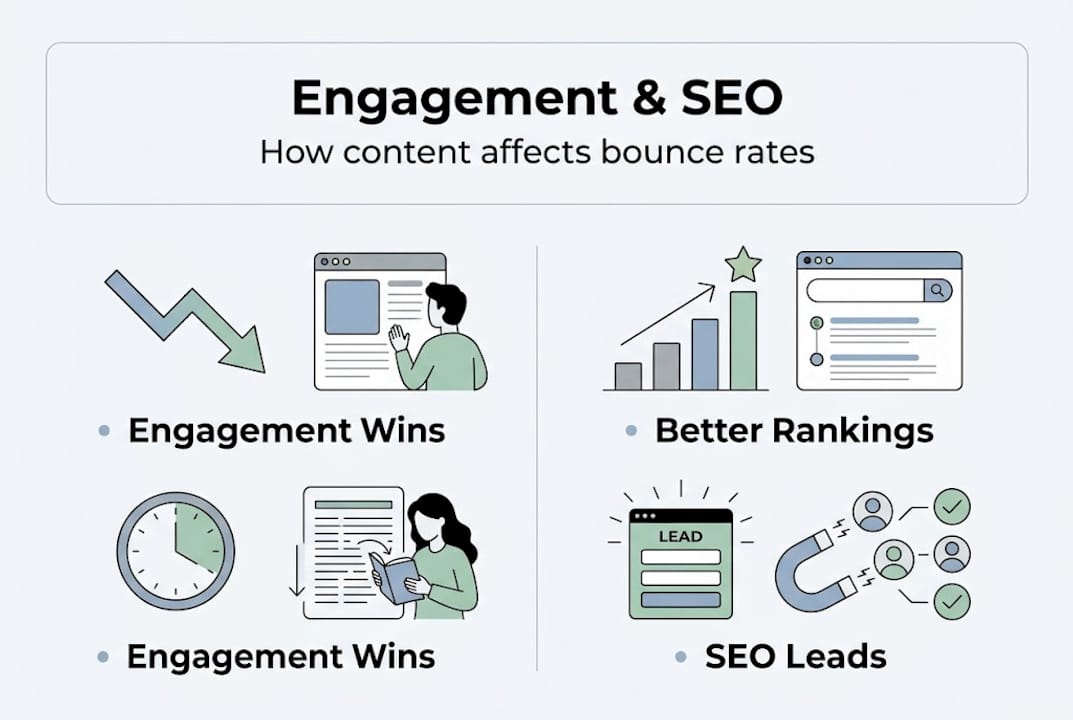
Freshness matters more than ever in 2026. 90% of AI search activity focuses on content published or updated between 2023 and 2025. Stale content loses visibility fast. Updating older posts with new data and insights is one of the highest-ROI moves you can make.
Here is a quick breakdown of what each core element delivers:
| Element | What it does | Impact on engagement |
|---|---|---|
| Search intent match | Answers exactly what users want | Reduces bounce rate |
| Clear structure | Makes scanning easy | Increases dwell time |
| Fresh information | Stays relevant in AI search | Boosts AI visibility |
| Original perspective | Builds trust and authority | Drives shares and links |
The steps to build engaging content:
- Research the top-ranking pages for your target keyword
- Identify gaps or angles those pages miss
- Structure your content with clear H2 and H3 headings
- Add visuals, tables, or examples to break up text
- Update every post at least once per year with fresh data
Pro Tip: Before creating new content, audit your existing posts. Refreshing a page that already has some traffic and backlinks is faster and often more effective than starting from scratch. Focus on boosting user engagement on pages that are close to ranking in the top 5.
Original perspective is the final, often overlooked element. Recycled information that restates what every other article says adds no value. Readers and AI systems alike reward content that offers a genuinely different angle or insight.
How engaging content fuels AI-generated SEO strategies
AI content tools have made it faster and cheaper to produce articles at scale. But speed without substance is a trap. Raw AI output, without human shaping, tends to be generic. It hits the right keywords but misses the nuance, experience, and specificity that make readers trust what they are reading.
Google's E-E-A-T framework (Experience, Expertise, Authoritativeness, Trustworthiness) is the filter that separates useful AI-assisted content from content that tanks. AI content ranks when it meets E-E-A-T standards, but raw, unedited AI output consistently fails that test. The human layer is not optional.
That said, AI tools are genuinely powerful when used correctly. They accelerate ideation, surface related topics, and help structure drafts. The key is treating AI as a starting point, not a finished product. Every piece needs a human to inject real experience, specific examples, and a clear point of view.
Benefits of combining AI tools with engagement-focused strategy:
- Faster content production without sacrificing depth
- Consistent publishing frequency, which Google rewards
- Better keyword coverage across topic clusters
- Scalable internal linking across your content library
- More time for human writers to focus on quality and originality
The other critical piece is connecting content to business outcomes. Informational content builds awareness, but it needs to lead somewhere. Crafting captivating content means every article should have a logical next step for the reader, whether that is a related post, a free tool, or a direct offer.
Pro Tip: Use AI to generate 5 to 10 headline options and outline variations for a topic. Then pick the strongest angle and write the actual content yourself, or heavily edit the AI draft. This hybrid approach is what content quality for SEO looks like in practice.
The businesses seeing the best results are not choosing between AI and human writing. They are layering both, using AI for speed and humans for substance.
Practical steps to craft and optimize engaging content
Knowing what makes content engaging is one thing. Building a repeatable system for it is another. Here is a step-by-step process you can apply starting today.
- Define your audience and intent. Before writing a single word, confirm who you are writing for and what specific problem they need solved. Vague audiences produce vague content.
- Research and outline. Use search results, forums, and customer questions to find the real angles your audience cares about. Build a clear outline before drafting.
- Write for humans first. Draft content that reads naturally, uses examples, and takes a clear position. Optimize for keywords after the draft is done, not before.
- Add engagement hooks. Include a table, a numbered list, a bold statistic, or a visual within the first 300 words. Give readers a reason to keep scrolling.
- Set clear CTAs. Every piece of content should guide readers toward a next step. Crafting effective CTAs is the bridge between engagement and conversion.
- Measure and iterate. Track bounce rate (target under 55%), dwell time (target 2 to 4 minutes for blog posts), and CTA click rates. Use Google Analytics or a similar tool to identify which posts underperform and why.
Key benchmark callout: A bounce rate under 55% and dwell time above 2 minutes are your baseline targets. If a page misses both, it needs a content or structure overhaul before you invest more in promotion.
Google's guidance is clear: people-first content that offers unique value consistently outperforms content built around SEO tricks. Volume matters, but only when quality is maintained. Publishing thin content at high frequency is one of the fastest ways to lose domain authority.
For ongoing improvement, build a monthly review habit. Check your top 10 pages for improving content interaction, update any outdated stats, and refine CTAs based on what your analytics show. Pair this with effective content marketing distribution to amplify each piece beyond organic search alone.
Our take: Why most engagement advice falls short
Here is what most engagement guides will not tell you: chasing metrics without substance is just as damaging as ignoring metrics entirely. We see businesses obsess over bounce rate dashboards while publishing content that says nothing interesting. The numbers might improve temporarily through formatting tricks, but real users notice when there is no genuine value behind the structure.
True engagement is a byproduct of actually knowing your audience better than your competitors do. It is not a content format. You cannot template your way to it.
The other failure point is over-automation. AI and analytics are powerful catalysts, but they are not substitutes for understanding what your customers actually need. The brands that win long-term use data to confirm instincts, not replace them.
Most critically, almost everyone skips the final step: mapping engagement back to real business results. High time-on-page means nothing if it never connects to a lead or a sale. Quality vs. quantity is the real debate, and quality always wins when it is tied to a clear business outcome.
Take your content engagement and SEO to the next level
You now have the framework. The next step is putting it into motion with tools built specifically for this kind of growth.
BabyloveGrowth.ai gives you everything you need to turn engagement strategy into measurable SEO results. Our SEO automation tools handle the heavy lifting of content planning and optimization, so you can focus on the substance that actually moves rankings. The backlink exchange platform builds the authority signals that amplify your engaging content, while the organic traffic tool tracks exactly where your growth is coming from. Start your free trial and see how fast engagement-driven SEO compounds into real business results.
Frequently asked questions
Why does engaging content matter for SEO in 2026?
Google prioritizes websites with lower bounce rates and longer user sessions, which only happen if your content is genuinely engaging. Improved user signals like dwell time and reduced bounces directly influence where your pages rank.
What are the key metrics to track for content engagement?
Focus on bounce rate (ideally under 55%), dwell time (2 to 4 minutes per post), and CTA interaction rates to gauge if your content resonates. These benchmark targets give you a clear baseline for improvement.
How do AI tools influence content engagement?
AI tools help scale content creation, but human expertise must shape messaging and ensure quality for strong engagement. Raw AI content consistently underperforms without the E-E-A-T layer that only human input provides.
What's the main difference between technical SEO and engagement-focused SEO?
Technical SEO gets your content seen, but engagement-focused SEO keeps users on your site and signals quality to search engines. Google rewards pages where users stay, interact, and return.
Can engaging content really drive more leads and conversions?
Yes. Engaging content increases discoverability and influences readers to follow CTAs, leading to higher conversions. Tying engagement to business outcomes through clear next steps is what separates traffic from revenue.
Recommended
Smart SEO,
Faster Growth!
Most Read Articles
Generative Engine Optimization (GEO)
Learn how Generative Engine Optimization (GEO) helps your content rank in AI search engines like ChatGPT and Google AI. This comprehensive guide explains the differences between SEO and GEO, why it matters for your business, and practical steps to implement GEO strategies for better visibility in AI-generated responses.
DylenJan 18, 2025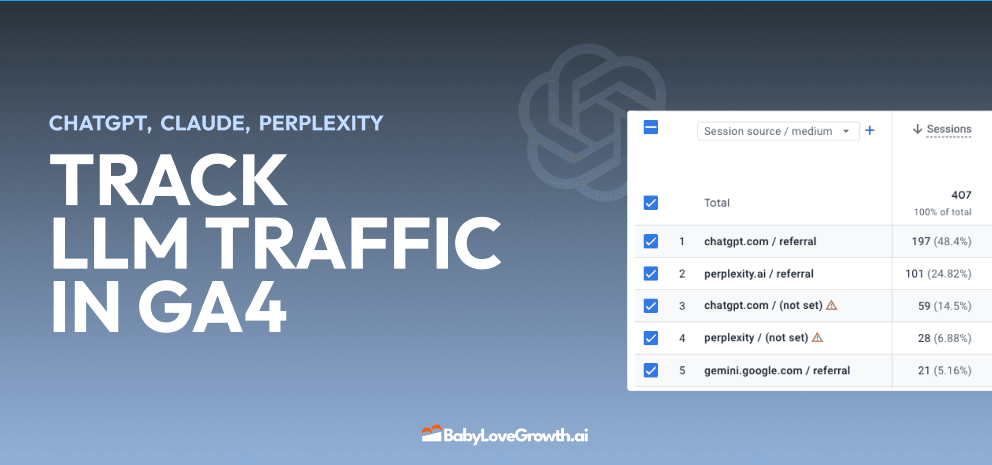
Track LLM Traffic in Google Analytics 4 (GA4)
Learn how to track and analyze traffic from AI sources like ChatGPT, Claude, Perplexity, and Google Gemini in Google Analytics 4. This step-by-step guide shows you how to set up custom filters to monitor AI-driven traffic and make data-driven decisions for your content strategy.
DylenMar 18, 2025
How to Humanize AI Text with Instructions
Learn practical techniques to make AI-generated content sound more natural and human. This guide covers active voice, direct addressing, concise writing, and other proven strategies to transform robotic text into engaging content.
DylenApril 7, 2025
Open AI Revenue and Statistics (2024)
Comprehensive analysis of OpenAI financial performance, user engagement, and market position in 2023. Discover key statistics including $20B valuation, $1B projected revenue, and 100M+ monthly active users.
DylenOctober 03, 2025