Defining Your Niche Market: Boosting Organic Growth


Most american entrepreneurs believe niche markets are too small to make a real impact, yet profitable specialized segments power some of the fastest-growing e-commerce brands worldwide. Misunderstanding what a niche market truly means can cost businesses their edge, especially when targeted strategies help smaller companies win against giants. This guide cuts through common myths so digital marketers and SEO professionals can accurately identify, validate, and serve highly specific customer groups for lasting organic growth.
Table of Contents
- Niche Market Meaning and Common Misconceptions
- Types of Niche Markets in E-Commerce
- Key Characteristics of Profitable Niches
- Steps to Identify and Validate Your Niche
- Common Pitfalls and How to Avoid Them
Key Takeaways
| Point | Details |
|---|---|
| Niche Markets Offer Growth | Niche markets can be substantial and profitable when effectively targeted and understood. |
| Understanding Customer Needs is Crucial | Deep market research and grasping customer pain points lead to successful niche strategies. |
| Competitive Differentiation is Key | Continuous innovation and unique value propositions are essential to maintain a competitive edge. |
| Avoid Over-Specialization | Striking a balance between specificity and market size is critical to ensure sustainable demand. |
Niche Market Meaning and Common Misconceptions
A niche market represents a specialized, targeted subset within a broader market that focuses on specific customer needs often overlooked by mainstream competitors. Targeted market segments allow businesses to create strategic advantages by addressing unique customer preferences with precision and expertise.
Contrary to popular belief, niche markets are not always tiny or insignificant. Some niche segments can grow substantially and become highly profitable when companies understand and serve their specific audience effectively. These specialized markets enable businesses to differentiate themselves by offering tailored products or services that meet distinct demographic, psychographic, or firmographic requirements.
Common misconceptions about niche markets include assuming they are inherently limited or unprofitable. In reality, successful niche strategies involve deep market research, understanding customer pain points, and developing specialized solutions that larger competitors cannot or will not provide. By focusing intensely on a narrow customer segment, companies can establish strong brand loyalty, command premium pricing, and create sustainable competitive advantages.
Here's a summary of common misconceptions and the realities of niche markets:
| Misconception | Reality | Business Impact |
|---|---|---|
| Niche markets are always small | Many niches can grow large and profitable | Potential for high ROI if well-targeted |
| Niche markets are unprofitable | Specialized needs allow premium pricing | Higher margins and loyal customers |
| Only demographics matter | Psychographics and firmographics are crucial | Greater personalization and brand loyalty |
Pro tip: Conduct thorough market research to validate your niche by analyzing customer needs, competitive landscape, and potential market size before fully committing to a specialized strategy.
Types of Niche Markets in E-Commerce
E-commerce has dramatically expanded opportunities for businesses to target specialized online market segments. These niche markets represent strategic pathways for entrepreneurs to differentiate themselves by focusing on specific product categories or unique consumer needs that larger retailers often overlook.
Some prominent e-commerce niche markets include emerging sectors with significant growth potential. Notable examples encompass sustainability-focused products like eco-friendly home goods, specialized health and wellness items, digital educational courses, personalized subscription services, and highly targeted accessory markets such as pet supplies or home office equipment. Each of these niches represents an opportunity to serve a specific customer demographic with precision and expertise.
Successful e-commerce niche strategies require deep understanding of consumer preferences and market trends. Businesses must go beyond generic product offerings and develop unique value propositions that resonate with their target audience. This might involve creating custom product lines, offering exceptional customer service, developing innovative packaging, or providing specialized knowledge that transforms a simple transaction into a meaningful customer experience.

Pro tip: Validate your e-commerce niche market by conducting thorough customer research, analyzing competitive landscapes, and testing product-market fit through minimum viable product strategies.
Key Characteristics of Profitable Niches
Profitable niche markets are distinguished by several critical characteristics that enable sustainable business growth. Specialized market segments require strategic positioning that goes beyond simple product differentiation, demanding a comprehensive understanding of unique customer needs and market dynamics.
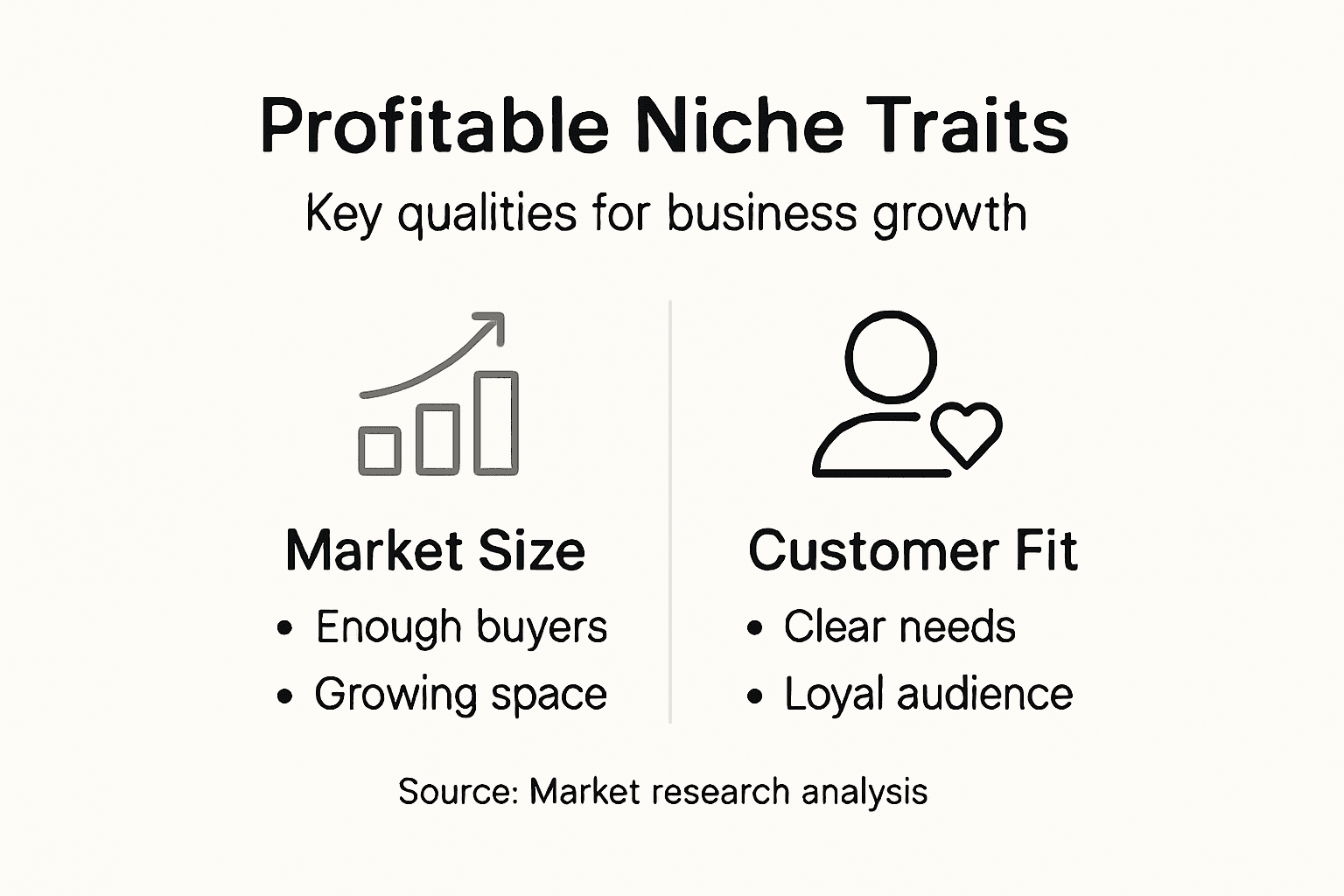
Key characteristics of profitable niches typically include a combination of market size, competitive landscape, and customer specificity. Successful niches demonstrate substantial growth potential, limited direct competition, and a clear ability to provide specialized solutions that mainstream providers cannot easily replicate. These markets often allow businesses to command premium pricing by delivering exceptional value through deeply targeted products or services that precisely address specific customer pain points.
Effective niche strategy involves more than identifying an underserved market segment. Businesses must develop robust customer relationship management, create innovative value propositions, and continuously adapt to evolving consumer preferences. This requires ongoing market research, a commitment to understanding customer needs at granular levels, and the agility to refine product offerings based on precise demographic and psychographic insights.
Below is a comparison of key characteristics that distinguish profitable niche markets:
| Characteristic | Description | Why It Matters |
|---|---|---|
| Market Size | Sufficient number of buyers | Enables sustainable growth |
| Competitive Landscape | Few direct competitors | Easier to differentiate |
| Customer Specificity | Clearly defined customer needs | Enables tailored solutions |
| Barrier to Entry | Difficult for competitors to copy | Ensures long-term advantage |
Pro tip: Conduct comprehensive market research using multiple data sources to validate your niche's profitability, including customer surveys, competitor analysis, and trend forecasting.
Steps to Identify and Validate Your Niche
Defining a profitable niche market requires a systematic approach to market research and validation. Successful entrepreneurs understand that identifying a viable niche goes far beyond intuition, demanding rigorous analysis and strategic investigation of potential market opportunities.
The process of niche identification involves several critical steps. First, assess your personal expertise, interests, and professional background to determine potential market segments where you can offer unique value. Next, conduct comprehensive market research using tools like Google Trends, industry reports, and competitive analysis platforms to understand market dynamics, customer pain points, and emerging opportunities. This research should reveal unmet customer needs, potential market gaps, and areas where existing solutions fall short.
Validation is the crucial next phase in niche market development. This requires direct customer engagement through surveys, focus groups, and prototype testing to confirm market interest and willingness to pay. Entrepreneurs must develop a minimum viable product (MVP) that addresses specific customer challenges, allowing for real-world feedback and iterative refinement. Successful niche validation involves not just identifying a market segment, but demonstrating a clear, differentiated value proposition that resonates with a specific customer base.
Pro tip: Create a detailed customer persona that goes beyond demographics, capturing the emotional drivers, challenges, and aspirations of your target niche market to guide product development and marketing strategies.
Common Pitfalls and How to Avoid Them
Niche market strategies are fraught with potential missteps that can derail even the most promising business ventures. Common niche marketing challenges require strategic awareness and proactive management to navigate successfully.
One of the most critical pitfalls is selecting an overly narrow market segment that lacks sufficient customer demand. Entrepreneurs often make the mistake of becoming too specialized without conducting comprehensive market research. This can result in a product or service with extremely limited appeal, making it challenging to achieve sustainable growth. Successful niche marketers must strike a delicate balance between specificity and market size, ensuring their offering addresses a genuine need while maintaining enough breadth to support business expansion.
Another significant challenge involves maintaining competitive differentiation and defending market position. Mainstream competitors can quickly replicate successful niche strategies, potentially eroding the unique value proposition that initially made the niche attractive. To combat this, businesses must continuously innovate, deeply understand their target audience, and develop strong barriers to entry through specialized expertise, unique product features, or exceptional customer relationships. Ongoing market trend monitoring and active customer engagement are essential for sustaining competitive advantage and preventing strategic stagnation.
Pro tip: Develop a dynamic market intelligence system that continuously tracks customer preferences, competitive movements, and emerging trends to stay ahead of potential market shifts and maintain your niche's relevance.
Accelerate Your Niche Market Growth with AI-Powered SEO
Defining your niche market is a crucial step to targeting specific customer needs and boosting organic growth. However, understanding market size, customer specificity, and the competitive landscape can feel overwhelming when trying to build strong brand loyalty and maintain a sustainable advantage. Key challenges include validating your niche, creating tailored content, and staying ahead of competitors who might replicate your strategies.
That is where Babylovegrowth.ai can make the difference. Our platform simplifies niche marketing by delivering automated, high-quality SEO-optimized articles that resonate with the exact audience your niche demands. You get a 30-day personalized content plan aligned with your target market’s unique pain points and interests along with an active backlinks exchange ecosystem to improve your search rankings fast. This AI-driven approach helps you focus on growing your business while we handle SEO on autopilot.
Take control of your niche growth today and stand out with precision-tailored content that drives real results.
Discover how you can unlock your niche’s full potential using Babylovegrowth.ai. Start your free trial now and watch your organic traffic soar by tapping into AI-powered content strategies designed specifically for niche markets. Don’t wait for competitors to catch up. Visit Babylovegrowth.ai to get started.
Frequently Asked Questions
What is a niche market?
A niche market is a specialized segment of a larger market that focuses on specific customer needs often overlooked by mainstream competitors. It allows businesses to create targeted products or services that cater to unique preferences.
How can I identify my niche market?
To identify your niche market, assess your personal interests and expertise, conduct market research to understand customer pain points, and analyze market trends for potential gaps that your product or service can fill.
What are the benefits of targeting a niche market?
Targeting a niche market allows businesses to differentiate themselves, build strong brand loyalty, command premium pricing, and create sustainable competitive advantages by effectively addressing specific customer needs.
What common misconceptions exist about niche markets?
Common misconceptions about niche markets include the belief that they are always small or unprofitable. In reality, many niches can be quite large and profitable when targeted effectively, allowing for significant growth and loyal customer bases.
Recommended
Smart SEO,
Faster Growth!
Most Read Articles

Generative Engine Optimization (GEO)
Learn how Generative Engine Optimization (GEO) helps your content rank in AI search engines like ChatGPT and Google AI. This comprehensive guide explains the differences between SEO and GEO, why it matters for your business, and practical steps to implement GEO strategies for better visibility in AI-generated responses.
DylenJan 18, 2025
Track LLM Traffic in Google Analytics 4 (GA4)
Learn how to track and analyze traffic from AI sources like ChatGPT, Claude, Perplexity, and Google Gemini in Google Analytics 4. This step-by-step guide shows you how to set up custom filters to monitor AI-driven traffic and make data-driven decisions for your content strategy.
DylenMar 18, 2025
How to Humanize AI Text with Instructions
Learn practical techniques to make AI-generated content sound more natural and human. This guide covers active voice, direct addressing, concise writing, and other proven strategies to transform robotic text into engaging content.
DylenApril 7, 2025
Open AI Revenue and Statistics (2024)
Comprehensive analysis of OpenAI financial performance, user engagement, and market position in 2023. Discover key statistics including $20B valuation, $1B projected revenue, and 100M+ monthly active users.
DylenOctober 03, 2025