Content Ideation Processes: Boosting Scalable SEO Growth


Most marketers still cling to outdated beliefs about how content ideation works, yet research shows that a systematic approach drives up to 40 percent more organic traffic for American tech startups. For digital marketers focused on results and efficiency, understanding the myths and mechanics behind ideation is the key to scalable content success. This article unpacks the real process, exposes common misconceptions, and breaks down practical methods to sharpen your organic traffic strategy.
Table of Contents
- Defining Content Ideation Processes And Myths
- Types Of Content Ideation Frameworks In SEO
- How AI Tools Reshape Ideation For Marketers
- Integrating Ideation With Automated Content Workflows
- Common Pitfalls And How To Avoid Them
Key Takeaways
| Point | Details |
|---|---|
| Structured Ideation is Essential | Content ideation should follow a systematic process involving stages like domain exploration and strategic validation to generate valuable ideas. |
| Collaboration Enhances Creativity | Effective ideation benefits from collaborative efforts and diverse perspectives rather than relying on individual creativity. |
| AI Transforms Ideation | AI tools streamline the ideation process by analyzing data and predicting trends, allowing marketers to focus on strategic refinement. |
| Avoid Common Pitfalls | Marketers should blend intuition with data-driven insights and establish validation frameworks to enhance the effectiveness of their content strategies. |
Defining Content Ideation Processes and Myths
Content ideation is far more strategic than most marketers realize. It's not about random brainstorming or waiting for creative lightning to strike, but a systematic approach to generating valuable content ideas that drive organic growth. Structured idea development requires understanding both the process and common misconceptions.
Traditionally, content creators believed ideation was an instinctive, unpredictable process where brilliant concepts emerge spontaneously. However, research reveals a more disciplined reality. Content ideation actually involves deliberate stages: domain exploration, concept refinement, and strategic validation. Professionals use methodical techniques like competitive analysis, audience research, and trend mapping to generate high-quality content concepts.
Several persistent myths undermine effective content ideation. First, many believe only naturally creative people can generate compelling ideas. Second, some assume ideation is a solitary activity. In reality, collaborative approaches and systematic frameworks significantly enhance idea generation. Modern content strategies leverage tools, data insights, and cross-functional perspectives to develop more robust, audience-aligned concepts.
Pro Tip: Create a dedicated ideation workspace where team members can collectively brainstorm, share insights, and build upon each other's content concepts systematically.
Types of Content Ideation Frameworks in SEO
Content ideation in SEO is not a random process but a strategic approach that requires systematic frameworks to generate high-value topics. Structured content research frameworks play a critical role in developing targeted, audience-aligned content strategies that drive organic visibility.

Several key content ideation frameworks emerge as powerful tools for SEO professionals. Buyer Persona Framework involves deeply understanding target audience demographics, pain points, and search behaviors to generate highly relevant content ideas. The Competitive Content Audit Framework analyzes existing content in your industry, identifying gaps and opportunities that your competitors might have missed. Another robust approach is the Keyword Intent Analysis Framework, which maps content ideas directly to user search intentions across different stages of the customer journey.
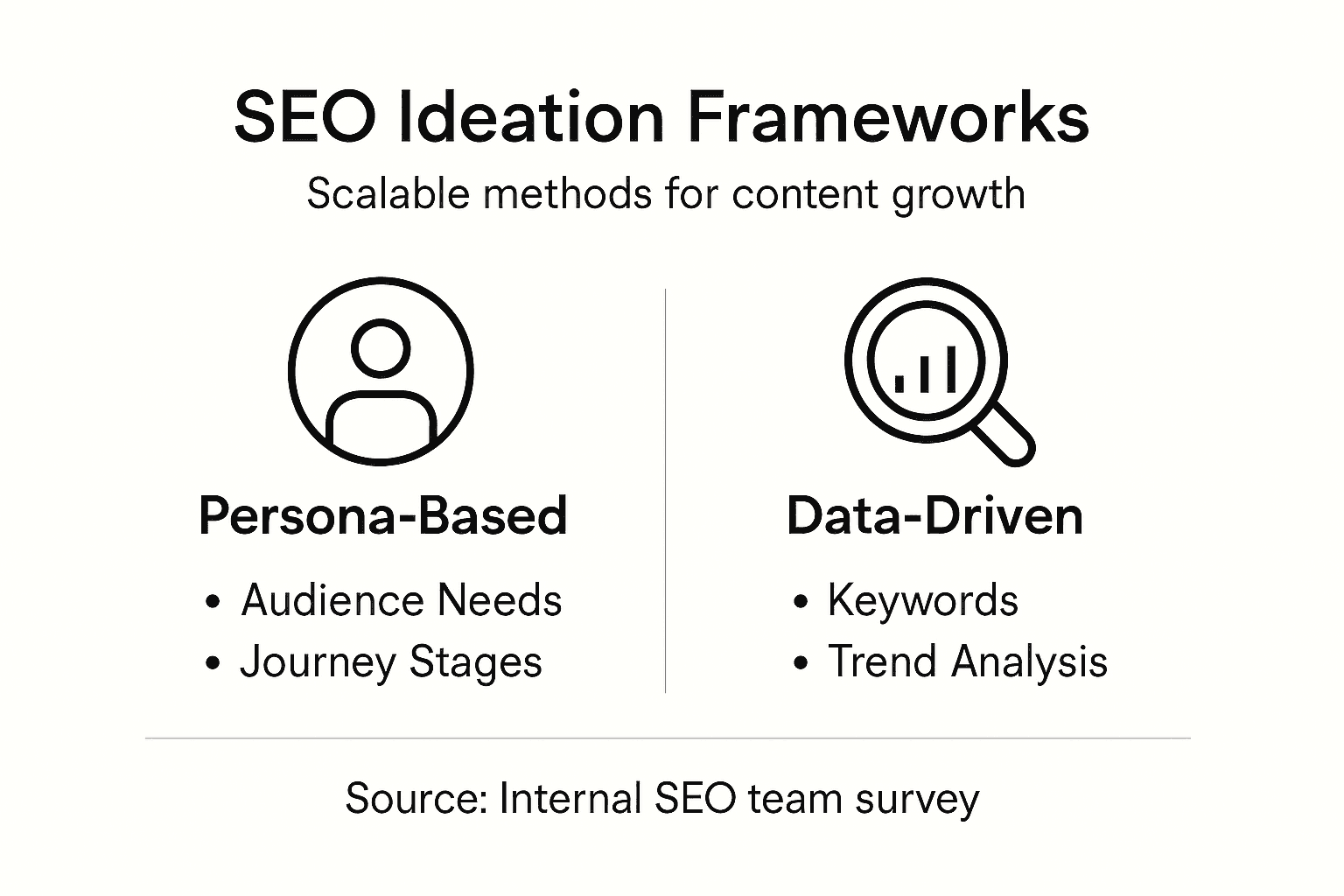
Advanced content ideation also incorporates emerging techniques like trend mapping, social listening, and predictive content modeling. These approaches leverage data analytics, social media insights, and machine learning to forecast emerging topics and content opportunities. By combining multiple frameworks, SEO professionals can create a holistic ideation strategy that not only generates ideas but ensures those ideas have genuine search potential and audience relevance.
Pro Tip: Create a centralized content ideation repository where team members can collaboratively track, score, and prioritize content ideas based on SEO potential and audience alignment.
Here's a summary comparing major content ideation frameworks used in SEO:
| Framework Name | Core Strategy | Key Benefit | Typical Use Case |
|---|---|---|---|
| Buyer Persona Framework | Audience profiling | High relevance | Targeted blog topics |
| Competitive Content Audit | Market gap analysis | Differentiation | Industry niche expansion |
| Keyword Intent Analysis | Search intent mapping | Improved search rankings | Landing page optimization |
| Trend Mapping | Real-time trend tracking | Timely content ideas | Viral or timely posts |
How AI Tools Reshape Ideation for Marketers
Artificial Intelligence has fundamentally transformed content ideation, moving beyond traditional brainstorming methods to create more intelligent, data-driven approaches. AI-powered ideation tools are revolutionizing how marketers generate, evaluate, and refine content concepts by dramatically reducing cognitive load and expanding creative possibilities.
These advanced AI ideation platforms leverage machine learning algorithms to analyze vast datasets, identifying emerging trends, audience interests, and potential content gaps with unprecedented speed and accuracy. Unlike traditional methods that rely solely on human intuition, AI tools can simulate multiple content scenarios, predict audience engagement, and generate diverse idea clusters that human marketers might overlook. They effectively break down complex creative processes into manageable, strategic components, enabling marketing teams to develop more targeted and resonant content strategies.
The most sophisticated AI ideation tools go beyond simple idea generation. They integrate semantic analysis, trend prediction, and real-time performance modeling to create a comprehensive content development ecosystem. By analyzing historical data, current market trends, and predictive analytics, these tools help marketers craft content strategies that are not just reactive, but proactively aligned with emerging audience needs and search behaviors.
Pro Tip: Integrate AI ideation tools as collaborative assistants, not replacements for human creativity, by using their suggestions as springboards for more nuanced, contextually rich content strategies.
Here is a comparison of how traditional and AI-powered ideation tools impact marketers:
| Aspect | Traditional Ideation Tools | AI-Powered Ideation Tools |
|---|---|---|
| Data Processing | Manual research | Automated real-time analytics |
| Idea Diversity | Limited by team experience | Expanded via machine learning |
| Speed | Slow, labor-intensive | Rapid, scalable |
| Predictive Capabilities | Relies on intuition | Forecasts trends with high accuracy |
Integrating Ideation With Automated Content Workflows
Modern content marketing demands a seamless integration between creative ideation and efficient execution, transforming traditional workflows into streamlined, intelligent systems. Automated content workflows represent the nexus where strategic thinking meets technological efficiency, enabling marketers to scale content production without sacrificing quality.
The integration process begins with strategic workflow mapping, which involves identifying key touchpoints where automation can enhance human creativity. This approach transforms content ideation from a linear process into a dynamic, cyclical ecosystem. Automated tools can now handle preliminary research, trend analysis, and initial content drafting, freeing creative professionals to focus on high-value strategic refinement, narrative development, and unique perspective generation. By leveraging AI-powered platforms, marketers can simultaneously generate multiple content variations, conduct real-time audience relevance assessments, and predict potential engagement metrics.
Successful workflow integration requires more than technological implementation. It demands a cultural shift where automation is viewed as a collaborative partner rather than a replacement for human creativity. Advanced content workflows now incorporate machine learning algorithms that can adapt to specific brand voices, understand nuanced audience segments, and provide intelligent recommendations that complement human strategic thinking. These systems continuously learn from previous content performances, creating a feedback loop that incrementally improves ideation and production processes.
Pro Tip: Develop a hybrid workflow model where AI handles data-driven tasks and initial content generation, while human experts provide strategic oversight, emotional intelligence, and final creative refinement.
Common Pitfalls and How to Avoid Them
Content ideation processes are fraught with potential missteps that can derail even the most well-intentioned marketing strategies. Content research pitfalls often emerge from fundamental misconceptions about how effective ideation actually works, creating significant barriers to sustainable organic growth.
One of the most critical strategic errors marketers make involves relying exclusively on intuition instead of data-driven insights. This approach leads to content that feels disconnected from actual audience needs and search behaviors. Successful ideation requires a balanced approach that combines creative thinking with rigorous research, competitive analysis, and continuous performance tracking. Common mistakes include developing content without clear audience personas, neglecting keyword intent, and failing to understand the competitive landscape of their specific industry niche.
Advanced content teams mitigate these risks by implementing systematic validation processes. This means establishing clear ideation frameworks that incorporate multiple validation checkpoints, such as audience relevance scoring, competitive gap analysis, and predictive engagement modeling. Effective teams create a culture of iterative learning, where each content idea is tested, measured, and refined based on real-world performance data. They understand that ideation is not a one-time event but a continuous, adaptive process that requires ongoing refinement and strategic adjustment.
Pro Tip: Create a structured content ideation scorecard that objectively evaluates potential topics across multiple dimensions including search volume, audience relevance, competitive difficulty, and potential engagement metrics.
Unlock Scalable SEO Growth with Smarter Content Ideation
Struggling to turn your content ideas into real SEO wins You are not alone. The article highlights common challenges like relying on intuition instead of data and the need for systematic frameworks such as buyer persona profiling and keyword intent analysis to drive meaningful organic traffic. At Babylovegrowth.ai, we understand these pain points and offer a powerful AI-driven platform designed to simplify your content ideation process. Our automation tools not only generate SEO-optimized articles aligned with Google and ChatGPT standards but also deliver a personalized 30-day content plan tailored to your audience and business goals.

Take control of your organic growth today by leveraging AI-powered insights to avoid common pitfalls and build a continuous content ideation cycle. Explore how our automated workflows integrate advanced ideation frameworks so you can focus on creativity while scaling efficiently. Don’t wait to elevate your SEO strategy start your free trial with Babylovegrowth.ai now and experience growth that works on autopilot.
Frequently Asked Questions
What is content ideation in SEO?
Content ideation in SEO is a systematic process for generating valuable content ideas that align with audience needs and search behaviors. It involves stages like domain exploration, concept refinement, and strategic validation, often enhanced by competitive analysis and audience research.
How can AI tools improve content ideation processes?
AI tools enhance content ideation by providing data-driven insights, identifying emerging trends, and generating diverse idea clusters quickly. They help marketers simulate various content scenarios and predict audience engagement, making the ideation process more efficient and effective.
What are common pitfalls in content ideation?
Common pitfalls include relying solely on intuition instead of data, developing content without understanding audience personas, and neglecting keyword intent. These errors can lead to content that fails to resonate with the target audience and misses organic growth opportunities.
How can marketers effectively integrate ideation with automated content workflows?
Marketers can effectively integrate ideation with automated workflows by mapping out key processes for automation, utilizing AI for tasks like preliminary research and content drafting, and maintaining a culture of collaboration between human creativity and technology.
Recommended
Smart SEO,
Faster Growth!
Most Read Articles
Generative Engine Optimization (GEO)
Learn how Generative Engine Optimization (GEO) helps your content rank in AI search engines like ChatGPT and Google AI. This comprehensive guide explains the differences between SEO and GEO, why it matters for your business, and practical steps to implement GEO strategies for better visibility in AI-generated responses.
DylenJan 18, 2025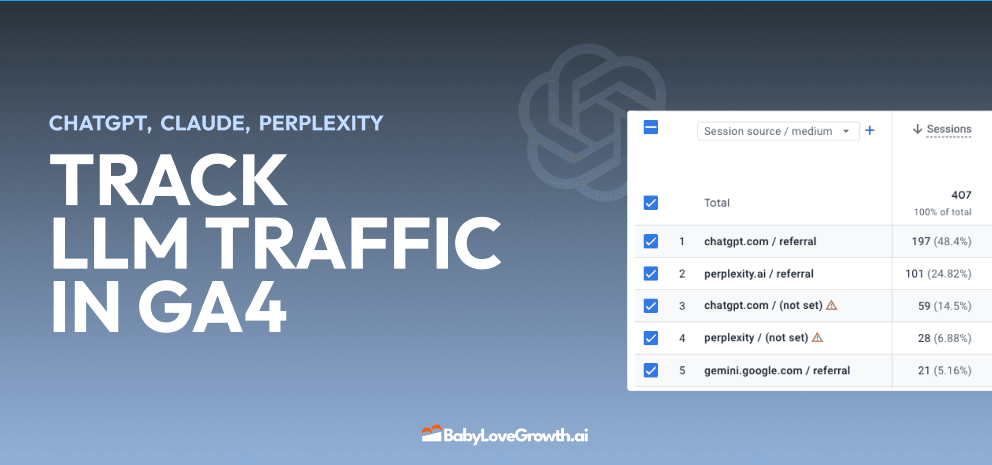
Track LLM Traffic in Google Analytics 4 (GA4)
Learn how to track and analyze traffic from AI sources like ChatGPT, Claude, Perplexity, and Google Gemini in Google Analytics 4. This step-by-step guide shows you how to set up custom filters to monitor AI-driven traffic and make data-driven decisions for your content strategy.
DylenMar 18, 2025
How to Humanize AI Text with Instructions
Learn practical techniques to make AI-generated content sound more natural and human. This guide covers active voice, direct addressing, concise writing, and other proven strategies to transform robotic text into engaging content.
DylenApril 7, 2025
Open AI Revenue and Statistics (2024)
Comprehensive analysis of OpenAI financial performance, user engagement, and market position in 2023. Discover key statistics including $20B valuation, $1B projected revenue, and 100M+ monthly active users.
DylenOctober 03, 2025