Content Gaps Analysis: Unlocking SEO Growth Potential


Nearly 60 percent of American e-commerce businesses see lower organic traffic because their websites miss critical content that matches actual search demand. The struggle to identify what users truly want goes beyond keyword lists and standard audits. Mastering content gaps analysis means discovering the specific questions, topics, and perspectives your audience cares about before competitors capture those searches. This guide offers proven strategies for pinpointing missed opportunities and transforming them into organic traffic wins.
Table of Contents
- Defining Content Gaps In Seo
- Major Types Of Content Gaps
- How Content Gaps Analysis Works
- E-commerce Applications And Strategies
- Common Mistakes To Avoid
Key Takeaways
| Point | Details |
|---|---|
| Identify Content Gaps | Recognize missing information in your content strategy to enhance search visibility and engage users. |
| Conduct Regular Audits | Implement a quarterly audit to stay ahead of emerging content opportunities and competitor advantages. |
| Utilize Analytical Methods | Apply keyword research, user intent mapping, and competitive analysis to pinpoint specific content shortcomings. |
| Avoid Common Mistakes | Emphasize data-driven approaches over intuition to ensure effective content gap analysis and strategy development. |
Defining Content Gaps in SEO
Content gaps represent critical missing elements in a website's search strategy where potential audience needs and search queries remain unaddressed. Search engine optimization practices reveal that these gaps directly impact a site's ability to attract and engage potential visitors effectively.
At its core, a content gap occurs when your website lacks comprehensive information about topics, questions, or keyword clusters that your target audience actively searches for online. These missing elements create opportunities for competitors to capture organic traffic and establish domain authority in your industry. By identifying these gaps, digital marketers can strategically develop content that fills information voids and meets precise user search intent.
Defining content gaps requires a systematic approach involving multiple analytical techniques. SEO content research typically involves several key investigation methods:
- Keyword research to uncover unaddressed search queries
- Competitive content analysis
- User intent mapping
- Search volume assessment for potential topics
- Analyzing search engine results page (SERP) features
By methodically examining these elements, businesses can pinpoint exactly where their content strategy falls short and develop targeted solutions to enhance search visibility.
Pro tip: Conduct a comprehensive content audit every quarter to proactively identify and address emerging content gaps before your competitors capture those opportunities.
Major Types of Content Gaps
Understanding the various categories of content gaps is crucial for developing a comprehensive SEO strategy. Research on content analysis reveals several distinct types of gaps that can significantly impact a website's search performance and user engagement.

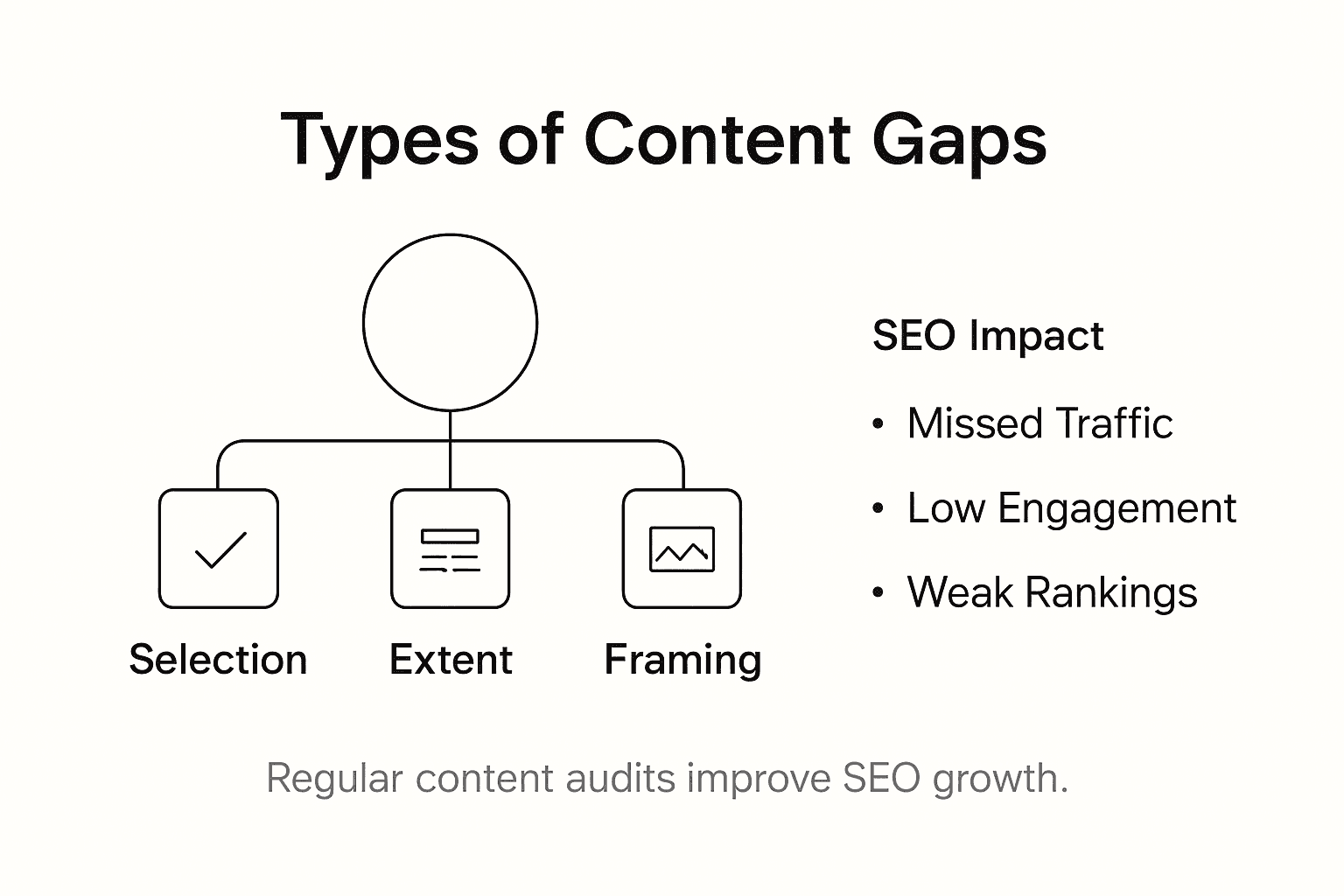
The primary categories of content gaps include selection gaps, extent gaps, and framing gaps. Selection gaps occur when entire important topics or key search queries are completely missing from your content strategy. Extent gaps represent situations where topics are present but lack sufficient depth, detail, or comprehensive coverage. Framing gaps emerge when content fails to address different perspectives, user intents, or critical nuances that potential readers might be seeking.
Research methodologies for identifying content gaps typically break down these categories into more specific types:- Knowledge Gaps: Missing critical information or insights
- Methodological Gaps: Insufficient approaches to explaining topics
- Empirical Gaps: Lack of concrete evidence or real-world examples
- Theoretical Gaps: Incomplete explanatory frameworks
Digital marketers and SEO professionals must systematically evaluate these different gap types to create a robust content strategy that comprehensively addresses user search needs and captures potential organic traffic opportunities.
Here is a summary of the main types of SEO content gaps and their business implications:
| Gap Type | Description | Business Impact |
|---|---|---|
| Selection Gap | Entire important topics missing | Lost search traffic to competitors |
| Extent Gap | Lacks depth or details on existing topics | Reduced user engagement and authority |
| Framing Gap | Misses perspectives or user intents | Lower conversion or relevance |
| Knowledge Gap | Lacks necessary facts or insights | Trust and credibility may suffer |
| Methodological Gap | Insufficient explanation or processes | Audience confusion or misinformation |
| Empirical Gap | Missing real-world examples or data | Decreased practical value for readers |
| Theoretical Gap | Incomplete underlying frameworks | Limits comprehensive industry coverage |
Pro tip: Conduct a quarterly content audit using a multi-dimensional gap analysis framework to identify and prioritize content improvements across different gap categories.
How Content Gaps Analysis Works
Content gap analysis methodologies provide a systematic approach to uncovering missed opportunities in digital content strategies. This process involves a comprehensive examination of existing content, identifying areas where critical information, keywords, or user perspectives are missing from your current digital assets.The analysis typically begins with a competitive benchmarking process that examines multiple dimensions of content performance. Digital marketers conduct detailed investigations by comparing their existing content against competitor websites, industry standards, and specific user search intents. This involves mapping out current content inventory, identifying keyword gaps, analyzing search volume for potential topics, and evaluating the depth and comprehensiveness of existing content resources.
Research methodologies for content gap identification suggest several key analytical approaches:
- Comprehensive keyword research
- Competitor content mapping
- User intent analysis
- Search volume and trend evaluation
- Performance metric assessment
Successful content gaps analysis requires a multi-dimensional approach that goes beyond simple keyword tracking. Digital marketers must develop a nuanced understanding of how different content elements interconnect, how user search behaviors evolve, and how to create targeted content that addresses specific information needs.
Pro tip: Develop a quarterly content gap tracking spreadsheet that dynamically maps emerging topics, competitive landscape shifts, and potential content opportunities.
E-commerce Applications and Strategies
Global e-commerce strategies represent a comprehensive approach to digital transformation that goes far beyond simple online selling. These strategies encompass complex frameworks designed to enhance digital infrastructure, optimize market accessibility, and create robust platforms that support businesses of all sizes in navigating the digital marketplace.The core of modern e-commerce applications involves integrating sophisticated digital technologies that enable personalized customer experiences. Digital marketers must focus on developing omni-channel strategies that seamlessly connect multiple touchpoints, from mobile platforms to desktop websites, ensuring a consistent and engaging user journey. This approach requires advanced data analytics, machine learning algorithms, and strategic content optimization to understand and predict consumer behaviors.
Digital transformation in e-commerce demands a multifaceted strategy that addresses several critical dimensions:- Technological infrastructure development
- Customer experience personalization
- Advanced data analytics implementation
- Cross-platform integration
- Continuous performance monitoring
Successful e-commerce strategies require businesses to be agile, continuously adapting their digital approaches to changing market dynamics, emerging technologies, and evolving consumer expectations. This means investing in scalable technologies, maintaining flexible digital architectures, and developing responsive marketing strategies that can quickly pivot based on real-time insights.
Pro tip: Create a dynamic e-commerce strategy dashboard that tracks key performance indicators across multiple channels, enabling rapid insights and data-driven decision making.
Common Mistakes to Avoid
Content gap analysis methodologies often fail due to critical systematic errors that can severely undermine the effectiveness of SEO strategies. Digital marketers frequently make fundamental mistakes that prevent them from accurately identifying and addressing content gaps, leading to missed opportunities and inefficient resource allocation.One of the most significant strategic errors involves relying on intuitive rather than data-driven approaches. Many teams default to guesswork instead of implementing rigorous, systematic research methods. This approach leads to superficial content analysis that fails to uncover meaningful insights about user search behaviors, competitive landscapes, and genuine information needs within their target market.
Research gap identification processes reveal several critical mistakes that undermine content strategy effectiveness:- Undefined or overly broad research scopes
- Insufficient stakeholder engagement
- Lack of standardized evaluation methods
- Poor prioritization of identified content gaps
- Inadequate quality assessment of potential content sources
Successful content gap analysis requires a disciplined, methodical approach that combines quantitative data analysis, qualitative user research, and continuous strategic refinement. Digital marketers must develop a comprehensive framework that goes beyond surface-level observations and systematically maps the entire content ecosystem.
Compare traditional vs. data-driven content gap analysis approaches for SEO effectiveness:
| Approach | Key Features | Limitations |
|---|---|---|
| Traditional | Relies on intuition and manual review | Prone to bias, misses hidden patterns |
| Data-Driven | Uses metrics, tools, and competitor insights | Time-intensive but highly accurate |
Pro tip: Develop a comprehensive content gap assessment matrix that objectively scores potential topics based on search volume, user intent, competitive difficulty, and strategic alignment.
Unlock Your SEO Potential by Bridging Content Gaps with AI
Many businesses struggle to identify and fill critical content gaps, leading to lost search traffic and missed growth opportunities. If you want to avoid selection gaps or framing gaps that reduce your site’s authority and user engagement, it’s essential to have a strategic, data-driven approach. Babylovegrowth.ai offers exactly that by automating your entire SEO content strategy using AI-driven keyword research and comprehensive content planning. Our platform helps you discover and prioritize the most valuable content opportunities so you can consistently rank higher on Google and ChatGPT.
Take control of your SEO growth today by simplifying content gap analysis with Babylovegrowth.ai’s personalized content plans and backlink ecosystem. Don’t let competitors capture your audience because of overlooked content voids. Visit Babylovegrowth.ai now to start your free trial and experience how automated, high-quality SEO content creation can drive scalable organic traffic. Explore how our rank-high services will keep your website relevant and authoritative in the dynamic search landscape.
Frequently Asked Questions
What is a content gap in SEO?
A content gap in SEO refers to missing information on a website about topics, questions, or keyword clusters that the target audience actively searches for. These gaps can prevent a site from attracting organic traffic and engaging potential visitors effectively.
How can I identify content gaps on my website?
You can identify content gaps by conducting keyword research, analyzing competitor content, mapping user intent, assessing search volume for potential topics, and evaluating search engine results page (SERP) features.
What are the major types of content gaps?
The major types of content gaps include selection gaps (missing topics), extent gaps (insufficient depth), and framing gaps (missed perspectives or user intents). Other specific types include knowledge, methodological, empirical, and theoretical gaps.
How can content gap analysis improve my SEO strategy?
Content gap analysis can improve your SEO strategy by uncovering overlooked opportunities within your content portfolio. By addressing these gaps, you can create targeted content that better meets user needs, enhances search visibility, and increases organic traffic.
Recommended
Smart SEO,
Faster Growth!
Most Read Articles
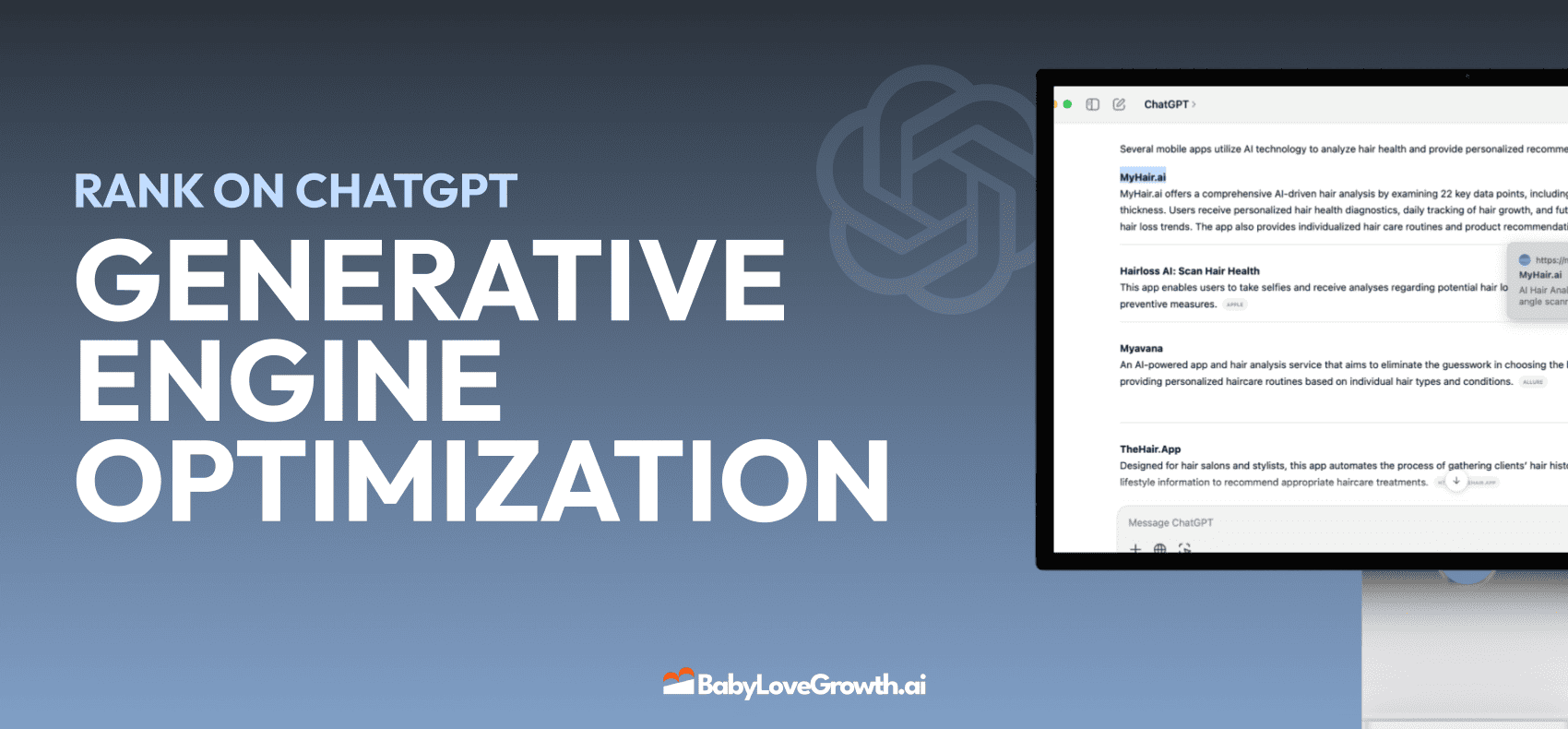
Generative Engine Optimization (GEO)
Learn how Generative Engine Optimization (GEO) helps your content rank in AI search engines like ChatGPT and Google AI. This comprehensive guide explains the differences between SEO and GEO, why it matters for your business, and practical steps to implement GEO strategies for better visibility in AI-generated responses.
DylenJan 18, 2025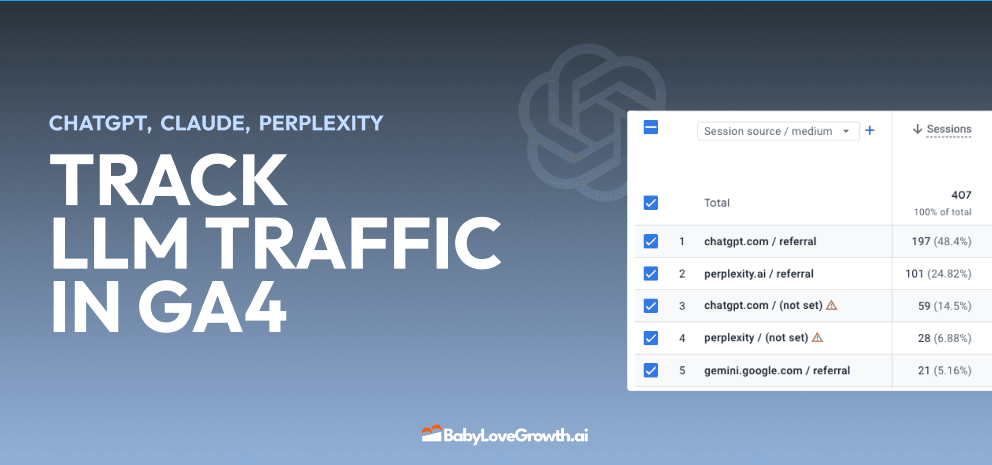
Track LLM Traffic in Google Analytics 4 (GA4)
Learn how to track and analyze traffic from AI sources like ChatGPT, Claude, Perplexity, and Google Gemini in Google Analytics 4. This step-by-step guide shows you how to set up custom filters to monitor AI-driven traffic and make data-driven decisions for your content strategy.
DylenMar 18, 2025
How to Humanize AI Text with Instructions
Learn practical techniques to make AI-generated content sound more natural and human. This guide covers active voice, direct addressing, concise writing, and other proven strategies to transform robotic text into engaging content.
DylenApril 7, 2025
Open AI Revenue and Statistics (2024)
Comprehensive analysis of OpenAI financial performance, user engagement, and market position in 2023. Discover key statistics including $20B valuation, $1B projected revenue, and 100M+ monthly active users.
DylenOctober 03, 2025