Content Design Principles: Complete Guide for 2025


Most american businesses underestimate the power of well-designed content, even though strong design can increase user engagement by over 50 percent. In today’s fast-paced digital world, standing out requires more than just catchy visuals. Thoughtfully crafted content shapes how audiences learn, interact, and remember a brand. This guide reveals the principles behind content design that drive real connection and long-term results.
Table of Contents
- Core Content Design Principles Explained
- Types of Content Design and Key Frameworks
- Essential Elements of Effective Content Design
- Practical Applications and Real-World Use Cases
- Avoiding Common Content Design Mistakes
Key Takeaways
| Point | Details |
|---|---|
| Core Principles of Content Design | Effective content design relies on principles like house style, maintenance, efficiency, engagement, and feedback to resonate with audiences. |
| User Experience Focus | Prioritizing user needs while ensuring accessibility and clarity is crucial in creating meaningful content that engages effectively. |
| Frameworks in Content Design | Utilizing frameworks such as Evidence-Centered Design and Concept-Knowledge Theory can enhance communication strategies and adaptability. |
| Common Mistakes to Avoid | Key pitfalls include overcrowding designs, neglecting user experience, and ignoring accessibility, which can undermine content effectiveness. |
Core Content Design Principles Explained
Content design isn't just about creating visually appealing materials - it's about strategically crafting experiences that engage and inform your audience. According to Leeds Beckett University, effective content design hinges on fundamental principles that transform how information is perceived and absorbed.
At its core, content design involves five critical development principles: house style, maintenance, efficiency, engagement, and feedback. These principles serve as a strategic framework for creating content that resonates with your target audience. House style ensures consistency in visual and tonal elements, while maintenance focuses on keeping content current and relevant. Efficiency means presenting information in the most streamlined, accessible manner possible.
Engagement and feedback are perhaps the most dynamic principles in modern content design. They require creators to not just broadcast information, but to create interactive, responsive experiences that invite audience participation. This means designing content that understands content marketing basics and incorporates elements that encourage user interaction, whether through compelling storytelling, interactive elements, or clear calls to action.
Successful content design in 2025 demands a holistic approach. It's about understanding user needs, anticipating their questions, and delivering information in a way that feels intuitive and valuable. Key strategies include:
- Prioritizing user experience over complex design
- Creating scannable, easily digestible content
- Using clear, concise language
- Incorporating visual hierarchy
- Designing for multiple device experiences
By embracing these core principles, businesses can transform their content from mere information delivery to powerful, engaging communication tools that genuinely connect with their audience.

Types of Content Design and Key Frameworks
Content design encompasses multiple strategic frameworks that help businesses create meaningful, impactful communication experiences. Wikipedia's evidence-centered design highlights how systematic approaches can transform content creation by linking specific design elements to targeted learning objectives.
Two primary frameworks stand out in modern content design: Evidence-Centered Design (ECD) and Concept-Knowledge Theory. ECD provides a structured approach with five critical layers: Domain Analysis, Domain Modeling, Conceptual Assessment Framework, Assessment Implementation, and Assessment Administration. This framework ensures that content is not just created, but meticulously crafted to achieve specific communication goals.
According to Wikipedia's C-K theory, another innovative design approach involves distinguishing between two fundamental spaces: the space of concepts (C) and the space of knowledge (K). This theory introduces a dynamic process of expanding understanding by exploring unknown objects and their properties. By integrating these frameworks, content designers can generate more innovative and adaptive solutions that go beyond traditional communication strategies.
Key content design frameworks typically include:
- Evidence-Centered Design
- Concept-Knowledge Theory
- User-Centered Design
- Adaptive Content Modeling
- Interaction-Driven Design
These frameworks all share a common goal: creating content that understands content strategy and adapts to evolving audience needs. Successful content design in 2025 requires a flexible, strategic approach that combines systematic methodology with creative exploration.
Essential Elements of Effective Content Design
Content design is a strategic discipline that goes far beyond aesthetic considerations. According to David Hodder, successful content design hinges on seven critical principles: purpose, context, accessibility, clarity, brevity, relevance, and flexibility. These principles serve as a comprehensive framework for creating content that truly resonates with audiences.
Purpose and context are foundational elements that drive effective content design. This means understanding not just what you're communicating, but why you're communicating it and within what specific context your audience will engage with the content. The goal is to create materials that are immediately meaningful and directly applicable to users' needs. Dr. Matthew Lynch emphasizes the importance of alignment with objectives, ensuring that every piece of content supports a clear, defined learning or communication goal.
Accessibility and clarity emerge as non-negotiable requirements in modern content design. This involves creating content that is easily understood by diverse audiences, including individuals with different backgrounds, learning styles, and potential accessibility needs. The most effective content design breaks down complex ideas into digestible, straightforward language while maintaining intellectual integrity. By creating captivating content, businesses can transform information delivery from a passive experience to an engaging interaction.
Key elements of effective content design include:
- Clear, purposeful communication
- User-centered approach
- Adaptable and flexible formatting
- Accessible language and design
- Contextually relevant information
- Measurable communication objectives
- Continuous user feedback integration
Successful content design in 2025 requires a holistic approach that balances strategic thinking with creative execution. It's about crafting experiences that inform, engage, and ultimately drive meaningful connections with your target audience.
Practical Applications and Real-World Use Cases
Content design has rapidly evolved from a theoretical concept to a critical strategic tool across multiple industries. ArXiv's research highlights the emerging GAIDE framework, which demonstrates how generative AI can transform content development, particularly in educational contexts by producing diverse and engaging materials more efficiently.
In the realm of digital platforms, content design plays a pivotal role in user engagement and experience. The Form-From model research provides fascinating insights into how content design influences social media systems, showing that strategic design choices directly impact user interaction and platform effectiveness. This approach goes beyond aesthetics, examining how structural and functional elements shape user experiences across digital ecosystems.
Practical applications of content design span multiple sectors, each with unique implementation strategies. In education, content designers are using AI-powered tools to create adaptive learning materials that personalize student experiences. Marketing teams leverage content design principles to craft compelling narratives that resonate with specific audience segments. Technology companies use these frameworks to develop user interfaces that are intuitive and engaging. Content optimization best practices have become crucial in ensuring that content not only looks good but also delivers measurable value.
Key practical applications include:
- Educational curriculum development
- User experience (UX) design
- Digital marketing content strategies
- Corporate training materials
- Interactive digital platform design
- Personalized learning experiences
- Brand storytelling and communication
The future of content design lies in its ability to adapt, integrate emerging technologies, and create meaningful connections between information and audience. Success depends on understanding user needs, leveraging technological innovations, and maintaining a human-centered approach to communication.
Avoiding Common Content Design Mistakes
Content design is a nuanced discipline where minor errors can significantly undermine communication effectiveness. Wikipedia's principle of separation of content and presentation highlights a critical mistake many designers make: intertwining content with its visual styling. This approach reduces flexibility and creates unnecessary complexity in content management.
Human-centered design emerges as a fundamental strategy for avoiding content design pitfalls. According to Wikipedia's research on human-centered design, neglecting user perspectives can lead to designs that fundamentally fail to meet audience expectations. The most common mistakes often stem from designers creating content in isolation, without genuinely understanding user needs, preferences, and interaction patterns. Content planning strategies become crucial in mitigating these risks by ensuring content remains aligned with user requirements.
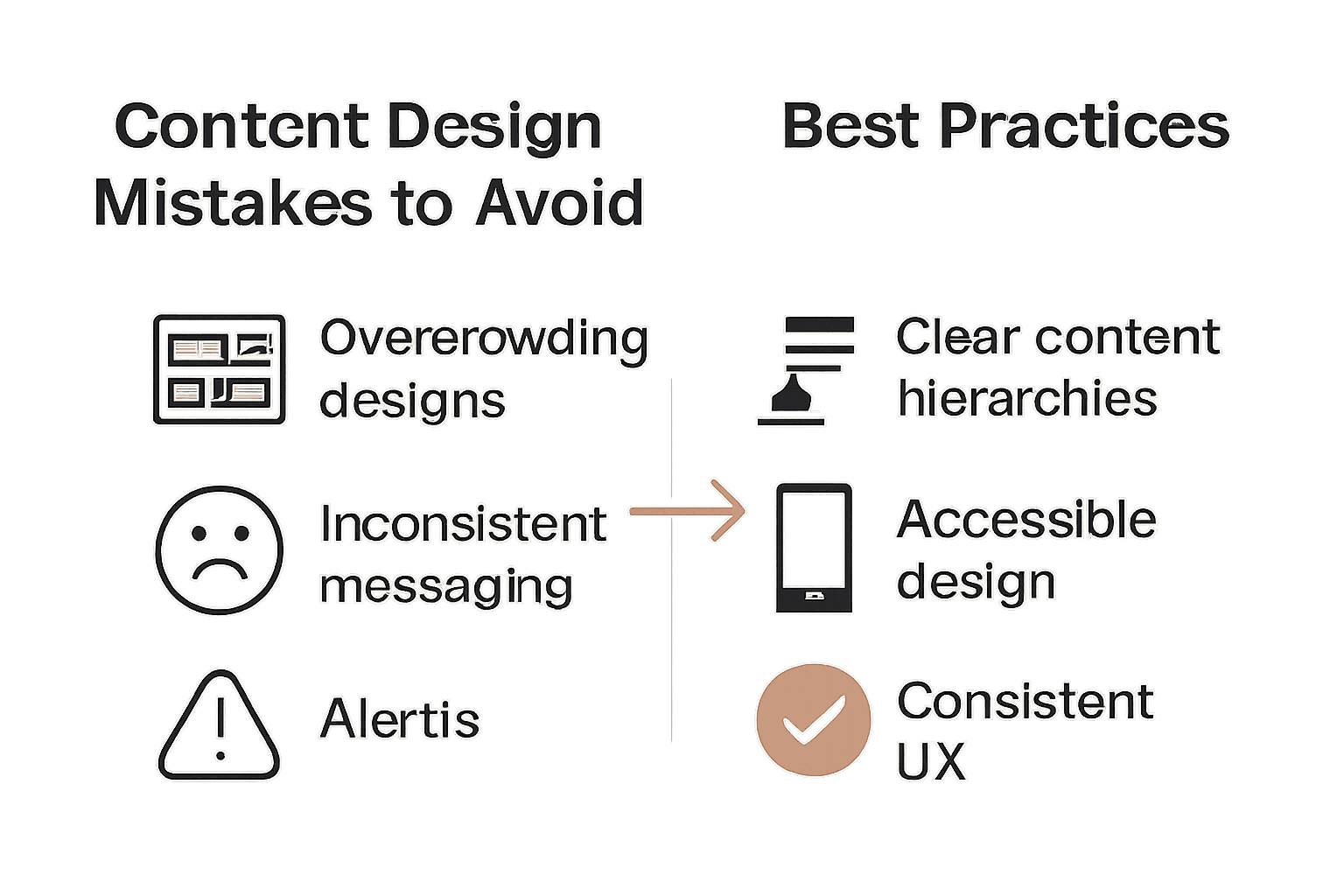
Designers frequently encounter several recurring mistakes that can derail content effectiveness. These include overwhelming users with information, using inconsistent messaging, neglecting accessibility requirements, and failing to adapt content for different platforms and devices. Successful content design requires a holistic approach that balances aesthetic considerations with functional clarity, ensuring that every element serves a clear communication purpose.
Common content design mistakes to avoid:
- Overcrowding visual spaces
- Ignoring user experience principles
- Using inconsistent typography
- Neglecting mobile responsiveness
- Creating text-heavy, unreadable layouts
- Failing to establish clear content hierarchies
- Disregarding accessibility standards
The key to exceptional content design lies in continuous learning, user feedback, and a willingness to adapt. By understanding potential pitfalls and maintaining a user-centered approach, designers can create more engaging, effective, and meaningful content experiences.
Elevate Your Content Design with AI-Powered SEO Solutions
The article highlights key challenges like maintaining clarity, engagement, and accessibility while delivering purposeful content that resonates. Businesses aiming to master the core principles of content design often struggle to efficiently create optimized, user-centered materials that stand out in today’s competitive digital landscape. Concepts like tailored content strategies, feedback integration, and adaptable formatting align perfectly with the need for scalable solutions that simplify organic growth.
Babylovegrowth.ai addresses these exact pain points by offering an AI-driven platform that automates the creation of high-quality, SEO-optimized articles designed for Google and ChatGPT. Our system ensures your content remains clear, relevant, and engaging while taking the guesswork out of complex content marketing efforts. By integrating automated backlink strategies and personalized content plans, Babylovegrowth.ai empowers business owners and marketers to implement effective content design frameworks without sacrificing time or quality.
Discover how easy and powerful content optimization can be when backed by AI technology.
Boost your content design strategy today with Babylovegrowth.ai and bring your ideas to life with precision and impact.

Ready to transform your content into a powerful growth engine Try Babylovegrowth.ai now for an automated SEO experience backed by the latest content design principles. Start your free trial and take control of your organic traffic growth today.
Frequently Asked Questions
What are the core principles of content design?
The core principles of content design include house style, maintenance, efficiency, engagement, and feedback. These principles provide a strategic framework for creating content that effectively resonates with the target audience.
How can I ensure my content is accessible to all users?
To ensure your content is accessible, use clear and concise language, consider diverse learning styles, and adhere to accessibility standards. This includes using headings, alt text for images, and ensuring readability across various devices.
What frameworks are commonly used in effective content design?
Common frameworks used in content design include Evidence-Centered Design, Concept-Knowledge Theory, User-Centered Design, and Adaptive Content Modeling. Each framework helps in creating targeted and impactful communication experiences.
What are some common mistakes to avoid in content design?
Common mistakes to avoid include overcrowding visual spaces, ignoring user experience principles, using inconsistent typography, neglecting mobile responsiveness, and failing to establish clear content hierarchies.