Automated Publishing: How to Scale Content and Protect Quality


TL;DR:
- Automated publishing can significantly reduce content production time and costs for small teams.
- Proper setup with quality gates and gradual automation minimizes errors and maintains content quality.
- Small businesses can compete at scale by intelligently automating rule-based tasks while retaining human oversight.
Most digital marketing managers assume that automating content publishing means trading quality for speed. That assumption is costing small teams real growth. Automated publishing can reduce production time by 30-70% for lean teams, yet the biggest gains go to those who build smart guardrails into the process from day one. This article breaks down exactly what automated publishing means in 2026, where it delivers the most value for small to medium-sized businesses, and how to avoid the pitfalls that trip up even experienced marketing teams.
Table of Contents
- What is automated publishing? Core concepts explained
- Why SMBs are embracing automation: Benefits and impact
- Key challenges and mistakes: What can go wrong?
- How SMBs can automate safely: Practical steps and best practices
- Our take: The real opportunity (and risk) in automated publishing
- Supercharge your marketing with smarter automation
- Frequently asked questions
Key Takeaways
| Point | Details |
|---|---|
| Automate repetitive tasks | Use automation for high-volume, repeatable publishing jobs to maximize speed and efficiency. |
| Hybrid human-AI workflows | Combine automation with human editorial checks to preserve quality and avoid penalties. |
| Start with core components | Begin by automating a few critical steps before scaling up to complex workflows. |
| Monitor for errors | Regularly check for issues like schema drift and duplicate content to keep your publishing pipeline on track. |
What is automated publishing? Core concepts explained
Automated publishing is the use of technology to handle repetitive, rule-based tasks in your content lifecycle without requiring manual action at every step. Think of it as a production line for your content: you set the rules, define the templates, and let the system execute. The human team steps in at key decision points rather than touching every piece of output.
At its core, automated publishing uses AI, APIs, and scheduling platforms to manage everything from content creation and formatting to metadata tagging, internal linking, and scheduled distribution. The key technologies involved include:
- AI writing and optimization tools that generate or enhance content based on briefs and keyword targets
- APIs that connect your content tools to your CMS, social channels, and analytics platforms
- Scheduling platforms that queue and publish content at optimal times without manual triggers
- Template systems that enforce consistent structure, formatting, and on-page SEO across every piece
- Quality gates that flag content for human review before it goes live
Here is a quick breakdown of the core components and what each one does:
| Component | Function |
|---|---|
| AI content engine | Drafts, rewrites, or optimizes content based on defined parameters |
| CMS integration | Publishes formatted content directly to your website |
| Scheduling platform | Controls timing and frequency of publication |
| Template system | Ensures consistent structure and SEO formatting |
| Quality gate | Triggers human review for flagged or sensitive content |
| Analytics connector | Tracks performance and feeds data back into the workflow |
For a deeper look at how these pieces fit together, the automated publishing overview on our platform walks through each layer in detail.
Pro Tip: Start by automating only your most repetitive tasks, such as metadata generation, internal link insertion, or social post scheduling. Nail those before touching content creation or bulk publishing.
The role of quality gates cannot be overstated. Without them, automation amplifies errors at scale. A single misconfigured template can push hundreds of malformed pages live before anyone notices. Building review checkpoints into your content marketing automation workflow is not optional; it is the foundation of safe scaling.
Why SMBs are embracing automation: Benefits and impact
The numbers tell a clear story. SMBs using automation have achieved 20 to 100 pages per month with a 30 to 70% reduction in production time and a 30 to 60x decrease in cost compared to outsourcing at scale. That is not a marginal improvement. That is a structural shift in how small teams compete.
One real-world example: a single content strategist published 130 blog posts in 26 weeks using an AI-assisted workflow. No agency. No large team. Just a well-designed process with automation handling the heavy lifting and a human steering strategy and quality.
The benefits stack up quickly for small marketing teams:
- Speed: Content moves from brief to published in hours, not days
- Scale: One person can manage a volume that previously required a full team
- ROI: Cost per published piece drops dramatically compared to freelance or agency rates
- Consistency: Templates enforce brand standards and SEO requirements on every piece
- Team sanity: Writers and strategists focus on creative and strategic work instead of repetitive formatting tasks
The tasks with the biggest automation payoff tend to be the ones that are high-volume and rule-based. Metadata generation, image alt text, internal linking, social caption creation, and content scheduling are all strong starting points. These tasks eat hours every week without requiring creative judgment.
A faster content workflow also compounds over time. When your team publishes more consistently, search engines index your site more frequently, topical authority builds faster, and organic traffic compounds month over month. This is why the SEO automation guide we put together focuses on sustainable volume, not just one-time output spikes.
The competitive advantage is real. SMBs that automate intelligently can outpublish competitors with larger teams while maintaining comparable or better content quality. That is the promise of automation done right.

Key challenges and mistakes: What can go wrong?
Automation scales everything, including your mistakes. Before you build out a publishing pipeline, you need to understand where things break and why.
Common edge cases in automated pipelines include schema drift, taxonomy mismatches, API rate limits, thin or duplicate content, and failed permission settings. Each of these can cause serious problems at scale.Here are the most frequent errors SMBs run into:
- Schema drift: Your structured data markup falls out of sync with your CMS schema after an update, breaking rich results
- Taxonomy mismatches: Content gets tagged to the wrong categories or topics, creating confusing site architecture
- Duplicate content: Slight template variations produce near-identical pages that cannibalize each other in search
- API rate limits: Your automation hits platform limits and either fails silently or publishes incomplete content
- Permission failures: Content publishes to wrong channels or with incorrect access settings
- Thin content: Templated pages that technically exist but offer no real value to the reader
"Automation without editorial oversight is just scaling your worst habits. Quality gates are not a bottleneck; they are the system."
Over-automation is a real risk that many guides underplay. When you remove human judgment entirely from the content process, brand voice erodes. Readers notice. Search engines notice. The SEO risks of automation are not hypothetical; they show up in ranking drops and engagement metrics within weeks.
Pro Tip: Build a minimal viable automation (MVA) first. Automate one task, monitor it for two weeks, then expand. This gives you time to catch configuration errors before they affect hundreds of pages.
Manual spot-checking is not a sign that your automation is failing. It is a sign that you are running it responsibly. Even a 5% sample review of published content catches the majority of systematic errors before they compound.
How SMBs can automate safely: Practical steps and best practices
Safe automation is not about doing less. It is about building the right structure so you can do more without losing control. Here is a practical sequence for small marketing teams:
- Audit your current workflow to identify which tasks are truly repetitive and rule-based versus those requiring creative judgment
- Define your templates for each content type before touching any automation tool
- Set up taxonomy and tagging standards so every piece of content lands in the right place
- Configure permission levels to prevent accidental bulk publishing to live channels
- Build quality gates at key stages: post-draft, post-formatting, and pre-publish
- Start with one content type such as product descriptions or location pages before scaling to editorial content
- Monitor for Google penalties and content uniqueness weekly during the first 90 days
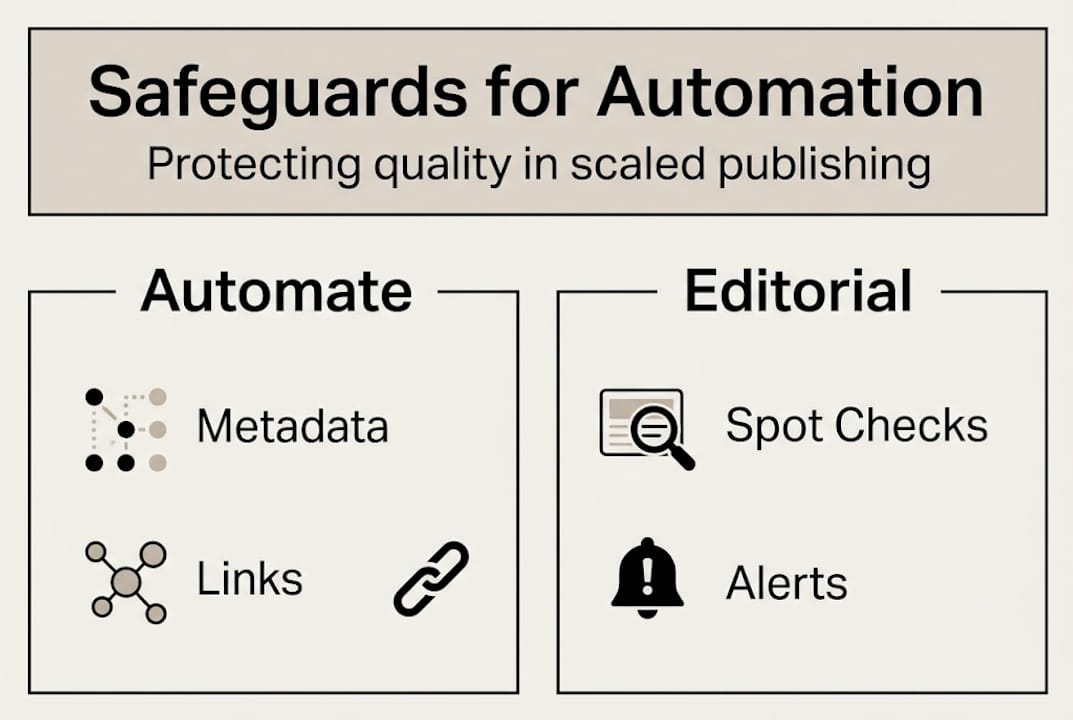
The hybrid model is what actually works in practice. Automate repetitive tasks, retain editorial gates, and focus on quality and E-E-A-T at every stage. E-E-A-T stands for Experience, Expertise, Authoritativeness, and Trustworthiness, and it is Google's framework for evaluating content quality.
| Task | Automate | Keep human |
|---|---|---|
| Metadata generation | Yes | No |
| Internal link insertion | Yes | Spot-check |
| Content drafting | Partially | Review and edit |
| Brand voice and tone | No | Always human |
| Strategic content planning | No | Always human |
| Performance analysis | Yes | Human interpretation |
| Final publish approval | No | Always human |
For AI-powered content marketing to work at scale, your AI content strategy needs to define what humans own before you automate anything else. Also, balancing AI and compliance requires ongoing attention, especially as Google's quality guidelines evolve.
Pro Tip: Set up automated alerts for sudden drops in indexed pages, crawl errors, or ranking changes. These are early warning signs that your pipeline has a configuration problem.
Our take: The real opportunity (and risk) in automated publishing
Most guides on automated publishing treat it as a binary choice: automate everything or automate nothing. That framing is wrong, and it leads small teams into expensive mistakes.
Bulk automation works well for templated, programmatic content like location pages, product listings, or FAQ compilations. It is genuinely risky for brand-defining long-form content where voice, nuance, and original thinking matter. The teams that win are the ones who know the difference and build their workflows accordingly.
Human editorial judgment, even at a 5% spot-check rate, is not overhead. It is the quality signal that separates scalable growth from a Google penalty waiting to happen. We have seen teams publish thousands of pages and lose rankings because no one was watching the output.
The real opportunity is using automation to scale your team's impact, not to replace your team's thinking. AI's role in scalable SEO is to handle execution so your strategists can focus on the decisions that actually move the needle. That is where the compounding returns live.
Supercharge your marketing with smarter automation
If this guide has shown you anything, it is that automated publishing done right requires the right tools working together. Piecemeal solutions create gaps. Gaps create risk.

Babylovegrowth.ai brings keyword research, content planning, publishing automation, and SEO auditing under one roof so your team can scale without guessing. Use AI keyword discovery to find high-value topics fast, run an AI SEO audit to catch technical issues before they cost you rankings, and build authority at scale with backlink automation for SMBs. Every feature is built for lean teams that want to grow without adding headcount.
Frequently asked questions
What types of content are best suited to automated publishing?
Templated, programmatic content such as directory pages, product listings, and location pages performs best with automation, while brand-critical and long-form editorial pieces still need human review and judgment.How do I avoid Google penalties when automating publishing?
Google targets scaled, low-quality abuse rather than AI content alone, so focusing on unique data, genuine user intent, and E-E-A-T standards with editorial checks in place keeps your site in good standing.
What common errors should I watch out for in automation?
Bulk automation risks include taxonomy mismatches, schema drift, API rate limits, and accidental publishing of duplicate or thin content, all of which can be caught early with proper monitoring and quality gates.
Is automated publishing only for large brands?
One person published 130 posts in six months using automation, proving that even solo marketers and small teams can achieve dramatic output and cost savings without an agency or large budget.
Recommended
Smart SEO,
Faster Growth!
Most Read Articles
Generative Engine Optimization (GEO)
Learn how Generative Engine Optimization (GEO) helps your content rank in AI search engines like ChatGPT and Google AI. This comprehensive guide explains the differences between SEO and GEO, why it matters for your business, and practical steps to implement GEO strategies for better visibility in AI-generated responses.
DylenJan 18, 2025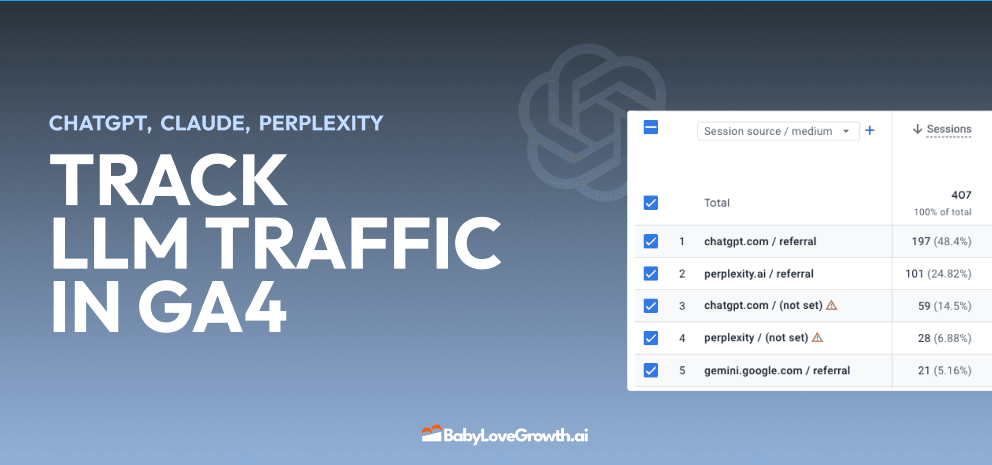
Track LLM Traffic in Google Analytics 4 (GA4)
Learn how to track and analyze traffic from AI sources like ChatGPT, Claude, Perplexity, and Google Gemini in Google Analytics 4. This step-by-step guide shows you how to set up custom filters to monitor AI-driven traffic and make data-driven decisions for your content strategy.
DylenMar 18, 2025
How to Humanize AI Text with Instructions
Learn practical techniques to make AI-generated content sound more natural and human. This guide covers active voice, direct addressing, concise writing, and other proven strategies to transform robotic text into engaging content.
DylenApril 7, 2025
Open AI Revenue and Statistics (2024)
Comprehensive analysis of OpenAI financial performance, user engagement, and market position in 2023. Discover key statistics including $20B valuation, $1B projected revenue, and 100M+ monthly active users.
DylenOctober 03, 2025