AI-powered content workflow cuts research time 60% for SEO


Manual content workflows drain hours of your team's time every week. Fragmented keyword research, disconnected planning tools, and slow editorial cycles limit your ability to compete for organic visibility. AI-powered content workflows reduce keyword discovery time by 60%, freeing your team to focus on strategy and quality. This guide shows you how to prepare, implement, and monitor AI-driven workflows that boost organic traffic and streamline production without sacrificing brand voice or SEO effectiveness.
Table of Contents
- Prerequisites And What You Need Before Starting
- Key Steps In Implementing An AI-Driven Content Process
- Common Mistakes And Failure Points With Remediation
- Alternative AI Integration Approaches And Tradeoffs
- Expected Timelines And Measurable Outcomes
- Explore AI-Powered Tools To Optimize Your Content Workflow
- FAQ
Key takeaways
| Point | Details |
|---|---|
| AI accelerates keyword research | AI-powered keyword discovery reduces research time by 60%, allowing faster content planning and execution. |
| Human editing prevents SEO penalties | Over-reliance on AI-generated content without human editing increases SEO penalty risk by 43%, making editorial review essential. |
| Traffic growth requires patience | AI-driven workflows boost organic traffic approximately 25% within 6 months of consistent implementation. |
| Regular audits maintain quality | Continuous monitoring prevents content overlap, keyword cannibalization, and maintains brand alignment. |
| Hybrid workflows balance efficiency | Combining AI automation with human expertise delivers speed without compromising content quality or user engagement. |
Prerequisites and what you need before starting
Before implementing AI into your content workflow, you need a solid foundation. Start with a comprehensive SEO content audit to understand your current content landscape, identify gaps, and ensure AI recommendations align with your brand voice and business goals. Research shows 72% of SEO experts recommend this foundational step before introducing automation tools.
You'll need basic SEO knowledge and a clear content strategy. Understanding keyword intent, search rankings, and content structure helps you evaluate AI outputs effectively. Without this baseline knowledge, you risk accepting irrelevant suggestions or missing opportunities to refine AI-generated content for maximum impact.
Access to the right tools matters significantly. Mid-sized businesses need AI-powered keyword research platforms, content planning tools, and AI SEO audit solutions tailored to their scale and budget. Generic enterprise tools often overwhelm smaller teams, while basic tools lack the sophistication needed for competitive markets.
Human editorial capacity is non-negotiable. AI generates content quickly, but your team must review, refine, and optimize AI content for brand consistency and user experience. Allocate at least 20-30% of content production time to editorial review to maintain quality standards and avoid algorithmic penalties.
Define clear organic growth objectives and key performance indicators (KPIs) before starting. Whether you're targeting 25% traffic growth, specific keyword rankings, or improved engagement metrics, measurable goals help you evaluate AI workflow performance and adjust strategies based on data rather than assumptions.
Essential preparation checklist:
- Complete SEO content audit to identify gaps and opportunities
- Secure AI-powered keyword research and content planning tools
- Establish human editorial review processes and capacity
- Define measurable organic growth KPIs and success metrics
- Document brand voice guidelines for AI output evaluation
| Prerequisite | Purpose | Time Investment |
|---|---|---|
| SEO content audit | Identify gaps and align AI recommendations | 2-4 weeks |
| Tool selection | Access AI platforms suited to business scale | 1-2 weeks |
| Editorial capacity | Review and refine AI-generated content | 20-30% of production time |
| KPI definition | Measure workflow effectiveness and ROI | 1 week |
Pro Tip: Start with a pilot project targeting 5-10 low-competition keywords. This limited scope lets you test AI workflow effectiveness, refine your editorial process, and demonstrate ROI before scaling to full production.
Key steps in implementing an AI-driven content process
Begin with your SEO content audit. This foundational step prevents topic overlap, identifies keyword cannibalization issues, and ensures AI tools recommend content that fills real gaps in your strategy. Skipping this step often leads to redundant content that competes with your existing pages rather than expanding your organic reach.
Use AI tools for accelerated keyword discovery and topic generation. AI-powered keyword discovery reduces research time by 60%, allowing your team to identify dozens of relevant topics in hours instead of days. Focus on long-tail keywords and question-based queries where mid-sized businesses can compete effectively against larger competitors.

Automate content production with AI, but always include human editorial review. AI-driven content creation provides speed and scale, but human editors ensure accuracy, brand alignment, and engagement quality. This hybrid approach balances efficiency with the authenticity that search engines and readers value.
Implement AI-driven structured data markup to increase visibility. Automated schema markup increases rich snippet appearance by approximately 30%, boosting click-through rates without additional content investment. Most AI SEO platforms now include this functionality, making it accessible to teams without technical expertise.
Use AI backlink analysis tools to improve link-building efficiency by 40%. These tools identify high-value linking opportunities, analyze competitor backlink profiles, and prioritize outreach efforts based on domain authority and relevance. This data-driven approach replaces guesswork with strategic targeting.
Implementation workflow:
- Conduct comprehensive SEO audit and document findings
- Configure AI keyword research tool with brand parameters
- Generate 30-day content calendar with AI recommendations
- Produce AI-generated drafts for highest-priority topics
- Route drafts to human editors for review and refinement
- Optimize AI content for search intent and user experience
- Implement automated structured data markup before publishing
- Monitor performance metrics and iterate based on results
Continuously monitor SEO metrics and iterate content based on data insights. Track organic traffic, keyword rankings, engagement metrics, and conversion rates weekly. Use these insights to refine your AI prompts, adjust editorial guidelines, and prioritize topics that drive measurable business results.
| Implementation Phase | Key Actions | Expected Duration |
|---|---|---|
| Audit and planning | SEO audit, tool setup, KPI definition | 3-5 weeks |
| Pilot content batch | Generate and publish 5-10 articles | 2-3 weeks |
| Process refinement | Adjust workflows based on initial results | 2-4 weeks |
| Scale production | Expand to full content calendar | Ongoing |
Pro Tip: Create an AI prompt library with templates for different content types. Refine these prompts based on editorial feedback and performance data, improving output quality and reducing editing time by 30-40% over the first quarter.
Common mistakes and failure points with remediation
Avoid sole reliance on AI content generation without human SEO review. Pure automation might seem efficient, but over-reliance on AI-generated content without human editing increases SEO penalty risk by 43%. Search engines increasingly detect and devalue content that lacks human insight, originality, and genuine expertise.
Align AI output with human SEO expertise to prevent engagement drops. Teams that publish AI content without editorial oversight see an average 28% drop in user engagement metrics including time on page, bounce rate, and social shares. Readers recognize generic, formulaic content and disengage quickly, signaling quality issues to search algorithms.
Perform regular quality audits to check content uniqueness, relevance, and keyword cannibalization. Monthly reviews help you catch duplicate content issues, identify pages competing for the same keywords, and ensure AI-generated content maintains your brand's distinct perspective. These audits take 4-6 hours monthly but prevent costly ranking losses.
Set editorial guidelines to maintain brand voice and originality. Without clear standards, AI outputs drift toward generic industry language that fails to differentiate your brand. Document tone, style preferences, prohibited phrases, and required elements so editors can efficiently evaluate and humanize AI content.
Use human review to catch AI errors and optimize for user experience. AI tools occasionally fabricate statistics, misinterpret sources, or generate logical inconsistencies that damage credibility. Editorial review catches these issues before publication, protecting your reputation and search rankings.
Common pitfalls and fixes:
- Publishing AI content without editorial review leads to penalties and engagement drops
- Skipping quality audits allows keyword cannibalization to erode rankings
- Ignoring brand voice guidelines produces generic content that fails to convert
- Accepting AI outputs without fact-checking damages credibility and authority
- Over-optimizing for keywords creates unnatural content that triggers algorithmic filters
"The biggest mistake we see is treating AI as a replacement for human expertise rather than a tool to amplify it. Successful teams use AI to accelerate research and drafting, then apply human judgment to ensure quality, accuracy, and strategic alignment."
Pro Tip: Implement a simple red-yellow-green rating system for AI-generated drafts. Green drafts need minor edits, yellow require significant revision, and red need complete rewrites. Track these ratings to refine your AI prompts and improve output quality over time.
Alternative AI integration approaches and tradeoffs
Full automation offers maximum speed and volume but carries significant risks. Publishing 50-100 AI-generated articles monthly without editorial review produces content quickly, but this approach faces higher SEO penalty rates and lower engagement metrics. Full automation works best for data-driven content like product specifications or event listings where creativity matters less.
Hybrid AI-human workflows provide balanced speed, better engagement, and reduced penalties. This model uses AI for research, outlining, and drafting, then routes content through human editors for refinement, fact-checking, and brand alignment. Most successful mid-sized businesses adopt this approach, achieving 60% time savings while maintaining quality standards.
AI backlink analysis tools increase link-building efficiency by 40% compared to manual prospecting. These tools scan millions of websites to identify relevant linking opportunities, analyze anchor text patterns, and prioritize outreach based on domain metrics. The tradeoff is cost, as premium backlink tools require monthly subscriptions ranging from $200 to $800.
Tradeoffs involve cost, scalability, control, and content uniqueness. Full automation costs less in editorial hours but risks ranking penalties that cost far more. Manual processes maintain perfect control but limit output volume. Hybrid approaches balance these factors but require workflow coordination and team training.
Choose your approach based on content staff size, volume targets, and budget constraints. Teams with 1-2 content creators benefit most from AI-assisted drafting with careful human review. Larger teams can implement parallel workflows where AI handles high-volume topics while humans focus on strategic, high-value content.
| Integration Model | Speed | Quality Control | SEO Risk | Best For |
|---|---|---|---|---|
| Full automation | Highest | Lowest | High | Data-driven, low-creativity content |
| Hybrid AI-human | High | High | Low | Most mid-sized businesses |
| AI-assisted manual | Medium | Highest | Lowest | High-value strategic content |
| Manual only | Lowest | Highest | Lowest | Small-scale, premium content |
Key considerations when selecting your model:
- Available editorial staff and their capacity for review work
- Monthly content volume targets and business growth goals
- Budget for AI tools, subscriptions, and training investment
- Content type mix (informational, commercial, technical)
- Risk tolerance for potential SEO penalties or quality issues
Pro Tip: Start with a hybrid model regardless of your long-term goals. This approach lets you build AI prompt libraries, refine editorial workflows, and gather performance data before committing to full automation or maintaining manual processes.
Expected timelines and measurable outcomes
Organic traffic improvements typically appear within 3 to 6 months of AI integration. Search engines need time to crawl, index, and evaluate new content before adjusting rankings. Early results often show keyword position improvements before significant traffic increases, so monitor ranking changes as leading indicators of success.
AI-powered daily article publishing correlates with a 25% traffic increase over six months. This growth assumes consistent quality, strategic keyword targeting, and proper technical SEO implementation. Inconsistent publishing schedules or low-quality content dilute these results, emphasizing the importance of sustainable workflows rather than short-term volume spikes.
Click-through rates can improve by 30% through AI-enhanced structured data markup. Rich snippets, FAQ schemas, and how-to markup increase visibility in search results, attracting more clicks without improving rankings. This quick win often appears within 2-4 weeks of implementation, providing early validation of your AI workflow investment.
Reduction in content overlap and keyword cannibalization by 30-35% enhances SEO effectiveness. AI-powered content audits identify competing pages faster than manual review, allowing you to consolidate, redirect, or differentiate content strategically. This cleanup work typically takes 4-8 weeks but produces lasting ranking improvements.
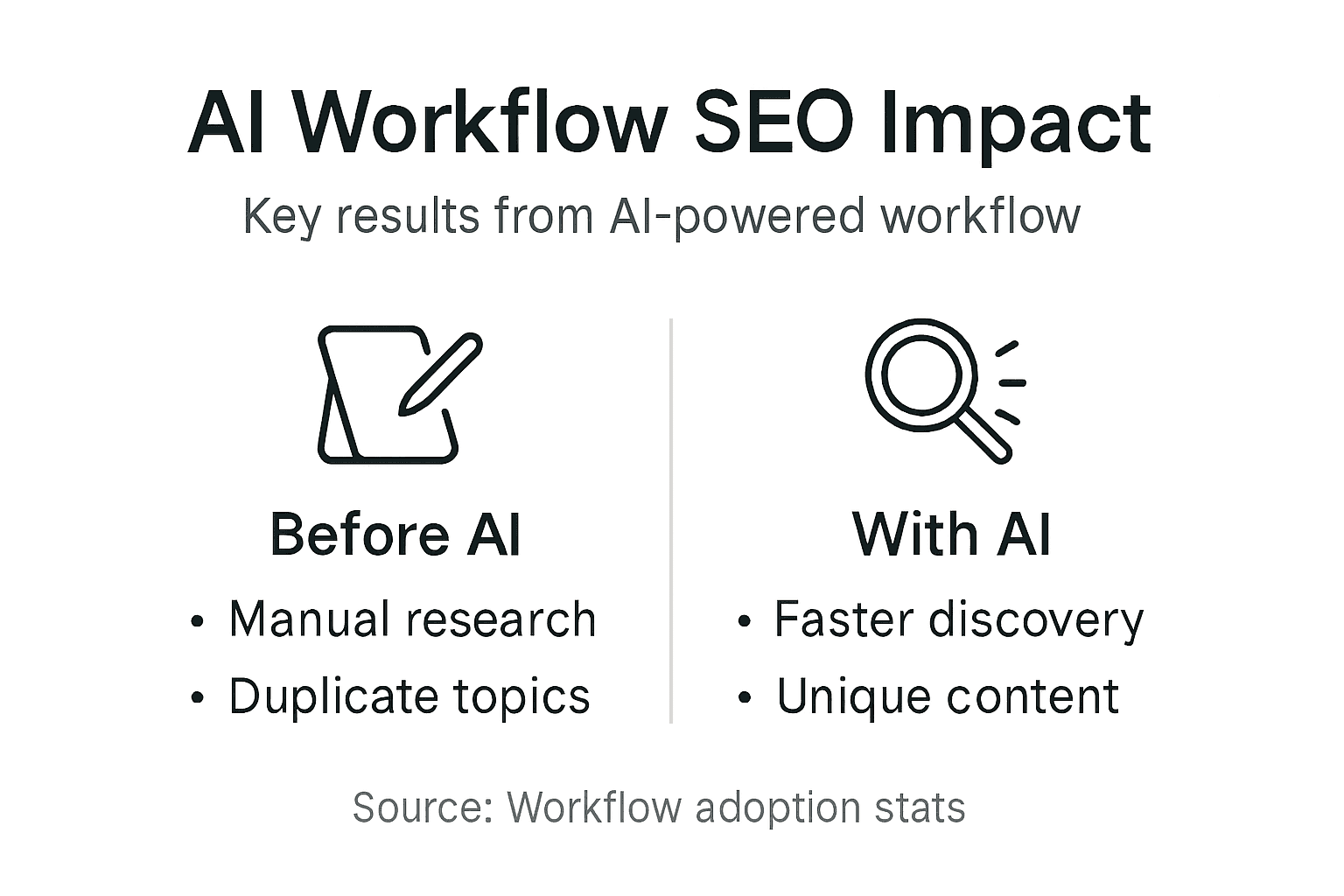
Regular audits and human review decrease SEO penalties by 40% compared to pure automation. Monthly quality checks catch issues before they trigger algorithmic actions, protecting your domain authority and traffic. This preventive approach costs less than recovering from penalties, which can take 6-12 months.
Human-reviewed AI content improves user engagement metrics by over 20%. Time on page, pages per session, and conversion rates all benefit from the authenticity and relevance that editorial oversight provides. These engagement signals reinforce search rankings, creating a positive feedback loop that accelerates organic growth.
Timeline expectations and milestones:
- Weeks 1-4: Setup, audits, and initial content production
- Weeks 5-8: First ranking improvements and indexing progress
- Months 3-4: Measurable traffic increases and engagement gains
- Months 5-6: 20-25% traffic growth if execution remains consistent
- Months 7-12: Compounding growth as content library expands
Success requires patience, consistent publishing, and continuous optimization. Teams that abandon AI workflows after 6-8 weeks miss the compounding benefits that emerge as content libraries grow and search engines recognize topical authority. Content workflow SEO success depends on treating AI integration as a long-term strategy rather than a quick traffic fix.
Pro Tip: Set up automated weekly reports tracking your core KPIs: organic sessions, keyword rankings, engagement metrics, and content production volume. Review these dashboards every Monday to spot trends early and adjust tactics before small issues become major problems.
Explore AI-powered tools to optimize your content workflow
Ready to implement these strategies? BabyLoveGrowth offers comprehensive AI-powered solutions designed specifically for mid-sized businesses seeking organic growth. Our platform combines AI-powered keyword discovery with automated content planning, helping you identify high-value opportunities in minutes rather than hours.
Explore our AI-driven content creation tools to accelerate production while maintaining quality standards. Our hybrid approach balances automation with editorial oversight, delivering the speed benefits of AI without the quality risks that come with pure automation.
Compare best AI SEO tools to find solutions that match your team size, budget, and growth objectives. Our detailed comparisons help you evaluate features, pricing, and integration capabilities so you can make informed decisions without wasting time on trial-and-error testing. Visit our blog for expert insights that guide your AI content strategy from planning through execution and measurement.
FAQ
What tools do mid-sized businesses need for an AI-powered content workflow?
Essential tools include AI-powered keyword research platforms, content planning software, SEO audit solutions, and content optimization tools tailored to your business scale. Human editorial tools for reviewing and enhancing AI-generated content are equally crucial for maintaining quality and preventing penalties.
How long until I see SEO improvements after implementing AI workflows?
Organic traffic and ranking improvements typically manifest within 3 to 6 months of consistent AI workflow application. Early indicators like keyword position improvements often appear within 4-8 weeks. Patience and regular publishing are key to realizing substantial benefits as search engines evaluate your content quality and topical authority.
Can AI-generated content replace human SEO editors entirely?
No, over-reliance on AI-generated content without human editing increases SEO penalty risk by 43% due to quality and originality issues. Human oversight ensures content remains unique, engaging, and aligned with your brand voice. Hybrid workflows that humanize AI content balance efficiency with quality for optimal results.
What are common pitfalls to avoid in AI content workflows?
Common mistakes include skipping SEO audits, ignoring editorial review requirements, and conducting inadequate quality audits. Over-automation without human oversight damages brand voice and content uniqueness. Regular monitoring, adjustment based on performance data, and maintaining editorial standards prevent SEO penalties and engagement drops that undermine your organic growth goals.